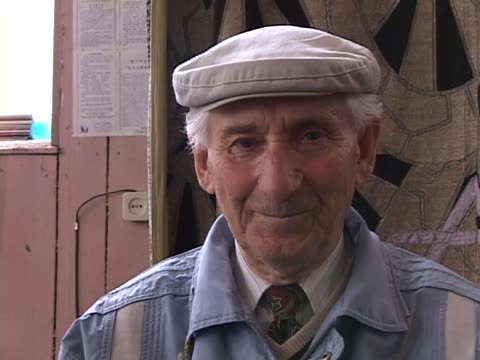
This tape consists of a formal interview with Semyon Semyonovich Krotsh (b. 1922 in Stefanesti). He speaks about his visit to Botoșani in Romania in the postwar period where his father lived after the war. Krotsh visited the town again most recently about five years ago, and reports that there are no Jews left there or in any other small towns. Krotsh also speaks in general about Romanian Jewry after the war and their mass emigration to Israel.
Krotsh recalls his father, a gabbai in Botoșani, and the father's friendships with rebbes and his hope of seeing his children again. He says no Jews are left in Botoșani or in the small towns of Romania, apart from perhaps a few in Iași and Bucharest. He describes how Jews left Ștefănești for Israel after the war, with the militia itself urging the last ones to go.
Also covers his father's rebbes and a Sabbath/holiday drink custom.
Krotsh details how he came to live in the Soviet Union beginning in 1940. Krotsh left Romania for the USSR in order to be with brother and other friends who were already in that country. He worked in a Moldovan village as a tailor for a year before the war broke out, and was then evacuated to the Caucasus region, working in several kolkhozes (collective farms). When the Germans took Rostov-na-Donu, he was evacuated further into Azerbaijan where he got sick with malaria while working on yet another kolkhoz.
Krotsh tells how in 1940 he left Romania, at seventeen, to join his brother in Soviet Bessarabia, and how he crossed the border at night with the parents' blessing. He describes the Soviet officers' order to leave the border zone and a year of work in Moldovan villages. After the war began he describes the flight eastward through kolkhozes to Azerbaijan, where he caught malaria and was hospitalised.
Gives the border crossing and the family farewell in detail.
Krotsh then discusses life on this latter kolkhoz in detail. He talks about his work in a dairy factory as well as the difficulties he and many other Jews faced in their agricultural labor.
Krotsh talks about kolkhoz life in the Krasnodar region. As a tailor with no Russian and no farm experience, he was sent to drive oxen. A Jewish brigadier and chairman from Bessarabia taught him the work, and he came to be shown off as a model kolkhoz worker. He then describes leaving the kolkhoz with his brother and working at an oil factory before being drafted.
Includes the language difficulty and the Jewish chairman who taught him.
Krotsh was drafted into the Red Army in 1942, at which time he left the kolkhoz for Baki Sähäri (Baku) where he was cured of his malaria. Krotsh talks about life and work in the city, telling stories about his initial assignment as a factory laborer and then as tailor under the direction of a Jewish couple.
Krotsh describes being drafted and sent to Baku, where he was cured of illness and worked hard on little bread. He tells of being registered as a tailor, an argument over the order to stop working, and meeting a Jewish couple, the Levitskys, who gave him work. He also recalls a Jewish woman's home with portraits of Lenin and Stalin and says he became a well-known tailor there.
Adds the Jewish couple and Russian-language dialogue he quotes.
Krotsh was demobilized in 1947, after which he worked two more years in Baku. After a brief stay in Chernivtsi, he was convinced to move to Kolomyya. He then shares other stories about work and life in Baku in the immediate postwar period.
Krotsh recalls being demobilised in 1947 and that he returned to work in Baku. He tells of a theft at his workshop and how he declined an offer from the owner. He speaks of making a coat for a woman whose husband turned out to be a Romanian-born acquaintance, who tried to persuade him to stay. He decided to travel to Chernivtsi rather than Odesa. Kerler comments on Chernivtsi as a Jewish centre; they close with his belief in fate.
Gives the reasons for his choice of Chernivtsi and some stories of work in Baku.
Krotsh shares his views on fate, G-d and religion. He discusses postwar Jewish religious life in Kolomyya, mentioning the clandestine prayer groups that would come together in private homes on holidays and important communal dates. He then speaks about the history of Kolomyya’s various synagogues.
Krotsh speaks about fate and about his standing in the community, and recalls secret prayer groups in private homes in Kolomyya for yortsayt and other occasions. He remembers a cantor named Pinsky and a Purim megillah reading. He then describes Kolomyya's former synagogues, the buildings that remain, and how to reach them by street, with Kerler asking about their location.
Adds a Purim megillah reading and directions to the surviving synagogue buildings.
Kerler asks how Yiddish speakers refer to Jesus. Krotsh says there was no such term for a son of God and gives a name (?) which he recalls from Pinsky, while the Romanian form is quite different. The talk turns back to what Pinsky said about the yeshiva.
Another AHEYM interviewee, David Abramovich Vider (b. 1922 in Sighetu Marmatiei), joins the conversation. Krotsh sings a fragment of the song "Ot Azoy” (Just Like That) and Vider sings a fragment of the song "Ikh ken a maysele” (I Know a Short Story).
Kerler asks Krotsh for a song and prompts him, but Krotsh says he does not remember the songs. A second interviewee then tells a story, of a poor tailor and his daughter attacked by a bandit, and Kerler asks questions about it. Other talk concerns signing a paper and a wedding saying. The transcript does not clearly show the songs named in the catalogue.
Adds a story told by Vider, in addition to the song request.