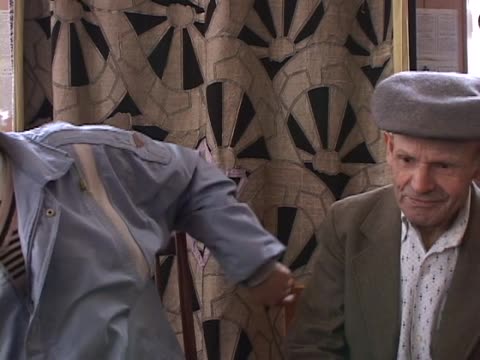
This tape is a continuation of a formal interview with Semyon Semyonovich Krotsh (b. 1922 in Stefanesti) and David Abramovich Vider (b. 1922 in Sighetu Marmatiei). The group talks about the researchers’ potential future visits and what gifts they should bring for the interviewees. Krotsh and Vider pose for photos.
Closing talk in the synagogue about a video of the singing and prayer, and the possibility of sending it to the participants, plus the cassettes of Jewish music that were promised and brought. Kerler says he hopes to come again, then photographs are taken of the two men together, who are addressed as fellow countrymen, and the group goes off for a meal.
Adds Kerler's talk of sending a video and cassettes of Jewish music, and his hope to return.
The group leaves the synagogue for lunch, while the camera follows Krotsh, Vider and the AHEYM team chatting and walking through the streets of Kolomyya.
The group walks through the streets of Kolomyya towards a restaurant. One of the men briefly recalls performing in a Purim play, and there is chat in Yiddish and Russian about directions and ordering pizza. Katz asks someone to repeat a question about how something was said.
Adds a mention of a Purim play and Kerler's invitation of the guests into a restaurant.
In the restaurant one man tells a story about a worker who drank in a factory office to get hired and found two drunk directors, and another tells about repairs of the city streets paid by money from Americans from Kolomyya. S3 then tells a story about a Christian woodcutter who is invited to a Jewish Sabbath-eve table, eats the fish and kugel and asks the Jew why he studies the prayer book so much. Kerler comments on the answer.
Adds the anecdote about the drunk job-seeker and the funded street repairs, and the Sabbath-table story.
Short, partly garbled stretch while the team drives to the next interviewee's home in Popel'nyky. Katz and others repeat a phrase about Beis-Yaakov, then Kerler introduces himself and his colleague to the new host.
Formal interview begins with Aron (Urn) Kalmanovich Biter (b. 1918 in Popel’niki). He discusses the prewar history of the village and its eighteen Jewish families. He also talks about his education in a "kheyder” (traditional Jewish religious boys’ school) and a Polish-language gymnasium. Biter shares his memories of prewar family life, noting that his father served in the Austro-Hungarian army during the First World War and how his family changed their surname from "Shafir” to the less Jewish-sounding "Biter”.
Biter says he was born in Popel'nyky, where there were eighteen Jewish families, in what was then Poland, and that he finished a Polish gymnasium after cheder. He explains the change of his name from Shafir to Biter, which was required by lawyers and the diploma, and mentions his father Kolmen, who served as a corporal in the Austro-Hungarian army in Italy. His grandfather was a tavern lessee and his maternal grandfather a lawyer in Snyatyn. Kerler also asks distances to Kolomyya, Zabolotiv and Snyatyn and the interview date.
Adds the distances to nearby towns, the date, and Kerler's talk about his own dress and background.
Biter speaks in greater detail about his family’s name change and the work his parents, Kolmen and Yeti had before the war. He then shares his wartime experiences, beginning with a pogrom in the village in 1941 led by local Ukrainian nationalists before the Germans invaded the town. When the town’s Jews were deported, Biter jumped from a train window and wandered from village to village, surviving with the help of non-Jewish friends. Biter was eventually able to arrange false papers that stated he was an ethnic Ukrainian and worked for the Germans in a village for the rest of the war.
Biter explains the reason for the name Biter, gives his birth year as 1918 and names his parents Kolmen and Yeti and his grandfathers; his father was a middle landowner. He describes the 1941 pogrom by Ukrainian nationalists, forced labor, deportation to Snyatyn and a train toward Ivano-Frankivs'k, from which he jumped through a window. He was helped by three student friends, got papers as a Ukrainian under a different name and worked for a German estate until the end of the war.
Adds the details of the parents' work, the three friends and the false papers.
When the town was liberated by the Soviets, Biter was accused of collaboration and exiled to Siberia where he labored in the city of Noril'sk from 1944 to 1952. When he returned to his native village, Biter learned that the other Jews of the town had all been killed. In the postwar period, Biter worked as an accountant on a kolkhoz (collective farm) in the surrounding five villages.
After the Soviets returned Biter was questioned about how he survived and was accused of working for the Germans. He was sent to Norilsk, where he says he was held from 1944 to 1952, first at hard labor and later as an accountant. On his return he found his family murdered and houses destroyed, and then worked as an economist on a collective farm covering five villages.
Adds the detail of the later work as accountant and economist on the collective farm.
Biter speaks in greater detail about prewar family life mentioning that his father immigrated to Canada, where he lived for three years and worked on the land. His grandfather held an arrenda (leasing right) and operated a tavern. Discussing prewar religious life in his village, Biter states that there were two "minyonim” (prayer groups of ten or more adult men) in his village; as such, communal functionaries, such as a shoykhet (kosher butcher) and kheyder teacher visited regularly from nearby villages. Biter briefly describes how he was given his "lapsterdekl” (lit. "small coat,” i.e. "talis kotn,” or Jewish male ritual garment) at the age of thirteen. Biter explains that his father wanted him to be a religious Jew, but his maternal grandfather, who was a Reformist and worked as a lawyer insisted he attend the nearest gymnasium in Snyatyn. Graduating in 1938, Biter then attended an agricultural lyceum.
Biter returns to his family: sisters Rachel and Siman, his mother as housewife, and his father's three years in Canada. His grandfather Abraham leased and ran a tavern in the village, there were two minyans, and the cheder teacher and a shoykhet came from nearby villages. He received the lapserdak at thirteen; his father wanted him religious but his maternal grandfather, a reform-minded lawyer, sent him to the Snyatyn gymnasium, 1934–38, and then he spent three years at an agricultural lyceum near L'viv.
Adds the lyceum, the shoykhet from a neighboring village and the grandfather's reformist views.