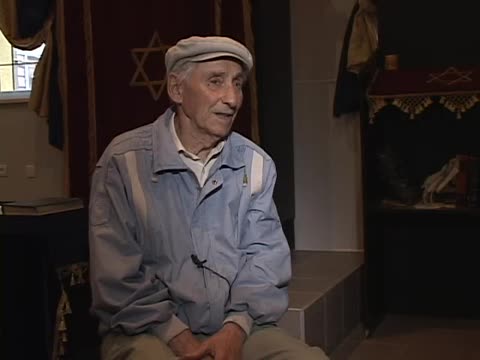
Krotsh sings a Yiddish song about drinking at an inn. He then sings a Zionist song longing for Eretz Israel in the Soviet Union.
From the machine transcript
Krotsh sings a Yiddish song about drinking in an inn and staggering home drunk. Lemster and Kerler ask where he heard it; he says he heard it as a child before the war. He then sings a Zionist song longing for the land of Israel and for an end to exile under Romanian rule. Kerler and Lemster ask him to repeat parts. Lemster asks about further songs about drinking. Krotsh begins another Zionist song at the end.
Includes the interviewers' questions about the songs' origin and a third song starting at the end.
Krotsh sings another Zionist song twice, which was sung shortly before World War II, he explains. He then recalls a song about poverty in the community.
From the machine transcript
Krotsh sings a Zionist marching song twice, saying it was sung shortly before the war, when Jews sensed a coming catastrophe. Lemster asks about songs mixing Yiddish with Romanian words. Krotsh recalls only a few words of a song about a tallis and tefillin bag, and of an orphan's lament at the cemetery. He points out that Romanian Jews said "land" differently from Jews in Ştefăneşti and Bessarabia.
Adds the Yiddish–Romanian mixed song, the orphan song, and a comparison of Romanian and local Yiddish usage.
Krotsh speaks about prewar Jewish life in Ştefăneşti, particularly about the Rabbi Avrohom Mattisyohu Friedman. He states that he remembers the time when the Ştefăneşti rebbe passed away in 1933.
From the machine transcript
Lemster asks about the history of the Ştefăneşti Jews. Krotsh says what he knows of them is from hearsay: the town's famous rebbe, whom people visited even from America, so that crowds filled the town. He was about seven or eight when the rebbe died, which Lemster places in the 1930s. The rebbe's name (Mattisyohu Friedman) is only partly legible.
Adds the visitors from America and the crowds in town.
Krotsh speaks about his apprenticeship at a tailor's shop. He then tells a story about the encounter of the Ştefăneşti rebbe and Krotsh's master craftsman. Another story involves a military tailor who encountered the rebbe (see also MDV 535).
From the machine transcript
Krotsh describes how he came as an apprentice to a tailor in Ştefăneşti. His master was a respected man who went to the rebbe's prayer house and spoke only Yiddish. He tells the master's story of a man who asked the rebbe not to be drafted in the war. He also tells of a military tailor who botched a general's coat and was saved by the rebbe's advice. Lemster asks about other rebbes and about people travelling there from Iaşi and Bălţi.
Gives two stories in full (the draftee and the military tailor), plus questions about other rebbes.
Krotsh mentions that he attended a yeshiva for two years. He then speaks about his father who consulted the rebbe about his trial concerning the imprisonment in a German prison during World War I.
From the machine transcript
Krotsh begins to say he attended a yeshiva. He tells how his father was captured by the Germans in the First World War and later faced a trial. The rebbe told the father not to be present when the trial was held. The trial was in Bucharest (?), and the account is cut off. Lemster and Kerler ask when the rebbe died and about the father's age.
Krotsh speaks about his family. He then talks about his life before the war, particularly education and work. Krotsh explains that he studied at a yeshiva in the mornings and worked as an apprentice in the afternoons.
From the machine transcript
Krotsh gives his father's death year as 1931 and approximate age. Lemster asks about the Jewish library in Ştefăneşti. Krotsh describes studying at the yeshiva in the mornings and working in the afternoons from the age of twelve or thirteen. He also studied Romanian and Hebrew and describes his Romanian teacher. Lemster asks what he sewed. He begins to mention his wartime experience.
Adds the father's death date, the library question, and Romanian schooling.
Krotsh speaks about his life during World War II. He was drafted into the Red Army and worked in military construction in Baku, Azerbaijan. Krotsh explains how he was called to work in his profession as tailor.
From the machine transcript
Krotsh recounts the war years, when he was taken into the army and sent with others to military construction work in Baku, Azerbaijan. The labour was hard and the bread ration small. A Jewish friend told him that he would be put to work as a tailor, and a brigade leader said it had been ordered. He met a Jewish woman who spoke Yiddish with him, and her husband promised him a sewing machine. He ends with a Yiddish saying that Kerler asks him to explain.
Adds the Jewish woman who helped him and the Yiddish saying.
Krotsh discusses his childhood memories and the difficulty to study at a yeshiva and work as apprentice at the same time. Hence, Krotsh continues, he dropped out of the yeshiva. During the war, Krotsh states, his profession helped him to survive.
From the machine transcript
Krotsh recalls how hard it was as a boy to attend yeshiva and work as an apprentice at the same time. He told his father, and the father agreed he should drop one of the two. He remembers an older tailor in the town, Chaim Leib (?). He says that his trade later helped him to survive the war. Lemster asks about songs about tailoring.
Adds the old tailor Chaim Leib and Lemster's question about tailor songs.
Krotsh sings snippets of a tailor song. He then sings a Yiddish song about growing up.
From the machine transcript
Asked about songs on tailoring, Krotsh remembers only snippets of a tailor's song. He then sings a Yiddish song about an orphan girl at the wedding canopy and the three occasions of weeping in a person's life. He repeats it at Kerler's request, and Kerler asks about unclear words. He says his mother loved songs and the theater.
Krotsh talks about prewar cultural life in Ştefăneşti, particularly theater performances. He recalls concerts by Sidi Tal.
From the machine transcript
Lemster asks about theater in Ştefăneşti. Krotsh says Yiddish theater troupes came regularly and staged plays, the Akeydes Yitskhok among them. Lemster asks about the director Yankl Sternberg from Bucharest, and Krotsh says he does not recall him. Krotsh describes the town's Jewish population and theatre posters, and Kerler asks whether such plays were done at Purim.
Adds the Sternberg question and a Purim-play question.
Krotsh speaks about his work before World War II. He then sings Purim songs, he remembers from his childhood. Krotsh recalls Purim celebrations, particularly he mentions that he dressed up as rich man.
From the machine transcript
Krotsh explains that he was too young for weddings, so did not hear a badkhn. Lemster asks about Purim. Krotsh recalls going door to door as a child singing Purim songs, and performs one about the Torah being offered to the nations. He describes dressing up in simple masks and as a rich man, and the traditional Purim plays. He also sings a short rhyme about a man who comes late from synagogue.
Adds the badkhn question and the work-before-the-war topic.
Krotsh recites three Purim shpiels.
From the machine transcript
At Kerler's request Krotsh repeats and sings Purim rhymes: first the verse about the forty days Moses spent in heaven and the Torah offered to the nations, then a second verse where the householder gives only a small coin. Kerler asks him to explain words and to sing the last verse. At the end Lemster asks whether he has heard of Itsik Manger.
Krotsh speaks about prewar religious life. He then speaks about his life and work after the war. He got married to a non-Jewish woman in 1949. Krotsh lists the places he lived after the war, including Kuban, Russia, 56:49. He moved to Kolomyya in 1949.
From the machine transcript
Krotsh says he does not know Itsik Manger. He mentions a Hasidic man in Ştefăneşti, Chaim (surname unclear), who was close to the rebbe and was sent to Transcarpathia after the war. He says he married in 1949 a woman from Russia and came to Kolomyya the same year. He lists the places he lived and worked as a tailor, among them Balta, Kuban and others; the transcript is unclear on several of them.
Adds the Hasidic man, the wife from Russia, and the lists of postwar places.
Krotsh speaks about Jewish life in the immediate postwar period in Kolomyya. He recalls secret services on holidays and importing matzos from Odesa and Chişinău. In Kolomyya, Krotsh worked for a military auction 59:00. He also mentions Romanian songs.
From the machine transcript
Asked by Lemster about Jewish life in postwar Kolomyya, Krotsh says Jews gathered cautiously, for example on Yom Kippur, and the authorities knew. He worked at a military auction. He says he was nearly the only one to eat matzo on Passover. Kerler asks whether Jews still spoke Yiddish, and Krotsh says that many did, in the street and when playing games. Lemster ends by asking about Romanian songs, and Krotsh names a few.
Adds the Yiddish-language question and Romanian songs.