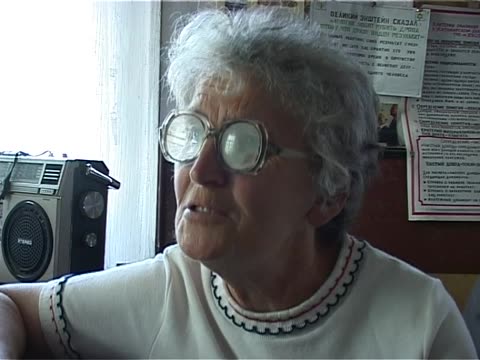
Futerman talks about her father's sister who lived in L'viv with a daughter, and about the death of that aunt and cousin. Kerler then asks about her grandparents and how they lived. She says her grandfather had a daughter who came back from evacuation, and mentions a seamstress who mended clothes in a hospital.
Includes a seamstress working in a hospital and a question about a song on this theme.
Futerman sings a Yiddish song about marrying off children and the klezmer who play. Kerler identifies it as a Warshavsky song. She also sings a lullaby and recalls her father as a furrier. Kerler then asks whether her grandmother sang or blessed the candles.
Kerler names the song's author and asks about the grandmother's candle blessing.
Futerman talks about her grandfather, who went to synagogue, and an aunt in Kyiv. She tells how her mother went to L'viv and married a drunkard, and how she herself came back from evacuation in 1946 and lived near her aunt. She recalls playing with a non-Jewish neighbour's child and a wartime incident with a grenade. Kerler asks whether folk healers existed; she says people went to non-Jews.
Covers the return from evacuation, relations with non-Jewish neighbours and healers.
Kerler asks Futerman for another song; others in the room discuss a young musician and his father, who is in Israel. She then begins to tell about a cousin of her father, a furrier, and his daughter's wedding.
Adds the talk about musicians and the cousin's wedding.
Futerman describes a Jewish wedding with a chuppah and klezmer, and a man who was a synagogue warden. Kerler asks about the name Kipnis and whether Jewish weddings continued after the war. She says weddings were held, and talk of singing at them follows.
Adds the question about weddings in the 1950s and later.
The team enters the Katsman apartment. Kerler greets the family, explains that they are making an interview about Yiddish and memories, and Katz explains it is a video recording.
Katsman continues about his military medical service, which lasted through the war until 1950, with the rank of a medical colonel's officer, and asks Kerler to write it down.
Katsman names his parents, his father a worker, his mother a pious housewife, and his two brothers Dovid and Leybl. Leybl was a pilot killed in the war; Dovid died after it. Kerler and Katz ask what the town was called in Yiddish. He then describes his grandfather, a melamed who taught four future rabbis, and his grandfather Elye in Chopovychi, who died over a Sabbath reading, aged about eighty.
Adds the brothers' fates, the town's old name, and Elye's death.
Kerler asks about Katsman's earliest memories. He tells how his grandfather took him to synagogue in a tallis at thirteen, put on tefillin and taught him Hebrew. Asked to recite his bar mitzvah portion and prayers, he says a little, mentions Kaddish, and that he prays daily with tallis and tefillin.
Katsman recalls that Korosten' had five synagogues, and a great cantor Glazman with a choir who came for holidays from Kyiv. Katz tells where his own family comes from. Katsman also mentions a clois, women's sections, and Rabbi Matisov (?).
Kerler asks whether Katsman went to cheder. He says he attended a Russian school, and his grandfather taught him in Yiddish, including two tractates of Gemara, not cheder or yeshiva.
Katsman says he does not remember his grandmothers. He describes his mother as a pious woman who baked matzo for the town, came from Chopovychi, and prepared for Sabbath with baked challah and candles. Kerler and Katz ask about Sabbath songs and tefillin, and he describes his grandfather's and father's habits of prayer and study.
Adds the Sabbath songs, tefillin habits and the mother's matzo baking.
Kerler asks about the Voledniker rebbe. Katsman says the family went to his grave every year, his father and mother, and he himself in the last ten years after the war, and discusses the difference between the Soviet period and later.
Katsman recalls Friday and Sabbath at the synagogue with his grandfather and says he knows little about the Baal Shem Tov. He mentions the Narolitcher (Narodichi) rebbe. Asked about prewar Passover, he first speaks of the army, where he did not know of Passover or Yom Kippur, and then of keeping a kosher home before it.
Covers army service and the lack of observance there.
Katsman says his parents in evacuation in the Stalingrad region kept Passover without chametz in hunger. Kerler asks about the seder in the 1920s, with the four questions and afikoman. Katsman describes the Passover foods his mother prepared: noodle kugel, fish, and others.