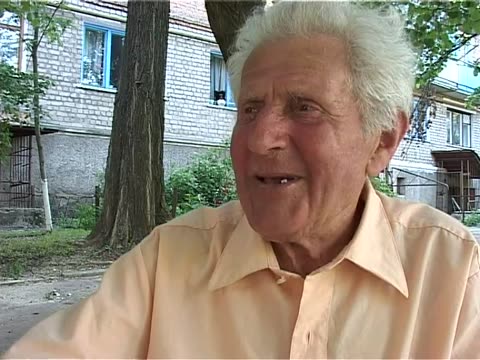
Skop says that until 1937 everything was as before, then schools were closed and synagogues turned into warehouses. Katz asks about childhood prayer, and Skop recalls Hanukkah money and the dreydl, Purim noisemakers, asking the Four Questions at his father's seder, and the labor of baking matzo. He then speaks of Lubavitch Hasidim, who were beloved in Korosten', and of a well-known rebbe whom people from far away, Jews and non-Jews, visited, with trips to a tsadik's grave and how it was spoken of. Katz asks about the Litvaks, and Skop describes the Yiddish of Vilna and Belarusian Jews as hard to understand and tells of his parents speaking Yiddish with Germans. The passage ends with healing practices and a story of a blind child brought to a rebbe.
Covers Litvak speech, the Germans and healers, and visits to the Lubavitch tsadik's grave, which the catalogue label does not mention.
Skop tells a story of a child who could not speak and was healed through a healer's help; the mother and an older sister are involved and the child finally begins to speak. It is a narrated tale, not about life today.
Katz asks about clever men of the town of Chavne (Polesskoye), and Skop speaks of a respected wise man there and of another man with a nickname. The transcript is garbled, so the names are not reliable.
Katz asks about prewar songs and weddings. Skop remembers weddings and the wedding canopy, and answers questions about the wedding jester (badkhn) and matchmaker (shadkhn), then a question about the dybbuk.
A single song is attempted and the passage moves on to wedding roles and the word dybbuk.
Dialectological questionnaire with Katz and Kerler. Skop explains words such as dybbuk and golem, then gives Yiddish equivalents for vodka, blood, house, skin, cat and mouse, dove, window pane, blue, building, ear, hair colour and illness, along with the cross, ladder and forms of address. Skop notes that Yiddish in Korosten' was like Belarusian Yiddish, and says the Litvak speakers talk differently.
Skop gives the prewar population of Korosten' and says where its Jews came from (figures partly garbled). The questionnaire continues with words for floor/ceiling, fence, face, back, wealthy man, 'another story', one and a half, attic and shopkeeper. Katz then asks him to recall stories of prewar Korosten'.
Gives the prewar population of Korosten' and its Jewish share.
Skop speaks about Nune, the madman of Korosten', killed when the Germans entered the town, and about Meir the blind man, a beggar who recognised people by voice. He then mentions Meyshe the gravedigger at the cemetery, and a search for a grave by visitors from abroad. The talk of the cemetery is partly garbled.