0:00
The first part of the tape is a tour through the former Jewish town of Bila Tserkva with Khariton Berman’s son.
The division was proposed from the catalogue's descriptions and the machine transcript, not stated by the catalogue (how).
The first part of the tape is a tour through the former Jewish town of Bila Tserkva with Khariton Berman’s son.
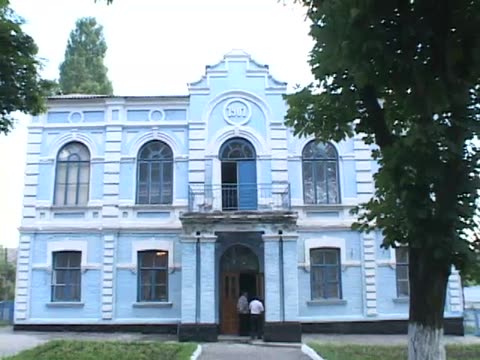
The first stop is at a building, which was used as a Talmud Torah school before the war and as a synagogue during the war.
At a building on the tour, a remark that there is nothing of interest inside: it now houses an arts center with clubs. Attention then turns to a nearby large synagogue, called the great synagogue.
The transcript shows the building is now an arts center with clubs and that talk moves on to the great synagogue; it does not mention a Talmud Torah.
The camera collects town footage of Bila Tserkva on the way to the next stop, the Great Synagogue.
They stop at the former Great Synagogue and the camera collects outside footage.
Outside the former great synagogue the group discusses which synagogue is which, including a second one called the merchants' synagogue (?). They remark that there is little to see inside and that the old buildings have been rebuilt. Kerler says old houses are also being recorded, and there is brief chat about the filming.
The team is back in the van and the camera collects footage on the way to a former home of Sholem Aleichem.
Short fragmentary exchange in the van, with a few words about a name and about cassettes.
They arrive at the former home of Sholem Aleichem, which has a plaque identifying the house. Berman’s son talks about how one wooden white prayer house survived the fire.
At the stop the speakers say that a classic writer, whose name the transcript does not give, once lived on this spot. They discuss a former Jewish center and market area and the Polish and Yiddish names for a gate or town (brama; Yiddish 'bromk'(?)). They also discuss a town of wooden houses and an old white monastery or church that burned down, which explains the name of Bila Tserkva ('white church').
The transcript does not name Sholem Aleichem or a plaque. It shows a discussion of the Jewish center, a place name and the burned white monastery or church, which is not the prayer house in the catalogue entry.
The team returns to the van and the collects footage on the way to the next stop.
They arrive at the grave of the Chernobyl rebbe.
The group arrives at a burial site and discusses where to film. The transcript is very garbled, with Russian remarks about a place where someone is buried and a military unit. Nothing in it identifies the Chernobyl rebbe.
The team travels in the van, leaving Bila Tserkva on the way to Korsun.
Travel in the van, apparently out of Bila Tserkva, with scattered fragments of conversation. Some English lines sound like texting, and there are brief remarks about a New Year and about the names of towns. The content is largely unclear.
The team gets out of the van in order to meet community members in front of the community center. Petr Rashkovsky talks about the Jewish population of Korsun before the war. Five thousand Jews lived prewar Korsun and today only 130 remained.
The group meets community members at Korsun'. They describe it as a large, beautiful Jewish town where about five thousand Jews lived before the war. Today about 130 remain, and many left for Israel, America and Germany.
The transcript gives the prewar and present figures but does not name Rashkovsky as the speaker.
They go inside the community center and join the members for Shabbat celebration. Rashkovsky introduces the team to several community members. The team informally chats with one member about his family in Hebrew.
Inside the community center the group is greeted ahead of the Shabbat gathering, with much garbled talk. A gift from Mark/Martin Horowitz (?) is mentioned, and community members say how much they have heard about the visitors and discuss whom to interview, with a wish to hear singing. One member says he does not understand Yiddish. Another asks about family in Israel and America.
The transcript shows a gift from Horowitz (?) and talk of whom to interview; it does not clearly show a conversation in Hebrew.
The team meets Tsadik Naumovich Groysman, born in Tarashcha. He moved to Korsun in 1952. They continue chatting at the community center and are given a tour of the Korsun Museum of Regional Association of Jewish Shtetls in Ukraine. The museum includes material from Korsun, as well surrounding towns.
A man named Groysman, from Tarashcha, is introduced and speaks some Yiddish about his move to Korsun' in the 1950s (?) and later departure. The rest is a tour of the museum of the association of Jewish shtetls. A Russian-speaking guide explains exhibits: old family photographs, famous natives such as the Tverskys of the Chernobyl dynasty, writers including Ivan Kulyk, Shimen Dobin and Itsik Fefer, descendants of Mendel Beilis, and the 1919 Jewish self-defense unit of Korsun' with a saber from Kotovsky's cavalry. Other exhibits are pogrom committee papers, a 1926 Berdychiv prayer book, Yiddish-Russian documents from Jewish village soviets, a Jewish school open from 1924 to 1938, family silver, a gefilte fish mold, a clockmaker's tools, a mezuzah and handwritten calendars. The guide also describes how the museum was assembled with American help after the association was founded in 1993. Kerler asks about scanning and clock terminology, and at the end the guide shows books by Poroshenko and Malka Pen.
Beyond Groysman and the museum, the transcript shows the guide's detailed account of named exhibits (writers, Beilis, self-defense, documents, ritual objects), the 1993 founding of the association, and Kerler's questions on scanning and clock terminology.