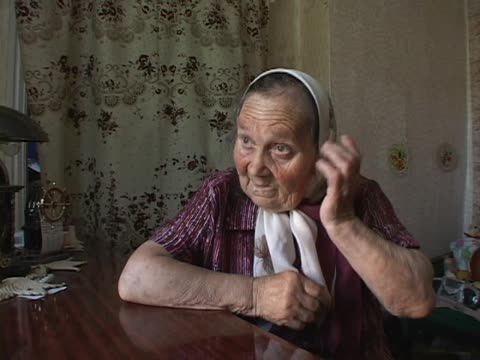
Kislinskaia addresses the relationship between Jews and non-Jews, as well as recalls non-Jews who spoke Yiddish. She then briefly discusses her education at a Yiddish school, before talking about life today.
Kislinskaia says that before the war Jews and non-Jews lived together without trouble, and she mentions her daughter's reception in the village market. She recalls non-Jews who spoke Yiddish, among them a man named Ivan and a master craftsman from Zaporizhia (?) who spoke Yiddish with her at work so others would not understand. Kerler asks whether there were converts to or from Judaism (there were none), and she says she read Yiddish books at school. She then talks about her goat and the work of keeping it.
Adds the Yiddish-speaking non-Jews by name, the question about conversion, her reading in Yiddish and her goat today.
At Kerler's request Kislinskaia gives the recipe for gefilte fish, which her granddaughter now makes, comparing her own use of sugar with her granddaughter's. She mentions an injury to her hand and that she keeps no pork in the house. Kerler then asks about her father's and grandfather's prayer; she calls them devout Jews. He begins to ask whether she remembers any Yiddish songs.
Adds her father's and grandfather's piety and the start of the question about songs.
Kislinskaia says her mother used to sing Yiddish songs at home, but she herself did not sing, and she cannot recall a song when Kerler asks. She says there were observant Jews in town before the war, who attended services on holidays, and that her mother always went. Kerler asks about customs for Tisha b'Av, and they discuss a name for the burrs that stick to the beard.
Adds Tisha b'Av custom and the burr terminology; the postwar setting in the catalogue is not clear in the transcript.
Kerler asks about a typical day at the Yiddish school. Kislinskaia says the Yiddish school building is now a Russian school, and that the youngest pupils received a warm meal. They discuss the word for synagogue, and she speaks of an observant postwar man and his family who kept the Sabbath. Kerler asks about the word for cemetery (the Jewish one) and the building by it where her grandfather washed the dead, and then asks about dybbuk and golem, which she did not know.
Adds the cemetery vocabulary, her grandfather's work with the dead, and the dybbuk and golem questions.
Kislinskaia answers the AHEYM dialectological questionnaire, with Kerler prompting in Russian and often explaining or correcting. The items include greetings, everyday words such as mouse, window pane, bird, house, skin, bed, bread, tree and potato, and sentences with pronouns and prepositions. Later ones cover words for faithful or honest, convert, peasant, midwife, cemetery chapel, ceiling beams, rich man, the dreidel, an expression for the dead, and 'earlier' and 'once'. In between they discuss Jewish life, such as drinking spirits, her grandfather's work at the cemetery building, and a cantor at the prayer stand.