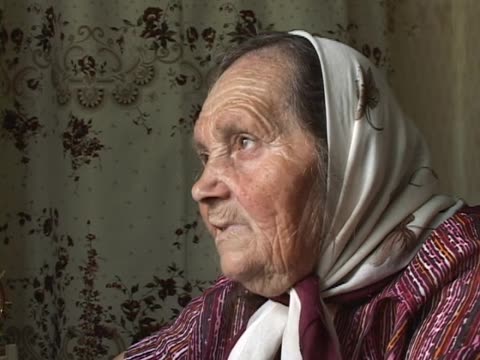
The first part of the tape is a continuation of a formal interview with Tsili Davidovna Kislinskaia. Kislinskaia answers a series of dialectological questions from the AHEYM Yiddish linguistic questionnaire.
From the machine transcript
Kislinskaia answers dialectological questions from Kerler (Katz also intervenes). The items are Yiddish equivalents for sentences and words given in Russian: the sun sitting down, a cart, a favour, man and machine, probably and back, suddenly, cases and plurals such as one enemy and two enemies. Kerler also asks how she says certain phrases. At the end he asks her to recall a song or story from earlier times.
Katz also puts questions; the items include sentence translation and grammatical forms, not only single words.
Kislinskaia compares her life before and after the war. She specifically addresses her return to Korsun. The team then concludes the interview with Kislinskaia.
From the machine transcript
Kislinskaia compares life before and after the war. She says things were better before the war. After the war she and her family returned to a house with no windows or beds and no work. Today she is content only because of her children and grandchildren. At 81 she prays to be able to help them and complains of poor health, hearing and sight. Kerler thanks her and asks for her initials.
She also speaks about her health and age today, and the closing exchange about her initials.
The second part of the tape includes town footage of Korsun. An unnamed woman gives a tour of the former Jewish neighborhood.
From the machine transcript
Town footage of Korsun. A woman (S3) speaks with Kerler about the Jewish cemetery. Two large gravestones were to be taken back there, with money from a man now living in America. In the end Kerler states the date and introduces the interview with Groysman.
The third part of the tape includes a formal interview with Tsadik (Tsolik) Naumovich Groysman, born 1923 in Tarashcha. Groysman provides personal information and talks about prewar Jewish life in his hometown. In particular, he recalls how he attended synagogue with his father. Groysman then talks about his family. His parents were born in Tarashcha. His father, a watchmaker, descends from a family dynasty of watchmakers. Groysman’s father had four brothers, who were also watchmakers. His sister married a watchmaker. He grew up with two sisters. He also addresses his mother’s cooking. Groysman’s wife was also born in Tarashcha and he met her there before the war.
From the machine transcript
Groysman gives personal information: he was born in the small, mostly Jewish town of Tarashcha, with three synagogues. He recalls going to synagogue with his father, carrying his tallit and tefillin. His parents, both from Tarashcha, are named, his father born in the 1880s (?). His father and his four brothers were watchmakers, and his sister married a watchmaker. He grew up with two sisters, one of whom lost her husband in the war. He mentions his mother's cooking and baking and his wife's kugel, and that he met his wife, also from Tarashcha, before the war.
Groysman talks about his life during the war. He was drafted into the Red Army in 1941. He was injured twice: in the Rostov and Stalingrad region. He describes how he survived the war: I was 18 years old when the war broke out. When the war was going on for a month they already drafted me into the army. I was injured twice: once in the Rostov region and then in the Stalingrad region. I was injured and of course I had to stay with the Germans. I was crawling for twelve or more kilometers until I reached our territory. [...] Of course, when I looked at the injury (?)... my parents believed in God, but we, the youngest, we didn't care (?). We were pioneers and komsomols. But during the war, when I was injured I started to believe in God. I will tell you why. People were in a tank. When they moved onward, fifty or sixty meters toward the village, we all had to lie down. They started to shoot so heavily, we couldn't even lift our heads. They started to scream: “ “ ?. During that moment the tanks came toward us. The tanks were approaching with one next to other within five meters. [...] They started to scream that everybody should save themselves however they can. We simply ran and the tanks followed us.
From the machine transcript
Groysman talks about his war service. He was drafted into the army about a month after the war began and was twice wounded, near Rostov and elsewhere. After being wounded he crawled many kilometers back to the Soviet side. He says that as a pioneer and Komsomol member he did not believe in God, but began to believe after the injury and a tank attack. He then comments on his Yiddish and his Russian, and says he spent over a year in hospital.
He also speaks about his Yiddish and Russian and his time in hospital.
Groysman talks about his life after the war during the Soviet period. Although Groysman began to study at a medical institute before the war, studying ENT, he joined his father’s work due to his injuries. Groysman was promoted to foreman and does not recall antisemitism. Groysman moved to Korsun in 1952. Immediately after the war, Groysman took courses for massage therapy and worked in the same hospital, he recovered in from his war injuries. Groysman then moved to Alma Ata, where he joined his uncle working as a watchmaker. Groysman’s father joined the family in Alma Ata, but worked in a different shop. Groysman continues that after his father passed away, he joined the business his father used to work at. He then returned to Tarashcha to meet his former girlfriend, whom he married in 1944.
From the machine transcript
Groysman talks about his work after the war. He worked as a watchmaker like his father, later became a foreman, and says he never met antisemitism. He moved to Korsun in the early 1950s. After the war he took a course in massage and worked in a hospital, and he worked in his father's workshop after his father's death. He went to Tarashcha, met the girl he had known before the war, and married her.
Groysman addresses life before the war and postwar Jewish life and charity. He states: “After the war, when we, the injured, came back we would help (osobelne). Widows would come, [...] older children whose parents were killed would come. We would collect money. We would collect the money in a way nobody would know whose money it is. They would give and we wouldn't say who did. Not everybody was in the same situation. There were people in our midst that died of hunger. They wouldn't want anyone to tell someone that they need money. The following episode took place in our community: A Jew came, just like you, with glasses and a beard. They came to our house and I sat and worked. My mother was standing next to me. [...] He asked about Groysman the watchmaker. I was 22, 23 years old. He said that he wanted to speak to the old man. [...] So, he said: 'How can it possibly be that they would send someone like me, a Jew with beard, to such a young man. [...] He was a cantor. I offered him charity, but he didn't want it. He wanted to earn money with his profession. His specialization was a cantor. So, let's gather the Jews and he would earn his kopeks because he could sing the songs. [...] This is what he told me. And I said: Fine, I will talk to some people. [...] We would agree to meet up. There was no synagogue. People had apartments, where we would meet. [...] He said: I thank you. I cannot give you any gifts, but what I can do is a sing a good song for you. [...] In those times we were afraid, but we could not call it off. We would cover the windows. And he sang a song about the war. [...] He sang so amazingly that we all cried.
From the machine transcript
Groysman speaks about postwar Jewish charity in Tarashcha. Wounded veterans collected money so that nobody knew the donors, and helped widows and orphans. He tells of a bearded man, a cantor, who came to the watchmaker's house, and the meeting was arranged in a private apartment. The windows were covered, and his singing about the war moved everyone to tears.
Groysman talks about his son’s circumcision in Kyiv after the war. His son was born in 1945. He then returns to his life during the war. In particular, he addresses how he started to believe in God during battle.
From the machine transcript
Groysman begins by mentioning his son's circumcision after the war, then returns to the war. He describes a tank chasing him in battle, and says he survived and began to believe in God. Kerler then asks where he studied.
The passage contains a long recogniser loop.
Groysman talks about his school education before the war. He attended a Yiddish school for seven years and finished his school education at a Ukrainian school. Groysman then recalls the farewell from his parents when he was drafted for his military service, as well as when he first met his parents after the war in Alma Ata.
From the machine transcript
Groysman talks about school: seven classes at a Yiddish school, then a Ukrainian school. He describes teachers of mathematics and literature (Babych (?)). He recalls the night his parents left in the evacuation while he stayed, the farewell on being drafted, and the later reunion with his parents in Alma-Ata, where he arrived on crutches. He ends by thanking God for his health.
It also covers the departure of his parents in 1941 and the reunion in Alma-Ata.
Groysman talks about his education at a Yiddish school in Tarashcha. He then describes his family’s observance.
From the machine transcript
Groysman answers Kerler's questions about the Yiddish school in Tarashcha: teachers, subjects taught, and writers read, such as Sholem Aleichem and Peretz, and Yiddish poets. He talks about his parents' religious practice: his father prayed, his mother read a lot, and as a pioneer he stopped going to synagogue. He tells a story about a man and dogs. Kerler asks whether he remembers songs.
He also names Yiddish writers read at school and tells a short story.
Groysman talks about his family today and then describes a regular day at a Yiddish school. He then shows a photograph of veterans.
From the machine transcript
Groysman talks about his family today, with grandchildren in Kyiv who sing Yiddish songs, and shows photographs of them. Asked about a school day in Tarashcha, he describes the school and his schoolmates. He talks about young people leaving the town and about dances and social life. He then shows a photograph of Stalingrad veterans with himself in it.
Groysman talks about prewar Jewish life and holiday celebrations, as well as food customs at home. He also addresses prewar Yiddish culture and cinema. He then recalls non-Jews speaking Yiddish.
From the machine transcript
Groysman speaks about prewar Jewish holidays and food. He covers Passover (baking matzo at home, what was not eaten), baked goods and dishes such as kugel and sour meat, Shavuot dishes, Purim, Hanukkah and the dreidel. He answers questions on Yiddish theater and films, and recalls non-Jews who spoke Yiddish, including a drunk and a Ukrainian woman at the market.