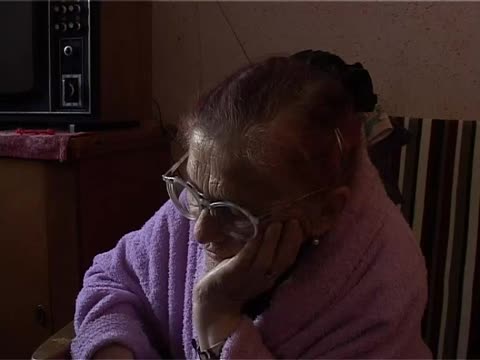
Dialectological questionnaire in Yiddish with the informant, who answers Kerler's questions. Items include words for walking with difficulty, running and fleeing, pious or believing person, baptized convert, cross, headache, 'where from', bed, flowers, oil, small tree, numbers (ten, thousand), 'you are right', and sentences to translate. Further items cover pronouns ('I don't hear him'), mourning formula ('may he have a bright son-in-law'), plural forms, words such as 'error', 'face', 'rich man', and the village/town terms ('attic', 'well', 'potatoes'). Some Russian chat about a magnifying glass and the Hesed doctor.
Includes talk in Russian about a magnifying glass, vitamins and Hesed visits.
The team and local guides drive through Zhovkva; the informant and a companion point out the town centre, the school and hospital, and former Jewish shops and houses. The informant says Jews lived here, some raised geese, and sold meat; the synagogue is pointed out. Part of the talk is in Russian and the audio is poor.
Names the Jewish shops and houses and the synagogue seen from the car.
The group visits the Hasidic cemetery in Zhovkva. They discuss who built it and when, how Belz Hasidim stop there on the way to Belz, and the tombstones reused under the Communists in a wall. Kerler also asks about a Yiddish word for a Shavuot item and the terms for cemetery (beys-oylem, beys-khayim), and explains the title of a book written by the tsadik buried there.
Adds the reused tombstones and the Belz Hasidic pilgrimage.
At the grave of the tsadik Efraim Zalman Shor, Kerler and a companion read and explain the inscriptions and the titles of his book. The informant adds that even among the wealthy there was no separate synagogue, only a study group. Russian comments about the concrete structure date it to the 1920s.
Adds the explanation of the inscription and the book title, and the concrete structure dating.
The team continues to drive and walk through Zhovkva as the informant and the companion explain the former Jewish neighbourhood. They point out where houses stood, mention Bohdan Khmelnytsky and Ivano-Frankivsk (?), and the informant recalls arriving after the war (the year is unclear in the transcript). A Polish gymnasium and a former town hall are also mentioned.
In the town centre, Lebvol describes the former Polish magistrate building used as a prison, where nationalists were shot at the start of the war, and the former homes of Poles. She and her companion recall that King Jan Sobieski lived in Zhovkva and that a synagogue is named after him. The team says farewell and the visit ends; Lebvol gives her name, Pepe (Pesye) Shulmanovna Lebvol, and that Pesye was her sister's name.
Adds the prison/magistrate, Sobieski, and her name and farewell.
Nisman's interview begins. She talks about her weak Yiddish at home, says Dorfman asks her to check his articles about people she knows, and Kerler explains the AHEYM project and asks about her childhood. They chat about the age of a young man who speaks Yiddish and about Kerler's beard, and she mentions a Lubavitcher rebbe's stories.
Includes an explanation of the project and a chat about ages.
Nisman talks about the Yiddish magazine Lekhayim, published in Kyiv. She says it is a good journal, half on religion and half on literature; she mentions a story by Jud Süss Oppenheimer (?) and an article about Freud, and she gets copies late.
Nisman says she was born in Moldova and, asked where, names Rezina; she gives its Romanian name as well. She says she never studied Russian but learned from newspapers and reads German; she recites a line about girls and love, and reads about Chernivtsi writers and Eliezer Steinberg's book.
Adds her birthplace Rezina, languages and Steinberg.
Nisman shows family photographs, particularly her husbands'. Nisman's first husband was shot. She then speaks about her cultural activities today and also describes how she became aquainted with Dorfman. Nisman also shows a copy of Eliezer Steinberg's collection of poems. She states that she bought the book from his widow.
Nisman reads the names of her two husbands: her first husband, Israel Nisman, was shot on 8 July 1941, and her second husband died seven years ago at 86. She mentions a daughter in Kyiv and one in Israel, and shows a photograph and a photocopy sent from Kyiv. She tells how she met Dorfman after singing a Yiddish song at a Hesed event, and shows Eliezer Steinberg's book, bought from his widow. They also talk about Chernivtsi writers and the artist Arthur Kolnik.
Adds the husbands' fates, the daughters, how she met Dorfman and Steinberg's book.
Nisman reads a humorous poem from Eliezer Steinberg's book about a ritual slaughterer's knife and the rabbi who blesses it. She explains terms used in it and mentions that she keeps a magnifying glass for reading; Kerler praises the writer.