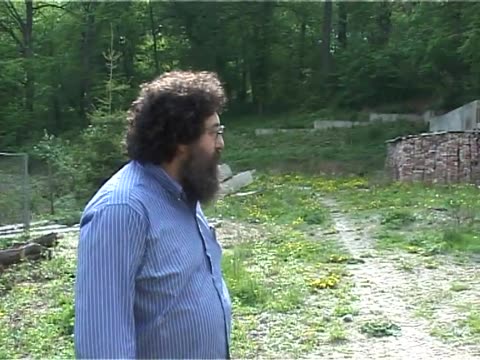
The tape begins with the AHEYM team driving around L’viv with Boris Mikhailovich Dorfman (b. 1923 in Cahul). They stop at an abandoned lot where a prewar building once stood and that Professor Kerler remembers from his childhood. The team then continues driving through L’viv.
From the machine transcript
The drive through L'viv with Dorfman, mostly in Russian with some Yiddish, consists of looking for street numbers, stopping at a lot where an old building stood and recalling its former residents. The speakers comment on the old Yiddish speech of the city and on a Polish-speaking Jewish man in his eighties who might be visited. The Russian parts also touch on what is built there and on the place of childhood games.
Adds a Polish-speaking Jewish man in his eighties whom they discuss visiting.
The camera cuts to the square in front of the L’viv Opera House. The team continues their drive, while Dorfman indicates various points of interest, including the site of the former wartime ghetto and Jewish historical sites.
From the machine transcript
Dorfman points out the monument and the site of the L'viv Jewish ghetto, and says a memorial was put up in 1992 (?). He describes the crowded housing, the twenty months of the ghetto and the number of Jews who died. He also recalls a London filmmaker and a family that survived in the sewers, the Margolis (?) family. Kerler asks him to tell it in Yiddish for the others.
Adds the survivors of the sewers and the London film.
The team continues driving into the countryside outside L’viv, while Dorfman relates further stories about the sites they pass, about the region’s history and contemporary visits by foreign tourists. Upon entering Zhovkva, Dorfman relates the Jewish history of the town.
From the machine transcript
The drive leaves L'viv for Zhovkva. Dorfman tells how the Russian printer Ivan Fedorov took his press from the Jews of Zhovkva, and mentions the Jewish cemeteries and the visits of tourists. He also talks about the nearby border at Rava-Ruska, the rebbe of Zhidachov, the old monastery and the Jewish houses of the town. They arrive at the house of the interviewee.
Adds the printer Fedorov, Rava-Ruska and the rebbe of Zhidachov, plus the cemeteries and tourists.
The team arrives at the home of Polina (Pepe) Shulimovna Lebvol (b. 1920 in Zhovkva). She speaks of her recent visit to her daughter in the United States and her family life before and after the war. Her parents, Shulim and Rekhele, had eight children: Sima, Sure, Ksil, Khayim-Volf, Ester-Libe, Rivkele, Zishe and the interviewee herself. Her father worked as a butcher and a glass-blower. Lebvol also speaks about the region's contemporary Jewish community and the recent visit of her relatives from abroad.
From the machine transcript
Lebvol, b. 1920 in Zhovkva, talks about her daughter in the USA, whom she visited about ten years earlier, and gives her name, patronymic and address. She names her parents Shulim and Rekhele and her eight siblings, and says only she and one brother survived. Her father was a butcher and then a glazier. She also mentions a local woman who researches the history of the Zhovkva Jews, her mezuzah, and the visit of her relatives who need a US visa.
Adds her address, her Yiddish name and her grandparents, and the Joint-type aid and visa talk.
Lebvol speaks about prewar Zhovkva and the history of the Jewish house in which she lives. She describes the town’s synagogues and Jewish religious life, detailing various holiday observances, and explaining the differences between prewar and contemporary Passover–related practices.
From the machine transcript
Lebvol talks about the Jewish house in which she lives, which belonged to a single wealthy owner, and the wooden house her own family had before the war. She recalls returning from Stalingrad to find nothing left, the Jews who stayed with her in transit to Poland, and the synagogues of Zhovkva. She also describes Passover customs, the seder, the afikoman, matzo from Zhytomyr and a seder in Rava-Ruska.
Adds the return after the war and her use of the Haggadah.
Lebvol provides a long description of the “Yoysef-shpil” (The Story of Joseph), in which she performed during Passover in her youth. She recites the lyrics to several songs, describes the plot, and then sings the opening song (00:46:16).
From the machine transcript
Lebvol describes the Joseph play (Yoysef-shpil), which she remembers from Zhovkva in the 1930s and in which she took part. She tells its plot from Joseph's sale by his brothers to the reunion with Jacob, and recites several of its songs and rhymes. She then sings the opening verses beginning with Abraham and Isaac.
Adds the plot retold, the timing in the mid-1930s (?), and the question whether it was a Purim play.
Lebvol recalls observances and customs connected with Purim and Chanukah and sings fragments from the songs “Oy khanike, oy khanike” (Oh Chanukah, Oh Chanukah) and “Afn pripetshik”.
From the machine transcript
Lebvol recalls Purim customs, children's masks and the reading of the megillah by her father, and then Hanukkah and the dreidel. She sings fragments of a Hanukkah song and of "Afn pripetshik", and recalls Sabbath songs sung at her father's table.
Adds the Sabbath zmires at the end.
Lebvol states that she was educated for a short time in a Beys-Yankev religious girls’ school and then recites two prayers that she learned there: the “moydene” (“moyde ani,” or morning prayer) and “amoytse” (“hamotsi,” or the blessing over bread). Lebvol also reports that she began working as a seamstress at age 13.
From the machine transcript
Lebvol says she went for a year and a half to the Beys-Yankev girls' school, and recites the "moydene" prayer and the blessing over bread that she learned there. She says that boys went to cheder and that there was no money for her to stay on in school. She started at 13 with a seamstress, after seven classes, while her mother was a housewife.
Adds the cost of schooling and the cheder for boys.
Lebvol describes prewar entertainment at the cinema and in the theater, comparing these performances to contemporary ones by Christian missionary groups in the Jewish community today.
From the machine transcript
Lebvol answers questions about prewar cinema and the Polish films in Zhovkva, and recalls an evening at a theatre where Yiddish songs were sung. She says the show turned out to be a Christian missionary group that brought in an image of Jesus, and that the audience walked out. She adds that such groups perform in Yiddish and Hebrew today.
Lebvol describes customs related to the High Holidays, including “shlugn kapure” (a custom related to the forgiveness of sin) and “farfastn” (feasting before the fast on Yom Kippur). Lebvol shares an episode of intergenerational understanding of Judaism and “kashres” (kashrut) between her and her religious son-in-law.
From the machine transcript
Lebvol describes the pre-Yom Kippur custom of swinging a chicken (shlugn kapures) and the meal before the fast, with its dumplings and soup. She names the fast days and then tells how a religious son-in-law from the US, from Los Angeles (?), refused to eat her cooking until he saw that she kept kashrut. Her daughter Nadya remarks that her mother knew better.
Adds the fast days and the Sukkot question at the end.