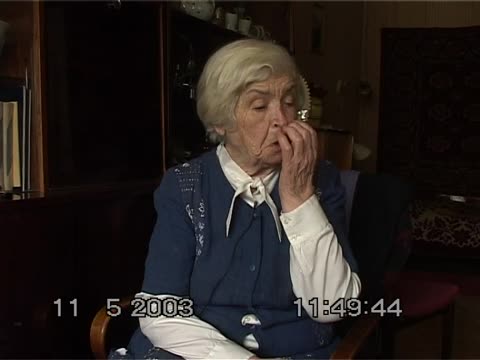
Nisman and Kerler record her name: she is from Rezina, her patronymic is Iosifovna, her maiden name Weissman and her surname Nisman, taken from her husband who was shot. Kerler then asks for her address.
Explains that she bears her husband's surname so that his family name will live on.
Nisman speaks about her life before World War II. She lived in Rezina until the age of fourteen, before she attended a Jewish vocational school to learn tailoring in Chişinău for two years.
Nisman says she lived in Rezina until the age of fourteen, then went alone to Chişinău for two years to learn at a Jewish vocational school. There were three trades on offer; she chose tailoring, because the richer children went to the others.
Names the school's street and the other two trades.
Nisman discusses her family. Her father was born in Raşcov, Moldova. Nisman grew up with five siblings. Her mother, however, gave birth to eight children.
Nisman gives her father's name (Moshe Yosef Weissman) and says he was born in Raşcov. She names her mother, Feyge Shpre (?), and both sets of grandparents, those on the mother's side being in Slobodia (?). Two of the children died; six siblings remained before the war, and she alone survived. She says she was in the Chernivtsi ghetto.
Gives the names of grandparents and her maternal grandfather's work as a cantor.
Nisman mentions that she was imprisoned in the Chernivtsi ghetto and speaks about politics about ghetto imprisonment. Nisman explains how she saved her parents. Nisman then continues to talk about her siblings.
Nisman says the Chernivtsi ghetto was run by the Romanians, who deported people to camps near the Bug. She saved her parents and a sister there, and the parents died in bed later. She then goes through her siblings: Leah, Shikele (Yeshaya), who served in the army and worked in Odessa and Kyiv, Esther, and Khayim, who died young in Samarkand. Nakhmen died in evacuation and Avrom of an illness. A second voice, probably Veidlinger, mentions his age and that he is from Toronto.
Adds the siblings' individual fates and the exchange with a second voice about his age and Toronto.
Nisman speaks about her life before the war, particularly her education. She studied at a Talmud Torah school for three years and remembers singing and dancing. Nisman states that she corresponded with her parents in Yiddish while learning in Chişinău. When Nisman finished her apprenticeship she worked as tailor in Chernivtsi.
Nisman recalls studying at the Talmud Torah from age seven for three years, learning Hebrew and Bible, and dancing and singing at the graduation party. She wrote to her parents in Yiddish; the teacher Taybermann taught Hebrew. Her father said he could not afford gymnasium and sent her to a vocational school, after which she became a seamstress.
Adds the teacher, the Yiddish letters to her parents and her father's refusal of gymnasium.
Nisman talks about postwar Jewish life in the region. She then discusses her childhood memories in an observant home, as well as her parents. Her father was a caretaker in a forest. Nisman recalls poverty at home. She also answers questions about cultural terminology.
Nisman estimates Jewish numbers in Chernivtsi and L'viv today. She describes her parents' poor but strictly religious home and her father's work as a forest caretaker. Kerler asks about words for an honest man and a pious man, and she explains terms for a trusted forest steward and for an honest and a believing person. Her mother complained about hunger.
Adds the terminology exchange on honest and pious.
Nisman speaks about prewar Sabbath celebrations at home. She describes how her father paid for his place in the synagogue and then mentions that her mother baked challah twice a week.
Nisman describes prewar Sabbath at home: her father went to the synagogue with the boys, where he paid yearly for his own seat. On his return the table was set with a white cloth and challah. Her mother baked challah twice a week, and Kerler asks what the dough-offering was called.
Nisman addresses prewar holiday celebrations, including Yom Kippur. She also talks about holiday food customs, particularly gefilte fish. Nisman also remembers that the synagogue was packed and people listened to shofar blowing outside.
Nisman describes Yom Kippur in prewar Rezina: the women's section of the synagogue, the pre-fast meal, and her father's challah-breaking. She goes on to the meat dish, to gefilte fish with her own recipe, and to a sweet-and-sour dish, with Kerler asking for the Yiddish word. She says the town stood outside the packed synagogue to hear the shofar, and she begins on Purim at the rebbe's.
Adds the recipe for gefilte fish and the terminology questions about dishes.
Nisman attended Purim celebrations at the rebbe's house in her hometown. She then answers dialectological questions from the AHEYM Yiddish linguistic questionnaire.
Nisman says that as a girl she visited the rebbe at Purim, and that she remembers the Chernivtsi rabbi, Dr Mark, who was shot with her husband and his group by the Germans. Kerler then asks about the word for the cucumber brine and she answers; she turns to Passover.
Adds the Chernivtsi rabbi Mark and the shooting of her husband.
Nisman continues to share her memories about prewar holiday celebration. She explains how her father and brother went to the synagogue for the day and her mother prepared food on Yom Kippur.
Nisman continues Yom Kippur: her father and brother spent the whole day in the synagogue, while at home the mother and sister prepared the table and the food kept warm in a sealed oven. She gives a recipe for a honey cake and describes the break-fast meal. Kerler asks about kreplach.
Adds the sealed oven, the honey-cake recipe and the sister Esther.
Nisman describes Sukkot: her father built the sukkah himself beside the house, with a roof open to the stars. On Hanukkah he made a menorah from half potatoes, with oil and wicks. She says her father kept Yiddishkayt at home even though the children were not very devout.
Nisman addresses her Yiddishkayt and celebrating holidays today. She also speaks about celebrating holidays during the postwar Soviet period. Nisman then addresses holiday food customs.
Nisman says she now keeps the holidays in memory of her parents, with only a few guests, mostly non-Jews. In Soviet times she kept Passover with matzo and potato pancakes. Kerler asks about the terms for potato pancakes, and she says she made them at Hanukkah and displays a menorah, burning candles for eight days.
Adds the terms for latkes and the Hanukkah candle custom.
Nisman recalls Purim as a joyful holiday, with her father playing dreidel with the children, and visits to the Sadagora rebbe's courtyard, with singing and dancing. She recounts how Rabbi Mark walked with the cardinal. Passover recollections: the search for chametz and burning it, and who asked the four questions.
Adds the Sadagora Hasidic rebbe, Mark and the cardinal, and the Passover search for chametz.
Nisman shows a new Haggadah that she was given, with the death toll in Bessarabia, and a certificate and handmade work from the day centre. Kerler asks whether Purim plays were staged in Rezina, and she says theatre troupes came and mentions the Jewish National House in Chernivtsi.
Adds the Haggadah, certificate and handicrafts shown.
Nisman describes Shavuot food in prewar Rezina: cheese dumplings and varenikes with sour cream, and a mix of cheese and green onions. Kerler asks for the Yiddish words for onion greens and tassel, and the house was decorated with greenery at Shavuot.