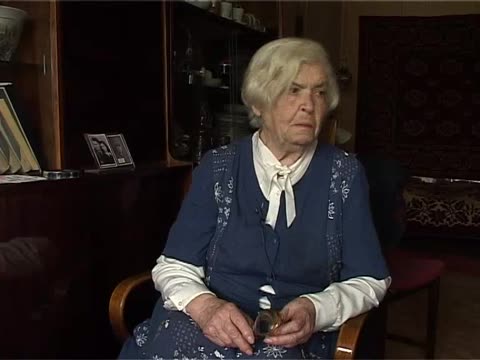
Nisman speaks about life before the war. She remembers non-Jewish neighbors who spoke Yiddish and positive relations between Jews and non-Jews. Nisman also talks about the contemporary relationship between Jews and non-Jews.
Nisman talks about non-Jewish neighbors in her hometown who spoke Yiddish. One was a monastery servant who asked her to help him sweep. She says there was no antisemitism before the war and recalls a non-Jewish neighbor's family helping her when she left to study in Chişinău at fourteen. She says she feels little antisemitism today. Kerler then turns to her first husband.
Includes her time as a student in Chişinău at fourteen and a neighbor's family helping her there.
Nisman talks about her first husband, who worked as accountant. She then speaks about her relationship with the writer Kubi Vol 4:20. Nisman then recites his last Yiddish poem and shows a fotograph of him. Nisman then lists prewar Yiddish writers of Chernivtsi.
Nisman talks about her first husband, a bookkeeper who was shot. She was married to him for only a few months and remains in touch with his family. Discussion turns to the Yiddish and German poet Kubi Vol (name unclear in the transcript). She says she was his wife, not a lover. They met in Chernivtsi in the 1930s, and he died young of tuberculosis. He wrote twelve Yiddish poems. She reads a last poem from his book and shows photographs, one of them with Romanian writers. She names other Chernivtsi Yiddish writers and teachers.
Adds details of the book, her portrait with the Romanian writers, her marriage and the dates of her husband's death, and the lists of writers from Lipcani.
Nisman addresses prewar cultural life, particular Yiddish performances at the Chernivtsi Yiddish house. Nisman states that she sang there herself. She also recalls Itzik Manger's visits to Chernivtsi.
Nisman recalls amateur theater and singing at the Yiddish house in Chernivtsi, in a group called Kameleon. Kerler asks about a small-stage (Kleynkunst) form. She describes performing, and a photograph that was lost. She remembers Itzik Manger visiting Chernivtsi. She sang songs he wrote, which were set to music and which he taught to her, and she recalls his family. She also says she recited a poem at the Hesed. She explains that she wanted a family and children.
Includes Manger's family and her explanation of why she chose family life.
The team concludes the formal interview with Nisman. She speaks about life today and her family. Nisman also answers questions about cultural terminology, before camera records family photographs. One of Nisman's daughters lives in Israel.
Nisman closes the interview because she must prepare for the 9 May celebration, which she calls a great holiday. She speaks about her family: grandchildren and great-grandchildren, with a younger daughter and grandchildren in Israel. A son was recently born to a grandson in Israel, and a brit was held. She then answers questions on terminology (the word for glasses, the word for pills). Her photographs are shown on camera. Russian conversation with another person is interspersed.
Adds the 9 May celebration, dialect terms asked about, and the Russian conversation with S3.
Mostly unclear chat in Yiddish and Russian between Kerler, S3 and Nisman around the end of her interview. The transcript does not show the singing of a song, and nothing of the community center is heard in this span.
The transcript does not show the song beginning or the cut to the community center.
The interview with Leibel begins. Kerler records the date, and Leibel gives his names: Volf in Russian and Polish documents, Zev in the synagogue, his patronymic spelled Tsalevich after his father Betsalel, and the family name Leibel. His address is asked about.
Leibel provides personal information. He then speaks about his family and mentions cousins who made aliyah in the 1930s. Leibel's father was a merchant and his mother helped him. Leibel's parents died in the Rivne ghetto.
Leibel gives personal information, including the Yiddish forms of his first and family names, with Kerler discussing diminutives. He mentions cousins who went to Palestine as pioneers in the 1930s. His family was poor: his father was a petty trader and his mother helped him. Two sisters, Gitl and Faygele, are named. His parents and sisters all died in the Rivne ghetto while he was in the army.
Adds the discussion of Yiddish forms of his names and the names of his sisters.
Leibel speaks about his life before the war. He studied at an institute in Lviv in 1939. At the beginning of the war, he was drafted into the Red Army. Leibel then speaks about his family.
Leibel says he studied at an institute in L'viv and survived the war, and that he was born in 1921. He names grandparents on his mother's side: a carpenter grandfather and a grandmother who sold yeast to poor Jews from a small scale. He also explains what their names were and where she sat in the town. The war's start and army call-up are mentioned only briefly.
Focuses on his maternal grandparents and their trades, which the catalogue summary only calls 'family'.
Leibel speaks about daily life in Rivne before the war. In particular, he remembers how his mother bathed him on Friday and local bookstores. Leibel also addresses his family. His father was a POW held by the Austrian army during World War I. Leibel grew up with two sisters. His parents were also born in Rivne.
Leibel talks about Rivne before the war: a small town, the streets, the large stores and a small bookshop that sold school texts and serial novels read by Jews, and his memory of Friday night. He names his mother Golda and recalls his father as a soldier in the First World War who told stories about Jews freed to attend synagogue on the High Holidays. His grandfathers, a carpenter and a tinsmith, are named. He grew up with two sisters, and his parents and grandparents were born in Rivne. Kerler also notes that his own great-grandfather came from Rivne.
Adds the bookshop, Kerler's family tie to Rivne, and discussion of his father's army years.
Leibel speaks about his life before the war. In 1939, he graduated from a Polish school. Leibel then recites a Polish poem by Adam Bernard Mickiewicz. He then speaks about his education, particularly at a religious school (cheder). Leibel mentions that his younger sister went to a Yiddish kindergarten before the war.
Leibel says he finished the Polish gymnasium (lyceum) in Rivne in 1939. He recalls the Polish poets and recites a Polish verse in answer to Kerler. He names his first cheder teacher, Rabbi Nisl, and describes the rabbi's discipline. He mentions that his youngest sister went to a Yiddish kindergarten led by someone named Erlikh.
Leibel recalls a Yiddish song his sister would sing in the kindergarten. He then speaks about prewar life in Rivne, including local institutions and figures.
Leibel recalls a song his sister sang at the Yiddish kindergarten, remembering only the first lines. He describes the Rivne street where he lived, its Jewish and Polish neighbors, the synagogue on the hill, and local figures including a children's doctor who survived the war. He names a professor and an economic figure or factory owner. A neighbor later hid people in a hideout (?).
Leibel speaks about his leisure activities before the war. He describes how he attended dinners at local Jewish schools on Purim and Hanukkah. Leibel then addresses his school education. Leibel mentions Sabbath celebrations and prayers at the cheder. Leibel studied at a cheder until the age of seven, a Polish primary school until fourteen and a Polish secondary school until eighteen. Leibel also studied with a private Yiddish teacher in the evenings, he explains.
Leibel recalls going to Jewish gymnasium Purim and Hanukkah evenings even though he attended a Polish gymnasium, and mentions a doctor's family whose daughter died in the war. He describes his cheder years from about age three or four to seven, the Friday blessing and kiddush, the Polish primary school of seven classes and then the gymnasium, and a private Yiddish teacher named Mandelboym who came in the evening. He also recalls Polish-language religion lessons, and teachers including Balaban (?).
Adds the Polish-language religion lessons and Balaban's role as teacher.