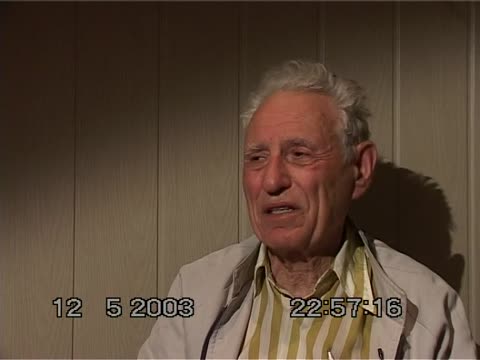
Dorfman speaks about postwar religious life. He mentions Cantor Eleazer Schulman and other local religious figures. Dorfman describes how the community repossessed the synagogue in 1992.
From the machine transcript
Dorfman talks about religious figures in L'viv after the war: Cantor Shulman of the great synagogue and his family, an old man buried near his mother who had studied in Italy, and a later cantor with a good voice. He describes how, in the early 1990s, the community was given a second synagogue building instead of the original one, which had become a warehouse. The building was cleared and renovated, and a rabbi was brought from America.
The synagogue he describes is a different building from the one the community sought; it is a former warehouse; the new rabbi came from America.
Dorfman addresses contemporary religious life.
From the machine transcript
Dorfman and Kerler discuss the new rabbi and the local religious factions, including the Lubavitch. They then work out which shoykhet Kerler has spoken to, a man named Melekh(?), who lives on a certain street, and Dorfman gives his telephone details.
The formal interview with Khonigsman begins. He provides personal information and speaks about his family. His father was a carpenter and his mother, a rabbi's daugther, was born in Ostrów Lubelski, Poland. His father was born in Lublin. Khonigsman grew up with a half-brother, who died in the Spanish Civil War. Khonigsman grew with another brother, as well as a sister. He then talks about his relatives in America, who sent his family money on holidays during the postwar Soviet era.
From the machine transcript
The formal interview with Khonigsman begins. Kerler states the date and place of the recording, and Khonigsman gives his biography: born in Lublin on 29 December 1922 into a Jewish family. His father Shmuel was a carpenter and his mother Mindl, née Grinberg, was the daughter of the Ostrov rabbi. A half-brother, a communist, fell in Spain, and he also had a younger brother and a sister. He tells of relatives in Brooklyn, Chicago and Detroit, one of whom sent money for the holidays and wrote to him after the war, and says that most of his family was killed.
Covers his half-brother's death in Spain and the American relatives, whom he could not trace after the war.
Khonigsman discusses his childhood memories and education. He attended a religious school (Lublin Talmud Torah) at the age of three for four years. Khonigsman then attended the Chachmei Lublin Yeshiva and a Polish primary school. Khonigsman recalls poverty in his family. After Khonigsman graduated from school, he began an apprenticeship with a hat-maker and took evening classes at a vocational school until 1939.
From the machine transcript
Khonigsman recalls his childhood in Lublin. At age three he was sent to a religious school, the talmud torah, by his pious father, and he later went to the yeshiva of Rabbi Meir Shapiro. Under the influence of his leftist brother he was moved to a Polish primary school around 1929, and he describes the family's poverty and the community's help. After school he was an apprentice and attended an evening vocational school until the outbreak of the war.
Mentions the community's soup for the hungry family, and the Polish primary school he entered around 1929.
Khonigsman talks about his life during World War II. He describes how he escaped with his friends toward Chełm, but had to return to Lublin, where he stayed for one month. Khonigsman continues that he escaped again and crossed the border to Russia through the river Bug. He lived in the Soviet Union from November 1939 and lived on a kolkhoz for one month and then left due to hunger. Khonigsman then passed through different places, including Kritchev, Russia, Mohyliv-Podilskyy, where he worked at a sewing factory. In Mohyliv-Podilskyy, Khonigsman also attended an institute for economics in 1941.
From the machine transcript
Khonigsman tells of the outbreak of war in September 1939: he fled with friends and a young girl toward Chelm, took the girl back to Lublin, and spent a month under German occupation. He escaped again in October, crossed the Bug with a peasant's help and, in November 1939, found himself in Soviet territory. After a month on a kolkhoz he fled hunger to Kritchev(?) and Mohyliv-Podilskyy, worked as a porter at a sewing factory and started at the pedagogical institute.
Adds the girl he took with him and returned, the peasant who bribed the Germans, and the factory where he worked.
Khonigsman speaks about his life after Germany attacked the Soviet Union in 1941. He was trained as komsomol to fight off German parachutes. According to him, only 24 out of 800 survived this military action. He then evacuated by train to Chistopol, Tatarstan, from which he escaped to Kuybyshev (today: Samara, Russia). In Kuybyshev, Khonigsman worked as deliverer and completed courses at an institute for economics, before being drafted into the Red Army. He was sent to a labor battalion eastward, which he eventually led in the Karakum Desert, Turkmenistan. Khonigsman was then called to Moscow to work as translator for six month, which he left due to sickness. He then lived in Kyiv for six months, before arriving in Lviv.
From the machine transcript
Khonigsman talks about the war after the German attack on the Soviet Union in 1941. As a Komsomol member he was put in a battalion against German parachutists with only sticks, and few survived. He evacuated by the last train from Mohyliv to Chistopol and on to Kuybyshev, where he worked and finished institute courses. He was then drafted into a labor battalion in Central Asia, led a group of two hundred Tajiks in the Karakum desert, worked as a translator in Moscow, and after falling ill moved to Kyiv and then L'viv.
Adds his command of a labor group of Tajiks and the residence restriction that barred him from Moscow.
Khonigsman speaks about his life in Lviv after the war. He worked odd jobs, before finding work at the Lviv Academic Library. Khonigsman then describes how he found the job at the Jewish division of the library in 1946. The library closed down in 1949 and he then worked at the Peoples Commissariat for Internal Affairs (NKVD) archive. He states that he was in constant fear of imprisonment as writer and was let go twice.
From the machine transcript
Khonigsman describes his work in L'viv after the war. He took a job in the Jewish department of the library after meeting Professor Zadaretsky(?), who lived there, and he tells of the library's fate: most of its books were removed to Kyiv, and some Jewish books remain at a Jesuit building. He was let go in 1949 and worked in the NKVD archive, where he lived in fear of arrest like the Yiddish writers.
Covers the fate of the library's books and the arrests of Yiddish writers that he feared would reach him.
Khonigsman speaks about his intellectual life after the war, including his encounters with Yiddish writers.
From the machine transcript
Khonigsman speaks about Yiddish writers and scholars whom he met in L'viv after the war, when they visited the Jewish library, among them Dovid Hofshteyn and Fefer. He describes the linguist Spivak in detail: his short stature, his beard and his fine Yiddish.
Khonigsman talks about his studies as historian of economic history. He also speaks about his life before the war, when he stopped going to the synagogue at the age of fifteen. Khonigsman returns to his life after the war. He was let go after one year of work at the archive and then wrote his dissertation about the infiltration of foreign assets from West Ukraine, supervised by Moscow State University. Khonigsman then worked as history teacher at a middle school in Kyiv. He was promoted to school principal in the 1950s, since he was a Party member and the only male teacher, as he explains. Khonigsman worked as school principal for nine years and finished his postdoc, before moving to Lviv. He eventually was assigned work in Drohobych as teacher.
From the machine transcript
Khonigsman talks about his early interest in history, his first written essay and how he stopped going to synagogue at fifteen. He then describes his academic career: dismissal from the archive, his candidate dissertation on foreign capital in the oil industry and West Ukrainian economy, and his work as a village teacher and school director near L'viv in the 1950s. After defending his doctorate he could not find work in L'viv and was sent to Drohobych. Much of this is in Russian and difficult to follow.
Includes his arguments with his brother over the Bible and details of the dissertation and foreign reviews that earned him his degree.
Khonigsman speaks about his research interests. He worked in Drohobych until 1973, before teaching at the Lviv Academic Institute, then Ternopil for two years and Polytechnical Institute in Lviv, where he has been teaching since 1976. Khonigsman then show his publications and returns to talking about his research interests.
From the machine transcript
Khonigsman speaks mostly in Russian about the later stages of his career: Drohobych until 1973, the Academy of Sciences in L'viv, two years in Ternopil, and the Polytechnic Institute in L'viv from 1976. He shows his publications and explains that he was an economic historian relying on archives and avoided attacking Zionism. After the Soviet collapse he turned to Jewish history, and Kerler asks about this work.
Adds that he avoided anti-Zionist themes and his turn to Jewish history after the Soviet collapse.