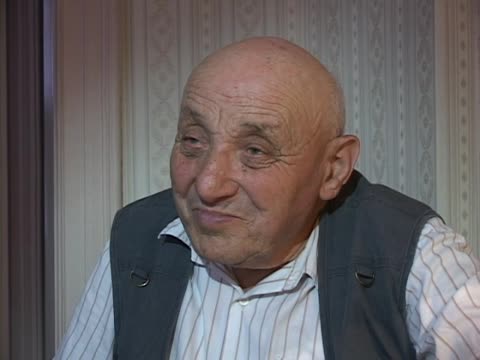
Brandler recalls September 1939, when the Red Army crossed the border into western Ukraine, which he does not call Poland. He describes tanks crossing a river where the bridge broke under the first tank, and says the Polish army surrendered and was taken to a camp. He then returned toward Mostiska.
Brandler describes the Soviet entry in 1939 and the Polish army's surrender, before the escape described in the catalogue.
Brandler talks about his return toward his hometown Mostiska during the war. He then describes the journy by train first from Hodovytsya to Hosyatin and then further east to Bobrynets, Kirovohradsky province. Brandler remembers German plane attacks and injured people. In Bobrynets, Brandler was drafted into the labor battalion division of the Red Army in 1941. In his division, Brandler went to the Rostov region. Brandler describes the different kinds of assignments he had throughout the war. Brandler was then drafted for combat in the Red Army and fought at the front in 1944. He points out that he was only drafted because he forgot his identification documents at home. He was wounded on Crimea. In 1945, Brandler left the infantry for the artillery, where he was injured for the second time, by a boy. Brandler was demobilized in 1946.
Brandler describes his wartime route from Mostiska by foot and train to Husiatyn, where German planes bombed the platform, and on to Bobrynets in the Kirovohrad region. He was taken into a labor battalion digging anti-tank trenches and worked in the Rostov area and in a coal mine. In 1944 he was drafted into the army, fought as a mortar man, and was wounded and hospitalized. He later served in the artillery, was hurt again, and was demobilized in 1946. Kerler also asks how Yiddish speakers in his area said words like trench and dugout.
Kerler interrupts to ask how Yiddish speakers said trench and dugout, and Brandler describes the Slovak towns liberated by his unit.
Brandler talks about his life after the war. He returned to Mostiska and then to Sudova Vyshny, joining his sister. Brandler then moved to Lviv, where he was trained at the municipal collection office. Brandler worked as supervisor in municipal offices in Peremyshlyany for thirty years. He then describes his work as tax collector during the Soviet era.
Brandler talks about his postwar career. His sister sent him to L'viv for courses, and he trained for a post in the financial office. He then worked for about thirty years in tax offices in villages, assessing and collecting taxes. He tells how he spared a poor priest by not recording the man's horse, and describes a case involving a priest accused of taking money from the monastery. Kerler asks about words for priest and church.
Anecdotes about taxing priests and how he spared them.
Brandler talks about his life after the war. After his retirement, Brandler worked in an insurance office. He shares episodes from his work and recalls peaceful work relationships.
Brandler continues about his work among villagers, saying he never carried a gun and no one bothered him. After retiring he worked a few more years as an insurance agent. He gives an example of a life-insurance case that ended with the widow collecting the payment, and Kerler asks the terms for insurance and for a well.
The insurance episode, and Kerler's questions about the terms for insurance and well.
Brandler speaks about his family. He was married in 1948 and raised a son and a daugther, who passed away. Brandler moved from Peremyshlyany to Lviv in 2003, where his son lives.
Brandler says he worked in Peremyshlyany for about forty years (?) and liked going to the forest alone to pick mushrooms. He married in 1948 and had a son born in 1949 and a daughter born in 1952, who died abroad in an accident. His wife died in 2002, and since then he has lived with his son in L'viv, at a street address he names. He attends the Hesed and the Sholem Aleichem society in L'viv, which he says he has lived in since 2003.
Brandler mentions his daughter's death abroad and his attendance at the Hesed and the Sholem Aleichem society.
Brandler speaks about postwar antisemitism in Peremyshlyany. Brandler moved to Peremyshlyany in 1958. He also mentions how he and a friend preserved the local cemetery. Brandler then recalls a close friend, who fought the Germans as partisan. Brandler also speaks about other friends' life during the war.
Kerler asks about Jewish life in Peremyshlyany. Brandler discusses the postwar Jewish presence there and how he and the partisan commander Shimon Zisser saved the cemetery and the small hall holding the tsadik's grave. He names the tsadik as Reb Meir (?) and compares him to the Belzer rebbe. He tells of Zisser's wartime partisan unit, and of a survivor named Kirzhner who escaped a shooting, along with other friends, and of Jewish police betraying people in hiding.
Brandler also tells of Jewish police informers and the survivor Kirzhner, and Kerler asks about the town's Yiddish name.
Brandler speaks about his life before the war, particularly his cheder melamdim. He then speaks about his family. In particular, he addresses his father's obervance. Brandler's mother sold milk bottles to merchants for a living.
Brandler answers Kerler's questions about his cheder teachers: one taught the alphabet, the second taught Yiddish writing and Humash, and a third taught Gemara. They discuss his dialect and the Litvak teacher's origins. He describes his father as a devout Jew, but not a Hasid, who never visited a rebbe, and his mother Hanna Rachel (?), who sold milk to customers for a living. He says he was called Khaim, with Nakhum added for the Torah reading.
Kerler's dialect questions about the Litvak teacher and Brandler's explanation of his own name.
Brandler says he can still read Hebrew and recites the names of the letters of the alphabet as he learned them. They talk about Polish Jewish pronunciation, and Kerler asks him to read prayers from a book. Brandler reads out words and short prayer passages with some difficulty, and Kerler asks how he says a few of them.
Brandler recalls a Sholem Aleichem play (Dos groyse gevins) in which the tailors' troupe, with his sister taking part, sang a song about potatoes through the week. Kerler asks what potatoes were called at home.