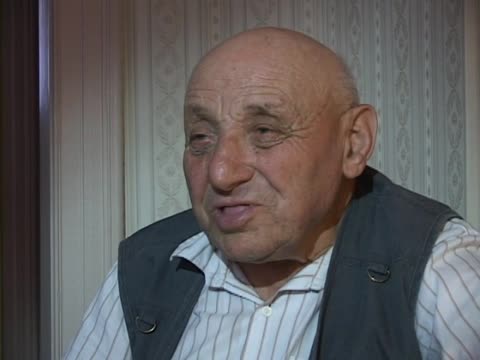
Brandler answers questions about cultural terminology. He then speaks about his family and the their view on his sister's acting. Brandler's father was married twice. Brandler grew up with three half-siblings and four siblings.
Brandler answers a question about a word for potatoes, then discusses his sister's acting in a prewar amateur production and how his parents reacted. His father and mother did not attend, and a hasid is mentioned objecting to Sholem Aleichem. He explains that his father had two wives, the first with several children, and that his own mother had eight children, of whom only he and his older sister Ester survived. Ester acted in theater and was a communist.
Brandler's father's two marriages and his sister Ester's name; also the hasid's remark about Sholem Aleichem.
Brandler speaks about prewar Jewish life and communists. He states that communists were frequently arrested on Christian holidays. Brandler then mentions prewar organizations, including Poale Zion, before addressing the Israeli Yiddish journal "Lebensfragn" (life questions).
Brandler says nearly all communists in the town were Jews, and that they were taken to the police on Polish holidays. He lists other interwar parties and organizations, including left and right Poale Zion and a Zionist society, and says there was no Bund in the town. He then talks about reading an Israeli Bundist Yiddish journal and objects to its view of Israel as occupying territory. Kerler turns to youth movements at the end.
Brandler's discussion of the Israeli political stance of the journal and his sister's influence on his own political path.
Brandler talks about his life before the war. During his childhood, he attended a Zionist summer camp in Krościenko, Poland. Brandler then sings part of "Hatikvah."
Brandler recalls going as a boy to a Zionist summer camp in Krościenko in Poland, where they studied, lived in a village and sang. He recalls Hatikvah and sings some of it, then says it is sung somewhat differently in Israel. He also mentions a group visiting Peremyshlyany to whom he showed the Holocaust grave. Kerler then moves on to libraries.
A later visit by a group to Peremyshlyany who sang Hatikvah at the Holocaust grave.
Brandler talks about prewar libraries in the town. There was a Ukrainian library and a Zionist library with Polish and Yiddish books, among them Bialik. He lists authors he read in Yiddish translation, such as Tolstoy, Trotsky and Jack London, and says books could be borrowed but not read on the premises. He also names Polish popular writers and an Polish book on sexual questions.
Specific authors and the lending practice of the library.
Brandler describes holiday and Sabbath food at home before the war. His mother made raisin wine and challah, and fish was a must, including fish dumplings; his mother's fish was not sweet, unlike his grandmother's. On Sabbath there was kugel and cholent, which he carried to and from the baker. He recalls an incident when the ritual slaughterer declared a fish treyf, and that the family ate plain food then.
Questions on the sweetness of the fish, fish dumplings and the baker's oven for cholent.
Brandler speaks about his family, before addressing the occupational structure in prewar Mostiska. He also mentions a local fire, before talking about Jewish prewar press.
Brandler confirms that his grandmother came from Mostiska, and lists the town's occupations: tailors, shoemakers, watchmakers and merchants, and porters who carried passengers from the station four kilometers away. He recalls Polish army maneuvers in the 1930s and a large fire that burned several houses. He then discusses Jewish and Polish newspapers read before the war, naming a few titles and an editor who left for America.
Polish army maneuvers and the train station porters; Kerler's questions on newspapers.
Brandler talks about prewar Purim, Rosh Hashana and Yom Kippur celebrations. He recalls how the synagogue caretaker symbolically hit the congregants on Yom Kippur. Brandler then addresses prewar religious institutions and continues describing holiday celebration during his childhood. Brandler recalls fasting.
Brandler recalls prewar holidays in Mostiska: a childhood Purim in costume, being given liquor at a brit, tashlikh on Rosh Hashanah, and the beadle whipping men symbolically before Yom Kippur. He describes the town's synagogue, two small prayer houses and study houses, a mikveh, Simchat Torah and Hanukkah candles, building the sukkah and antisemitic harassment of it. He also gives the word for the ruffians who threw things, and says he fasted on Yom Kippur and Tisha b'Av.
Distinction between shul, kloyz and beys-medresh, Hanukkah, Sukkot, and antisemitic harassment.
Brandler answers whether prayer was possible in Peremyshlyany after the war. The synagogue was burned by the Germans, and nobody prayed except a doctor, Fridman, who went to L'viv. He talks about the lack of kosher meat and about a trip to L'viv to bring a Torah for a rabbi in Husakiv. Kerler compares this with the Carpathians, where kosher meat could be had.
Kosher meat, the Husakiv Torah, and the doctor Fridman who prayed in L'viv.
Brandler answers questions about the meanings of the words dybbuk and golem, calling the first a bad person and the second a legend of a robot made in Prague. He gives terms for a non-Jewish and a Jewish cemetery. He then explains that after demobilization he found gravestones used as paving stones in Mostiska, and notes how few remain.
Terms for cemetery and golem legend in addition to the use of gravestones.
Brandler answers dialectological questions: words for everyday things (book, house, groats, cut skin, blue, dove, build, greetings and replies, thanks, the grace after meals), adverbs and adjectives (early, late, cold, high, near, fast), and sentences to translate with pronouns, 'I like it/I don't like it', 'ill', 'beautiful', 'come', 'escape'. Many items are asked in Russian or Ukrainian and the transcript is garbled in places.