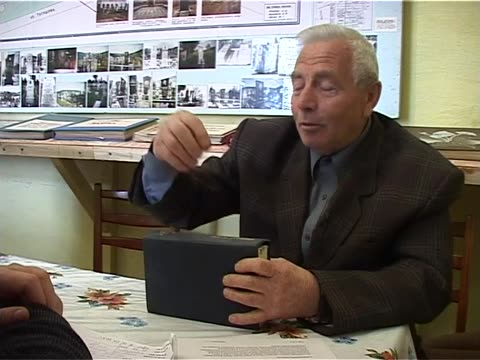
This video begins in the middle of a formal interview with Abram Davidovich Kaplan. He briefly explains what he sees as discrimination against women in Jewish religious tradition. Kaplan remembers his aunt Khone’s wedding from before the war. Jewish weddings before the war were celebrations complete with a chuppah, rabbi, badkhn (wedding jester) and the breaking of plates. Purim before the war was characterized by noisemakers, children going door-to-door to ask for money, and the sending of sholekh-munes (care packages of fruits and other foods to neighbors and friends). Recalling Passover, Kaplan remembers how matzos were baked in the home and how special holiday dishes were kept in the attic. Kaplan also briefly discusses traditions associated with Yom Kippur and shabes (the Sabbath).
From the machine transcript
Kaplan complains about the separation of women and men in the synagogue, which Kerler says is a debated issue among religious groups. He remembers a prewar Jewish wedding of his mother's sister with a rabbi, chuppah and badkhn, and mentions the breaking of plates at weddings. He answers questions about Purim (Purim players, going to neighbours, sending festive plates, shalekh-mones). He describes the isolation from Jewish life during thirty years of army service, Passover matzo baking at home with the utensils kept in the attic, the pre-Yom-Kippur meal and Sabbath cholent baked in the oven.
Adds Kaplan's army years away from Jewish life, Yiddish terms for food, and Sabbath cholent.
Driving from the community center to the Jewish cemetery, Kaplan indicates different points of interest around town, such as where another potential interviewee lives.
From the machine transcript
Driving with Kaplan toward the Jewish cemetery, Kerler asks about the prewar Jewish streets and the transit camp and concentration camp sites. Kaplan, mostly in Russian, points out the Jewish street, where Jews have always lived, and the apartment building where Tsilia Borisovna Khaiut lives, discussing whether to visit her. They then drive along the road to the cemetery, and Kerler asks the local Yiddish word for the cemetery.
Adds the camp site, Khaiut's apartment and the question of the cemetery's Yiddish name.
Kaplan leads Professor Kerler on a tour of the Mohyliv-Podil’s’kyy Jewish cemetery, pointing out different matseyves (gravestones) and the meyloyl [the building used by the burial society to ritually clean the dead].
From the machine transcript
At the Jewish cemetery, Kaplan and Kerler look for the oldest section and look at gravestones, noting that the grounds are cleaned by hired workers from May to October. Kerler reads inscriptions and points out the stone of a man who opened a synagogue in his house after the war. Kaplan explains that the nearby building is the meyloyl, where the dead are prepared, and gives its date. Kaplan also points out the new section of the cemetery.
While driving through the newer section of the Jewish cemetery, Kaplan explains how the community’s landslayt (former residents) come from all over the world to visit their relatives’ graves and how they help the local community financially.
From the machine transcript
Driving through the newer part of the cemetery, Kaplan and Kerler compare the old gravestones with the granite ones of the new section. Kaplan says that visitors come to graves from all over the world and support the cleaning of the cemetery, and that the oldest stones are some 400 years old. The cemetery is large, in four sections.
While on the road back into town from the cemetery, Kaplan again points out different sites.
From the machine transcript
Driving back to town, Kaplan points out sites: cleaned and tended cemeteries, a street whose pavement slabs were made from gravestones, the meyloyl building (Kerler asks again for its name), the part of town with vineyards where officials live, and the military commissariat. The Yiddish is largely garbled and the passage rests on Russian lines.
Kaplan answers a few brief linguistic questions and he and Professor Kerler say their goodbyes in front of Kaplan’s home.
From the machine transcript
In front of Kaplan's house, Kerler asks him to translate a sentence about who lives on the street, and Kaplan gives a Yiddish rendering. Kerler thanks Kaplan and they say goodbye.
The camera cuts to a formal interview with Tsilia Borisovna Khaiut, who was born in 1917 in Mohyliv-Podil’s’kyy. Her father, a shoemaker known as Berl Adeser, was also born in Mohyliv-Podil’s’kyy. Khaiut’s mother Rukhl was born in Bessarabia, a fact which causes her to remark about the dialect difference between her Yiddish and that of Bessarabia, as well as the killing of Bessarabian Jews in Mohyliv-Podil’s’kyy during the war. Khaiut’s maternal grandparents and their family immigrated to the United States during the Tsarist era and she remembers how her mother used to receive dollars from them, with which they paid rent. When Soviets took power, Khaiut remarks, however, the official exchange rate made these remittances worthless and contact between these familial branches ceased. Khaiut had two sisters, Ester and Ronya, and a brother, Khoskl (who moved to Israel) all of whom have died. Khaiut also talks about her education in Soviet Yiddish schools and the traditionally religious life at home during her youth. Before beginning her formal education at ~4-5 years old, Khaiut studied with a melamed (private religious teacher) named Mendl. The melomdim were the very poorest people in the shtetl, and she tells a joke/anecdote about their poverty. Her first son (b. 1938, d. at age of 42) also learned with a rabbi. Khaiut has another son who still lives in Mohyliv-Podil’s’kyy, as well as four grandchildren in Ashdod, Beer-Sheva and elsewhere. Khaiut shares her views of child-rearing and the difference between children today and in her youth. In her home as a child everything was done “Jewishly”. Khaiut discusses her marriage and family life, including the custom of taking off a bit of dough from the khale (challah) and burning it. She speaks about the curriculum of Soviet Yiddish schools, recalling for instance "Vi bisti geveyn ven dus gelt iz geveyn" (Where were you when there was money) as one of the songs they learned. In school she studied writers, such as Sholem Aleichem and Itsik Fefer, as well as sciences and mathematics, algebra and chemistry all in Yiddish. The interviewee also answers a series of questions related to linguistics and dialectology. During the war, Khaiut lived in the ghetto in Mohyliv-Podil’s’kyy and was transferred to a camp in Transnistria. She relates how she would dress as a Ukrainian woman and buy goods in the bazaar, taking off the yellow star that identified her as a Jew, but was nevertheless hit by a German on one of these outings. At this time, her husband was serving on the front with the Red Army. Khaiut also recalls a number of recipes of Shabes (Sabbath) foods, including: yukh (chicken soup), tsimes fasolyes (bean stew), kigel (casserole), and different kinds of fish. Cities and towns mentioned on this tape: Mohyliv-Podil’s’kyy, Ivano-Frankivs’k, Ashdod, Beer-Sheva.
From the machine transcript
Khaiut gives her details: she was born in 1917 and her father Berl, a shoemaker, and her mother Rukhl, from Bessarabia, are discussed with Kerler. She notes that Bessarabians speak Yiddish differently and recalls the fate of Bessarabian Jews after the war; she also recalls her grandparents and the relatives who emigrated to America and sent dollars. She names her siblings (two sisters and a brother who went to Israel) and her son born in the 1930s who died at 42, and mentions grandchildren in Israel. She talks about the Soviet Yiddish school, the teacher Mendl and her childhood cheder, Jewish home life and Soviet pioneers and songs, and answers questions on Yiddish terms for Soviet institutions and foods (kigel, gefilte fish). She also tells of the ghetto and Transnistria, where she dressed as a Ukrainian to sell goods at the bazaar and was beaten by a German while her husband was in the Red Army, and gives her mother's fish recipe.
Adds the details of her son's cheder teacher, Soviet school teachers and subjects, the bazaar episode and the fish recipe.