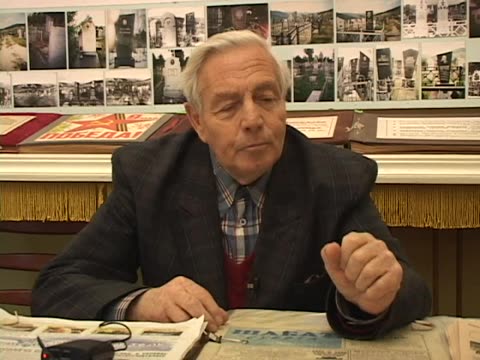
Brief exchange at the start of the tape in which Kaplan says he can speak Yiddish and Hebrew but not English. Katz then announces the date, 13 December 2005, and the place, Mohyliv-Podil's'kyy.
The camera then cuts to a formal interview with Abram Davidovich Kaplan, born 2 May, 1933 in Mohyliv-Podil’s’kyy. Kaplan begins this interview sharing much of the information about his parents and siblings that he gave in his first interview. His twin brother Leyb/Lev has lived in Germany for the past seven years, where his wife was stabbed to death by a Rom (Gypsy). His youth was marked by poverty and a strict, disciplined upbringing “like Tsar Nicholas”, i.e. very strict.
Kaplan gives his official and Yiddish names, his birth date and place, and the Yiddish name of the town and region. He names his parents and his brothers, corrects the count to three brothers and no sisters, and mentions the twin brother in Hanover whose wife was killed. He recalls his grandmother's death from hunger in evacuation in Central Asia, and a childhood of poverty and strict discipline, with a mother who taught literature. He then mentions the Jewish school and gymnasium and the number of Jews in the town.
Also gives his Yiddish name and the Yiddish form of the town's name, and the death of a grandmother in evacuation.
Kaplan sings "A Postekhl" (A Shepherd) in a better rendition than in his first interview, but states that he had a heart attack, and it is therefore hard for him to sing.
Kaplan remembers the deported Bukovina, Bessarabian and Hungarian [sic] Jews that were sent to Mohyliv-Podil’s’kyy during the war. Kaplan also describes how the Russian school had two classes set aside for children who grew up in Yiddish-speaking homes and didn’t know Russian, and so studied in Yiddish, Ukrainian and Russian, only later being integrated into the mainstream Russian school system after seventh grade. Kaplan himself did not enter school until after the war (he was supposed to enter in Sept. 1941, but could not attend as hostilities had already broken out by then). Kaplan also discusses synagogues in Mohyliv-Podil’s’kyy both before and after the war. His mother was, as he says, “more frum (religious) than necessary” and fasted every Wednesday and Thursday. She died in his arms as soon as he returned from the army.
Kaplan comments that he has had a heart attack and can no longer sing well, and recalls a song about a tailor. He remembers the deported Jews from Bukovina, Bessarabia and Hungary who were brought to the town during the war, and the children he played with. He describes the two Yiddish-language classes in the Russian school and his own late start in school after the war. He speaks about the surviving synagogue, its builder (the name is unclear), his religious mother who fasted twice a week, her death in his arms, and his grandmother from Ozaryntsi.
Gives the town's Jewish population in 1944 (about nineteen thousand with deportees) and names Ozaryntsi as his maternal grandparents' village.
His father worked as a soap-maker and a cantor in one of the town’s synagogues. Kaplan relates shabes (Sabbath) customs from before and after the war, detailing, for example, how his mother sometimes employed a shabes goy. During the war, Kaplan was in different camps in Transnistria, and tells the story of how his family escaped and returned to Mohyliv-Podil’s’kyy in 1942, all the time hidden and cared for by non-Jewish neighbors. Kaplan notes that many Jews collaborated with the Germans and Romanians, forming special Jewish police battalions, and relates the story of the sinking of a ship of Jewish orphans who had supposedly bought freedom off the coast of Constanta, Romania. Kaplan also speaks about contemporary war memorials and ceremonies, as well as ties to landslayt (former town residents) from abroad and the post-Soviet revival of Jewish life led by Sobol [late husband of interviewee Maria (Molke) Iosipovna Sobol (née Cioban)]. Kaplan then sings a fragment from the song "Shik mir a shtral" (Send Me a Ray (of Sunlight)). Kaplan also speaks about the different sections of the Jewish cemetery, how holidays were celebrated sometimes in secret before/after the war and answers some questions related to linguistics and Yiddish dialects. Cities and towns mentioned on this tape: Mohyliv-Podil’s’kyy, Kozenits, Ozaryntsi, Pechera, Constanta, Bucharest.
Kaplan describes his father as a soap-maker and cantor, and talks about Sabbath food and customs, a Russian neighbour lighting the stove, Hanukkah, Purim, and Hebrew lessons. He tells of the camp at Pechera, the escape of a group of Jews with a Ukrainian guard's help, the walk home along the river, and the family's hiding in the cellar of Polish neighbours (Zbigin?) until 1944. He covers the Jewish police, the drowned orphans off Constanta, commemoration work led by the late rabbi Sobol, and a ghetto song. He also tells of secret Passover matzo baking after the war, the three cemetery fields, non-Jews who speak Yiddish, the word Litvak, and the term for a 'good Jew' (rebbe or tsadik).
Also covers a Hebrew teacher, the escape from Pechera, the rescuers' monument, the ghetto song and Passover under Soviet rule, and the word Litvak.