0:00
The tape begins with a number of false starts and audio problems for the first thirty seconds.
The division was proposed from the catalogue's descriptions and the machine transcript, not stated by the catalogue (how).
The tape begins with a number of false starts and audio problems for the first thirty seconds.
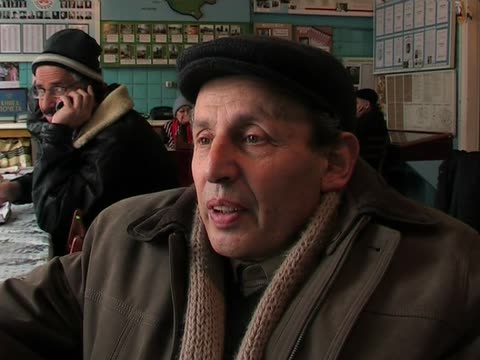
The next part of the tape consists of a formal interview with Mikhel-Shmiel (Misha) Gilevich Leger (b. 1935). He is officially registered, i.e. legally named “Mikhel-Shmiel”, although Misha is his nickname. His father Gilel worked as an accountant/bookkeeper, while his mother Faye worked as a nurse. He was born in Feburary 1935 in Mohyliv-Podil’s’kyy. Leger claims to have learned to speak Yiddish in the wartime ghetto, because before that his family spoke to him only in Russian. During the war, his father was on the front, while he and his mother tried to escape to the nearby village of Chernivtsi (Kleyn Tshernovits), but Germans had already captured it. Leger recalls how his mother gave birth to a stillborn daughter in that town. After a few months there, his father found them there, and they all went back to Mohyliv-Podil’s’kyy, ending up in the ghetto. With upwards of 30-40 people living in one room in the ghetto— including Bukovinan and Bessarabian Jews— there was great fear of a typhus outbreak and so Leger was moved with a cousin into another house with fewer people. The children would hide when the Romanians and Germans would come rounding up Jews for work, but his parents had to labor. After the war, Leger continued to speak Yiddish with his parents and other children. The interviewee also describes his Russian-language schooling and how, although he is illiterate in Yiddish, he is now trying to learn how to read Hebrew characters. Leger reminisces about traditional celebrations of holidays such as Passover and Simkhes Toyre (Simchat Torah) (audio problems: 13:50-14:01; 14:09-14:12). At the conclusion of the interview, Leger addresses post-war and contemporary Jewish life in Mohyliv-Podil’s’kyy. In the Soviet period, according to Leger, prayer was legal and took place in private homes, but only older people went to services since most people were afraid of the consequences. His father, for example, would go only on yortsaytn (commemoration of a relative's death). Today, in Leger’s estimation, there are 300 Jews in the town, a figure which includes families of mixed backgrounds
Leger gives his name, patronymic, birth year and the names of his parents and grandparents. His father was a bookkeeper and his mother a nurse. He says he learned Yiddish in the ghetto, after the family had spoken Russian at home. He recalls trying to evacuate with his mother, her stillborn child in a nearby village, the return to the ghetto, overcrowding with Bukovinian and Bessarabian Jews, typhus, fear and hunger, and his mother's work in a hospital. He then describes language after the war, his work as an engineer, Soviet-era prayer, the destroyed synagogue, and the 300 or so Jews in the town today. In the final part Kerler and Lemster ask about songs, stories, folk customs and Yiddish writers, which he does not remember.
The transcript adds the recalled hospital for Bukovinian Jews, his work as an engineer, the sister Gitl (?), the destroyed synagogue, and the closing questions on songs, stories and writers.
The rest of this tape consists of a formal interview with Berta (Betya) Aronovna Vaisburd, who was born in 1931 in Mohyliv-Podil’s’kyy. While her father, Arn, a factory worker, was born in Mohyliv-Podil’s’kyy, her mother Gitl was born in a very small village nearby. Without siblings, Vaisburd is an only child. During the war, Vaisburd was in the Pechera camp along with her mother, aunt, paternal grandmother Reyzl, and cousin, the latter of whom was in charge of burying the camp’s dead in the forest. One night in 1942, this cousin smuggled Vaisburd, her mother and her aunt (her grandmother had died in the camp earlier) in a wagon generally used for carrying corpses. At first, the family hid in Sharhorod, and then returned to Mohyliv-Podil’s’kyy, where they squatted in abandoned houses, and then were sheltered in a cellar by a Christian neighbor who knew Vaisburd’s mother from her village. Although this cellar was used as common storage by many families, Vaisburd and her relatives were never given up. Eventually, Vaisburd’s mother and aunt found an abandoned one-room house, where they and seven other kids lived until the war’s end. Vaisburd remembers in particular going to the local Russian market in disguise in order to buy food. Vaisburd also shares her few memories of the Pechera camp experiences, such as when people were shot for trying to get drinking water from the river. Vaisburd then turns to the pre-war period, describing her grandmother, and the different foods she would make for shabes. Before the war, Vaisburd’s family raised geese, a multi-purpose affair she describes in detail. She also shares her family’s recipe for gefilte fish. Her paternal grandfather died on the way to America. After the war, Vaisburd studied in Tashkent, where she married a non-Jew. She has two daughters, one of whom lives in Mohyliv-Podil’s’kyy, and another in Israel; her grandchildren live in Canada. Vaisburd also recalls her mother’s folk remedies against the evil eye and the one pre-war Jewish wedding she attended, the most memorable aspects of which were the food, her mother’s relatives and the klezmorim. Throughout the latter part of the interview, Vaisburd also answers the research team’s questions related to linguistics and dialectology. Cities and towns mentioned on this tape: Mohyliv-Podil’s’kyy, Chernivtsi (city), Chernivtsi (Kleyn Tshernovits), Nemie, Pechera, Sharhorod, Murafa, Tashkent, Beit She’an.
Vaisburd gives her name, birth year and birthplace and speaks of her parents, her father at a factory, her mother from a nearby village, and her grandparents. She was in the Pechera camp with her mother and grandmother. Her grandmother died there, and a cousin who buried the dead smuggled them out. She recalls hiding in Sharhorod and then in Mohyliv-Podil's'kyy, in a cellar kept by a Christian neighbor and in a one-room house shared with other children. She also recalls going to the market disguised. She then describes her grandmother's baking, Sabbath food, fattening geese, gefilte fish and Purim, and questions on devils, evil eye, songs and the one prewar wedding she remembers. After the war she studied in Tashkent and married a non-Jew; one daughter lives in Israel (Beit She'an) and one at home. Many of her answers respond to Kerler's and Lemster's questionnaire items.