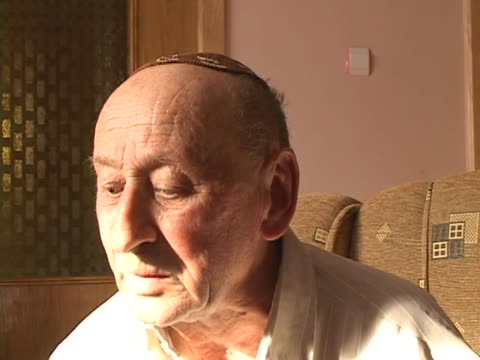
Nayman talks about childhood friends and Jewish life before the war. He remembers the Yiddish names of surrounding towns and answers questions about cultural terminology. Nayman then recites prayers.
Nayman and Kerler talk about a man named Lebovitsh (?) and his father Binyomin, who worked for Nayman's family and lived in a village near Munkács. Kerler asks about a rabbi from Romania who set up a prayer house and mikveh in Munkács. Nayman gives the Yiddish names of nearby towns (including Rakhiv, Khust, Berehove (?), Uzhhorod and Bila Tserkva) and answers questions on the dybbuk and the golem. He also tries to recall prayers.
Adds the dybbuk and golem questions and his attempts to recall prayers.
Nayman talks about prewar Jewish life, in particular the wedding of Rabbi Chaim Elazar Spira's daughter in Mukacheve. He then remembers his studies with the rebbe of Mukacheve and describes several prayer houses.
Nayman recalls the wedding of the Munkács rabbi's daughter, with many rabbis present and the groom's learning, and says it lasted a day. He describes studying under the Munkács rebbe, taking notes at lessons and having them checked. He then describes the synagogues, study houses and prayer rooms of Munkács, and how a shul, a besmedresh and a shtibl differ. He mentions the two parts of the prayer house in Klyachanovo.
Adds the distinction between shul, besmedresh and shtibl and the Klyachanovo prayer house.
Nayman describes coming home after the war to find his parents gone, not knowing where they were killed; he says Kaddish for them yearly. He gives approximate birth years for his parents and says he was taken into the military in October 1942. Kerler asks what he knew then of the killing of Jews; Nayman says he knew little and heard only of deportations to Germany.
Adds what Nayman knew in 1942 about the killing of Jews, and his parents' possible fates.
Nayman briefly talks about his life during the Soviet period. He owned a vineyard and produced wine. He then answers a number of dialectological questions from the AHEYM Yiddish questionnaire.
Nayman briefly says that after returning he got his vineyard back, made some wine and sold grapes. He then answers questions from the dialect questionnaire, including the Yiddish for 'cross', 'honest' and 'believing', words for mistake and certainly, a sentence translated from Russian, and 'who does this child belong to'. He also answers questions on 'cart', 'quick', 'sick' and 'barely'.
Adds the vineyard and wine production, and the kinds of items in the questionnaire.
Nayman recalls episodes from his life during the war, including hiding in a pit. He then talks about his liberation by the Americans. He explains how the first food they had was sugar. After his liberation, Nayman became sick with typhus and stayed at a hospital for one a half months. He then talks about the reparation payment he receives from Germany.
Nayman recalls hiding in a pit and sleeping on the ground in the camp. He describes the Americans arriving and the first food, sugar. He fell ill with typhus and was in a hospital, and later tracked down the German support he now receives. Kerler and Nayman compare this with his Israeli and Ukrainian incomes.
Adds the comparison of reparation payments from Germany with Israeli and Ukrainian incomes.
Nayman answers a long series of questionnaire items put by Katz and Kerler. The items include words for paradise and hell, shop, potato, bag and mouse, the greeting 'good day', 'please' and 'thank you', and 'to build'. He also gives words for near and nearer, window panes, sour, stone house, bricklayer, cold and colder, and high and higher. Several translations from Russian are involved, with S2 and S3 prompting in Russian or Ukrainian.