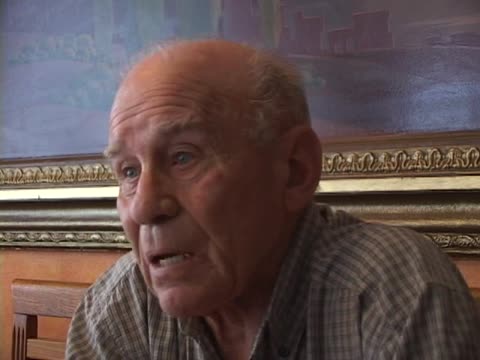
The first part of the tape is the continuation of a formal interview with Hershel Ylyevich Vider, recorded in Mukacheve. Vider talks about his childhood memories and his family. Vider then discusses prewar Jewish life, in particular his political activity. He describes how he joined the Betar movement.
Vider talks about his family: his father was an only son with many sisters, and his mother's brother married in Satu Mare and the relatives came to Mukacheve in summer. Kerler asks about a local kosher meat dealer, and Vider says only veal was sold. He mentions his children's studies and careers. He then describes his youth in Mizrachi and Betar, reading about Yosef Trumpeldor in Hungarian, and the evenings with singing, study and politics.
Also covers relatives in Satu Mare, the kosher meat trade and his children's careers.
Vider tells prewar Hasidic anecdotes and jokes. One anecdote includes a story about a wife who complains about her husband to the rebbe. He then discusses the prewar youth movements Betar and Mizrachi, as well as the Bund. Vider continues to talk about Yiddish literature.
Vider tells Hasidic jokes about a rebbe, including the wife who complains to the rebbe about her husband, and a poor Jew who writes a letter to God asking for money for Passover. He discusses the Zionist youth movements (Mizrachi as religious, Betar mixed, Shomer Hatzair less observant), communists and Bundists in the town. Asked about Yiddish books before the war, he says there were many, including Bialik and Sholem Aleichem. He ends with another joke and a remark about his own sleeping arrangements.
Also covers communists and Bundists in the town and Yiddish books before the war.
Vider explains greeting customs, such as a Latin-derived word for greeting and handshaking, and the Hungarian influence on them. He says his Yiddish is weak and that he mostly watches Hungarian television. He talks about Jews in Hungary and Budapest today (a Jewish hospital, a choir, the old Jewish street and ghetto, and a children's summer camp). He answers a few terminology questions, then mentions that Nayman survived the Gulag with him and was born in Rakhiv.
Also covers greetings and Hungarian influence, plus a mention of Nayman.
The second part of the tape is a formal interview with Moyshe Nayman, recorded in Klyachanovo. The team travels to the next interview with Moyshe Nayman, born in Klyachanovo in 1921. After the team arrives at Nayman’s apartment, they set up the formal interview.
The team arrives at Nayman's home and sets up with several people talking, partly in Russian. Kerler greets Nayman and explains that they are recording how Yiddish was once spoken. Nayman briefly mentions that he lived in Israel for some years and then says he studied in a yeshiva until the age of eighteen.
Shows the setup and greetings before the interview starts.
Nayman talks about his education at a yeshiva in Korsun, together with 300 other students. He studied with the rebbe of Mukacheve, Chaim Elazar Spira , until the age of eighteen. He then provides personal information and talks about his family.
Nayman says he studied in a yeshiva with the Mukacheve rebbe Shapira, with over three hundred students. Kerler takes the date and place: Klishanov, where Nayman was born in 1921 and still lives, and he gives his age as 84. Nayman says he came back from Israel because his wife wanted to die among the children, and he speaks about his sick wife. A woman nearby weeps.
Also gives the date, his age and his return from Israel because of his wife.
Nayman talks about his childhood memories of Klyachanovo (Yiddish: Klitshanif), where eighty Jewish families resided. He attended religious school (cheder) until the age of thirteen. Nayman then recites prayers. His parents farmed land and owned six cows. They produced butter and cheese and distributed it among the surrounding villages. Nayman helped out his parents. He then talks about his yeshiva education and recites prayers.
Nayman recalls attending cheder until age thirteen and mentions his brothers Berish and Hershl, one of whom lived in Haifa and died in the early 1990s. He says about eighty Jewish families lived in the village among many non-Jews. His parents farmed, kept six cows and made butter and cheese that he carried to Mukacheve and sold. He recites bits of psalms, prayers and songs, much of it garbled.
Also mentions his brothers Berish and Hershl and a village of mostly non-Jews.
Nayman recalls studying Gemara at the yeshiva in Korsun before the war. He then sings religious melodies, prayers, and discusses his yeshiva studies in Korsun.
Nayman recalls studying Gemara, with tractates such as Sanhedrin, Bava Metsia and Sukkah, and going to the yeshiva in Mukacheve at age thirteen. He remembers praying at the large synagogue, once serving as cantor on Yom Kippur, and the yeshiva of about two hundred students. He recites the names of the Torah portions and other prayers from memory, much of it garbled. Kerler clarifies that he was a student, not a teacher.
Adds Torah-portion recitation and memories of praying as cantor.
Nayman talks about his childhood memories and his family. He grew up with four siblings. His parents produced kosher wine. He then recalls different holiday prayers.
Nayman answers questions about his early life: cheder moved around, with a different rebbe each year, and he had brothers and sisters. His family made wine, some of it sold, and they had a vineyard. He recalls an uncle in Brooklyn and sleeping with his siblings. He recalls Passover songs and then recites prayers from the holidays, part of it garbled.
Adds siblings, an uncle in Brooklyn and Passover songs.