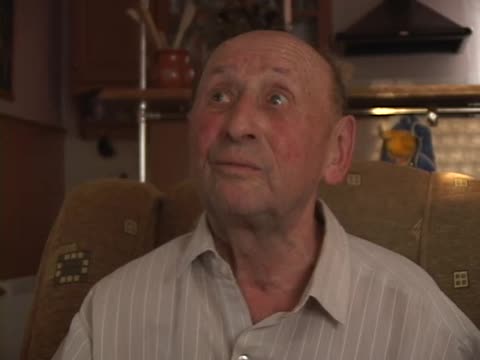
The first part of the tape is a continuation of a formal interview with Moyshe Nayman, recorded in Klyachanovo. Nayman answers a number of dialectological questions from the AHEYM Yiddish questionnaire.
The informant answers dialectological questionnaire items prompted in Russian and Ukrainian-like phrases. They include knowing, being sick or beautiful, liking and disliking, believing in God, a Jew converting to Christianity, the word for non-Jews, hitting, and agreement of the pronoun for "you are right". Katz and Kerler ask for repetitions.
The catalogue says Nayman answers; the transcript shows Katz and Kerler also questioning and a second voice, S3, supplying the prompts.
The second part of the tape consists of the continuation of a formal interview with Hershel Ylyevich Vider, recorded Mukacheve. Vider shows a number of photographs: family, a postcard from the synagogue of Mukacheve, Frume’s (daughter of Haim-Elazar Shapiro) wedding, Mukacheve ghetto, Hebrew school, and Haim-Elazar Shapiro. He then shows several documents and newspapers.
Vider shows photographs and documents. They include a picture connected to the ghetto in Mukacheve, a wedding, a Jewish school class in the 1930s, and a rabbi's funeral. He then shows newspapers and a certificate of merit from a Hasidic or Jewish communal fund. He mentions a person with a telephone number to contact, who knows several languages. The speech is partly garbled.
The transcript shows newspapers and a certificate, and a telephone contact he suggests for the interviewers.
Vider talks about his life after the war, when he returned from the Vorkuta gulag. He explains that initially, he was not allowed to return to Mukacheve, because Vider was told that it did not belong to the Soviet Union then. Vider was sent to Nadvirna. When the war broke out he was sent to prison in Nadvirna, before he was sent further to the Vorkuta gulag. Vider continues that upon arrival in Mukacheve he did not find his parents or relatives and stayed with a friend. He worked several odd jobs before settling for the mineral water facility in Svalyava, where he remained for twenty-three years as chief of a department. He explains that he could not become director of the factory without a party membership.
Vider tells of his return from Vorkuta. He was at first refused entry to Mukacheve and sent to Nadvirna, where he had earlier been in prison. On reaching home he found no parents or relatives and stayed with an acquaintance who had fought in Spain. He took various jobs and worked for twenty-three years at the mineral water factory, but could not become director without a party card. He mentions marrying in 1949 and his late wife. Kerler then asks about words for Romanians and Gypsies.
Besides the return, the transcript shows his marriage and a closing questionnaire detour about ethnic terms.
Vider answers a series of dialectological questions from the AHEYM Yiddish questionnaire. Vider recalls a non-Jewish girl running errands for his family for Sabbath celebrations.
Kerler puts Russian questionnaire items and Vider gives Yiddish equivalents. They cover thanks, the cat and mouse, the belly, stone buildings and masons, sour cabbage, hearing and deafness, kissing, comparatives, near and far, being ill, sleepy, honest and observant, and words for Christians and non-Jews. Vider says a non-Jewish girl carried the Sabbath cholent to the bakery and brought it home. He also gives numbers and the pronoun forms in "you are right", with a story of a rabbi.
The transcript adds a rabbi's anecdote, birth year and numbers.