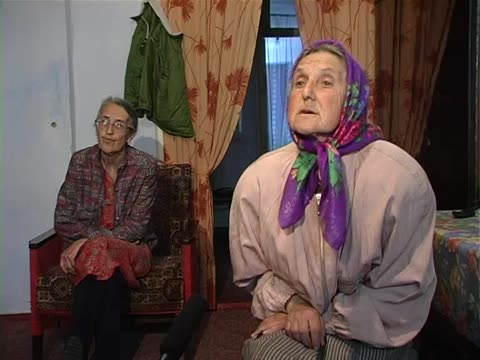
Pasik provides personal information and talks about her family. Her mother was born in the Jewish agricultural colony Efingar, located in the village Plyushchevka, Bashtanka region, Mykolayivsk district. Her father was born in the village Dobre. After Pasik was born, her family moved to the Efingar colony to escape the Great Hunger in 1932/33. They lived there until the outbreak of World War II in 1941.
From the machine transcript
Pasik gives her personal details: born in Mykolayiv in August 1933, with her official Russian name and surname. She says her mother came from a colony in the Bashtanka district and her father from Dobre. The family later lived in the Jewish colony Efingar until the war began.
The transcript includes her official Russian name and birth date, which Kerler asks for.
Pasik talks about her life during World War II. She evacuated eastward, where she spent nearly two years in the Saratov and then another two years in the Stalingrad district. They returned to the village Plyushchevka in 1944. She then talks about her life after the war and her family. Her brother was born after the war and now lives in Israel. Pasik’s brother was six months and her younger sister seven years old when their father died. She explains that the neighbors helped out her family and therefore avoided that the children were given into an orphanage. Her family lived in Plyushchevka until 1965 and then moved to Mykolayiv. Her younger sister and brother got married in Mykolayiv. Her brother immigrated to Israel in the 1970s. Pasik recalls how her brother supported her family by sending money from Israel.
From the machine transcript
Pasik tells of the evacuation to the Saratov and Stalingrad regions and the return to the village, now called Plyushchevka. Her father fell ill and died while her brother was six months old. She says neighbors reassured the family, which stayed together. They moved to Mykolayiv later, her sister and brother married there, and her brother emigrated to Israel and the family sent money to him.
The transcript says the brother is the one in Israel and mentions his children and the cost of his flat; it also gives her sister's age as seven, as the catalogue does.
Pasik talks about her childhood memories in the Efingar agricultural colony and her family. In the village were two kolkhozy, where Ukrainians and Germans lived as well. The name of the kolkhoz her family worked at was called Rakoshe and Molotov was the name of the kolkhoz her maternal uncle worked at. He had a leading position in Molotov. According to Pasik’s mother, there were three active synagogues before Pasik was born. During her childhood, only one synagogue was officially open in both kolkhozy. Non-Jewish students also attended the local Yiddish school.
From the machine transcript
Asked about early childhood, Pasik says she remembers little before the evacuation, when she was seven. She describes the colony as Jewish, with Ukrainians and Germans living there too and two kolkhozy, where her maternal uncle held a leading post. Her mother said there had once been three synagogues and only one remained; Yiddish was the language spoken, and there was a Yiddish school.
The transcript adds the Yiddish-speaking environment and mentions that most of the Jews of the place were killed.
Pasik discusses Jewish holidays and food customs, in particular Passover. She then talks about her family. Pasik’s mother worked on the kolkhoz after the war.
From the machine transcript
Pasik answers Kerler's questions about Jewish holidays before the war: Passover matzo-baking and the seder led by her paternal grandfather, Purim, Shavuot baking, and borscht. She names her grandparents and says she was named after her paternal grandmother. Her mother worked on the kolkhoz, and the family did not work on Saturday or Sunday before the war.
The transcript adds the grandparents' names and a terminology exchange about a Shavuot pastry.
Pasik talks about her life during the war in evacuation. She explains how eleven family members evacuated on a horse and wagon and travelled for three months. They then took the train to Saratov, Russia. Before moving on to the Stalingrad region, her family stayed in Saratov for approximately one year.
From the machine transcript
Pasik describes the evacuation. Eleven relatives travelled by horse-drawn cart for about three months before they took the train to Saratov, stayed about a year, and moved on to Stalingrad.
Pasik talks about her life after the war, when her family returned from evacuation in 1944. Pasik states that mostly men from the kolkhozy were evacuated as part of a mobilization plan and the women who stayed behind were killed. She then talks about contemporary life.
From the machine transcript
Pasik recalls the return home in 1944 after evacuation. She says the kolkhoz men and vehicles were mobilized and evacuated, while the women who stayed in the village were killed. She then talks about present-day life, with the hardships and the transport problems of the village. Kerler and Lemster then ask her about a Yiddish phrase about the evil eye, which she does not know.
The transcript adds a short elicitation about an evil-eye expression, which Pasik does not know.
Pasik discusses her childhood memories and life after the war. Pasik, unlike her siblings, does not have any formal schooling and worked on the 21:40 kolkhoz, which became Russian after the war. Pasik talks about the different kinds of work she did on the kolkhoz and life after retirement, including her family.
From the machine transcript
Pasik talks about her childhood after the war: she did not attend school but worked in the kolkhoz with her mother, while her brother and sister studied. The kolkhoz became Russian after the war. She describes her work and her mother's pension, her siblings Henekh and Beba, her health, and her family today. She says she spoke Yiddish before the war, only with her mother afterwards, and her friends were Russian.
The transcript adds her siblings' names and her family's Yiddish language use, as well as a daughter's stay in Israel.
Pasik discusses prewar cultural life, in particular cinema and theater. She then talks about her family, in particular her uncle, before moving on to contemporary life.
From the machine transcript
Pasik talks about prewar cinema and theater visiting the village from Mykolayiv. She then speaks of her mother's brother Zuska (Hroisman family), who was a driver, married in the 1930s, had a daughter, and was killed in the war. She mentions other relatives who were killed or died, and who still speaks Yiddish in Mykolayiv, and Kerler notes the name and telephone number of a man there.
The transcript adds the uncle's family details, the discussion of who speaks Yiddish today, and a contact name and number.
Pasik talks about religious life on the kolkhoz before the war, including holiday food customs. She also addresses farming life.
From the machine transcript
Pasik describes religious life on the kolkhoz before the war: one synagogue, a rabbi and a ritual slaughterer, the keeping of animals and fowl, and fattening geese. Kerler asks about holiday and Sabbath foods (Hanukkah potato latkes, Sukkot, Simchat Torah, Sabbath dishes, carp). She talks about a mother and grandfather blessing candles, and does not remember the morning prayer.
The transcript adds specific dishes asked about, and a Sabbath and candle-lighting exchange.
Pasik addresses prewar holiday celebrations and remembers how non-Jews spoke Yiddish. She then talks about Jewish life on the kolkhoz and lists towns of Jewish kolkhozy, including Novopoltavka Bereznehuvate, Dobre, and Romanovka.
From the machine transcript
Pasik talks about prewar holidays she remembers little of, and says non-Jews in the colony spoke Yiddish and that there were craftsmen, such as tailors and shoemakers. Yiddish newspapers arrived. She lists other Jewish colonies near Mykolayiv, such as Novopoltavka, Bereznehuvate, Dobre and Romanovka, and Kerler and she discuss the name Efingar and the river. Kerler asks whether theater visited from Mykolayiv.
The transcript adds Kerler's discussion of the colony's name and the nearby river.
Pasik discusses prewar Yiddish culture. She remembers translators at Yiddish theater plays for the Russian-speaking audience. Pasik then talks about prewar religious life on the kolkhoz and mentions traditional weddings, before talking about her family.
From the machine transcript
Pasik says Yiddish theater came from Mykolayiv, with interpreters translating for the Russian-speaking audience. She tells a story from her mother about children refused entry at the river by the beadle, and discusses the cheder and rabbi. She mentions weddings before and after the war and Kerler asks about her mother's death and birth year.
The transcript adds an anecdote told by her mother.
Pasik discusses food and answers questions about cultural terminology.
From the machine transcript
Pasik answers Kerler's questions on terminology, mainly foods and bread: a Yiddish word he asks about that she does not know, festival pancakes, small dough pieces, and bread and baked goods. Kerler also asks about burial and the cemetery, and a blessing wish.
Pasik talks about her life during the war in evacuation. Her family lived on the 52:35 kolkhoz in the Khvalynsk district, Saratov region, Russia, for one year, before moving on to the Stalingrad region.
From the machine transcript
Pasik answers Kerler's question about evacuation: the family went to a kolkhoz in the Saratov region for a year and then to the Stalingrad region. Jews from Bereznehuvate and Romanovka were also there, and they went home after the war.
The transcript adds the Jews from Bereznehuvate and Romanovka who were also in the Stalingrad region.
Pasik talks about Jewish life in Mykolayiv, where she moved to in 1965. Her mother’s father-in-law worked as a kosher butcher in the 1960s. Pasik’s sister mentions how her family acquired matzos after the war. Pasik then discusses faith and her best moments in life. She also addresses contemporary Jewish life and episodes about prewar antisemitism.
From the machine transcript
Pasik talks about the move to Mykolayiv in 1965 (?) and the Jewish life she found there: speaking Yiddish, the synagogue under Soviet pressure and a relative who was a ritual slaughterer. Passover matzo and fasting days are discussed, and she tells of a blood-libel story told by her mother. She says faith is hard after the killings, names her best time as before the war, and compares prices and pension then and now.
The transcript adds her reflection on God after the killings, the question of what it means to be a Jew, and prices under the Soviets.