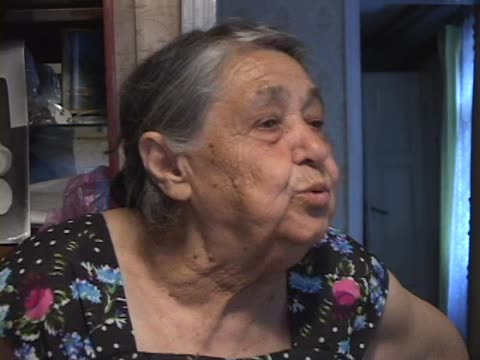
Kerler asks Gvinter dialectological and terminology questions. They cover words for a rich man (gvir), a Hanukkah top (dreydl), paradise after 120 years, and 'then'. Further items are words for a ship, husband/wife, perhaps/probably, planks and fence, Tisha b'Av, a woman's looks, rooms, 'suddenly', 'various things', enemy and curses. Gvinter answers with her own forms, and a few other voices comment.
Kerler asks for anecdotes and sayings from before the war or from older people. They talk about Nukhem, an old Jew from Chechel'nik who wore a sheepskin and bathed in the river in winter. He lived in the synagogue, and the details of the story are only partly clear.
identifies Nukhem as an old man who lived in the synagogue and bathed in winter
Kerler returns to dialectological questions. They cover 'sun' and 'husband', words for non-Jews (narelim (?), 'olam') and for thieves and boasters. Gvinter answers, with occasional comments from others, and Kerler then asks her to sing again.
Gvinter sings two songs at Kerler's request, a winter-days song about travelling and a ghetto/camp setting, and a song about the Jewish cemetery. Kerler asks about words in the first song and about its history, and she says she has forgotten more.
Kerler asks Gvinter what she wants to say to American Jews and to students of Yiddish culture. She wishes that they never know the troubles she has known, that the surviving Jews multiply, and that the younger generation lives in health. The passage ends with her offering food.
Partly garbled conversation at the wooden synagogue in Bershad, with Russian remarks. The speakers seem to discuss the building and Yiddish books found there. The detail is unclear.
Camera footage in which a voice prays at length, in Hebrew-Yiddish with repeated invocations of mercy. This is probably the Hasidic prayer at the grave in Uman'. No interview is in progress.
The team arrives at Vaynshteyn's house in Nemyriv and she greets them outside and invites them in. Kerler explains that they want to record how she speaks Yiddish and what she remembers. She says she learned some Yiddish from her parents. Kerler gives the date and place of the recording.
Vaynshteyn gives personal information: she was born in Dzhurin, about ninety kilometres from Sharhorod, and now lives in Nemyriv. She gives her name, patronymic, address and telephone number, and her birth year, 1935.
Vaynshteyn talks about Dzhurin before the war, a Jewish town smaller than Sharhorod with a Jewish school. She finished seven classes, studied at a technical school and worked in Moldova. She names her father Moshe, a native of Dzhurin, her mother Sara, a housewife from Kryzhopil', and her grandfather Ayzik and grandmother Kheyke. She recalls Simchat Torah with children and the grandfather's morning prayer with tefillin.
Vaynshteyn recalls her childhood in Dzhurin, including Jewish classmates and a mezuzah on the door of the house. Non-Jews speaking Yiddish in Sharhorod are mentioned, and the brothers are discussed, one of them born during the war and the other in Israel. She describes the Sabbath at home, with no heating on Saturday, cooking in the oven on Friday, and her mother baking. Kerler asks the word for challah.