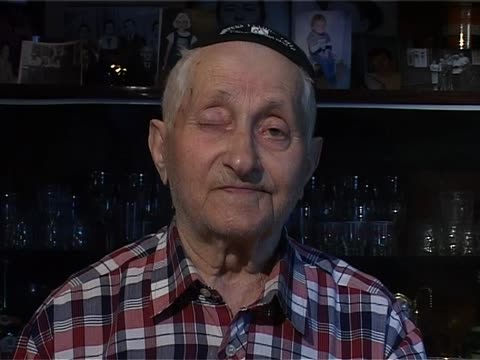
Katz asks Feldman what he remembers of Yom Kippur prayers, especially Kol Nidre, and of services and the synagogue. Feldman recalls a few words and says he can no longer see to read. Katz then asks him to say the rabbis' Kaddish slowly.
Feldman says he has forgotten much of what he once knew by heart in recent years. At Katz's prompting he recites or begins various prayers and blessings, including a morning blessing, parts of the Shemoneh Esrei, and a blessing for the Sabbath. The recitation is mostly unintelligible in the transcript.
Feldman says that until about ten years ago he led the minyan at the Ovruch synagogue, until too few people were left. He describes what happened to the Torah scrolls of the old minyan: one went to the Korosten synagogue and one to Israel. Katz then asks for the Aleinu prayer and passages of the Torah (the opening of Genesis, with the Yiddish for earth, waste and darkness), the haftarah blessings and Simchat Torah. Feldman says he cannot recite the beginning of Genesis without a book.
Adds the fate of the Torah scrolls of the old minyan and Katz's questions on Genesis wording and the haftarah.
Asked about pious non-Hasidic Jews before the war, Feldman says he does not remember, mentions that he lived in Ovruch from 1933, and says there were Hasidim in the area, including Volednicker Hasidim and Chernobyl ones.
Feldman says his father and brother and his grandfather were Hasidim of Skrebelitsh (?). Kerler and Katz ask him what a mitnaged is, whether he remembers Lithuanian Yiddish, and what he knows of Vilna, yeshivas in Volozhin and Minsk, and the Baal Shem Tov and other rebbes. Feldman explains the term baal-shem and mentions a baal shem near Zhytomir, and answers questions about Poland and Slobodka. He has no recollection of shadow-divination.
Adds the mitnaged terminology, discussion of Lithuanian Yiddish and Lithuanian yeshivas, and the baal shem.
Feldman says his father used to visit the Volednicker tzaddik, whose wife Esther Tsiba belonged to his father's family, and Kerler asks about the rebbe's full name. They work out the name Yisroel Dov Ber ben Yosef from what a woman told them. Feldman describes how women from Kotelnya (?) travelled to the rebbe by oxcart.
Adds the rebbe's wife Esther Tsiba and the women's oxcart journeys from Kotelnya.
Feldman discusses the Yiddish and Russian names of Korosten and what kind of town it was, and speaks of the Jews who settled there from the surrounding villages. Katz and Kerler ask for Yiddish forms of local places: Slovechno, Lehin (Luhyny), Veledniki, Narodychi and Norinsk. Feldman says his wife is from Narodychi, where her father was a lumber dealer. Kerler ends by asking about antisemitism before 1917.
Adds the Yiddish place-names and his wife's origin in Narodychi.
Feldman says there was no antisemitism before 1917 and that Petliura's forces killed Jews around 1919–20. He explains that Ovruch was a district town, that Korosten grew to three times its size, and that it was a railway junction. They return to the Yiddish form of the town's name.
Adds Petliura's killings of Jews, the growth of Korosten as a railway junction, and the Yiddish name of Korosten.
Feldman starts the Friday-night Kabbalat Shabbat prayers and says he remembers only a little. He is asked about grace after meals and Sabbath songs (zmires). He says that for about fifteen years there has been no minyan and he has forgotten it. Katz asks which Talmud tractate he studied.
Kerler asks whether Feldman knows a word for a husband leaving his wife and about an abandoned wife (agune). Feldman says he does not know the word and that husbands only used to divorce in his time. Katz then asks about interesting people in the town in his youth.
Feldman names the teachers (melamdim) he studied with in Veledniki, Slovechno and Luhyny, including the sons of rabbis who had studied at the Vilna yeshiva. He names Yosl the rabbi's son and a relative. He also mentions a strange man living near the village. Kerler asks whether being a melamed was honourable, and Katz asks about women healers, who whispered cures and were called babkes (?).
Kerler asks Feldman for kinship terms in Hebrew, such as father, grandfather, grandmother, uncle and aunt. Feldman also says there are many yeshivas in America and Israel. Kerler asks for a story about the Volednicker rebbe.
Feldman says people told stories of the Volednicker rebbe helping the childless and the poor. He describes a Khavner (?) man, a trefer (a seer who could tell you your name and background), who was killed in the war. He recalls that this man, who had come to Ovruch, called him by name in 1933 and later met him at work. Katz and Kerler then begin to ask Feldman about daily life.
Adds the story of the Khavner seer; the passage begins with a story about the rebbe himself.
Feldman compares the economy under Tsar Nicholas, when trade was free, with Soviet times, when state trade took over; he worked in a cooperative. He cannot name a best time in his life and recalls that his father was killed and that the war started for him in 1941 (?). He says he wants to sell his house in Ovruch to move to his daughter and son in Simferopol, and discusses prices. He talks about his second wife, who went to Germany with her children, and Katz suggests another match.
Adds the plan to sell the house and move, his second wife in Germany, and the comparison of tsarist and Soviet trade.
Dialectological questionnaire put by Kerler and Katz. Feldman is asked for the Yiddish for words for animals, birds, body parts, household objects and food, as well as sentences with 'to live', 'to sit' and other verbs. The questions also test grammatical gender and diminutives of table, face, street, house and girl. He also describes what his mother cooked for Sabbath. He was asked Slavic words by the interviewers.