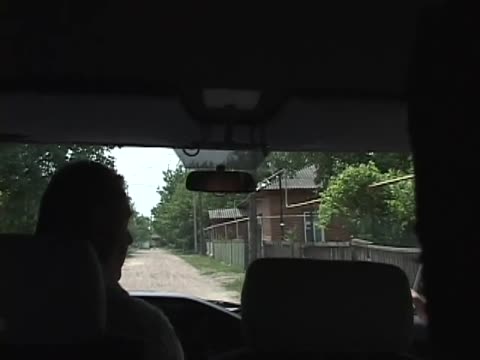
Town footage and conversation in the car while the team looks for the way to the informant's house. They ask passers-by in Russian for Sverdlova street, and other places in town are mentioned.
The team arrives and Turovskaia greets them. Kerler introduces Lemster as a Yiddish writer. There is talk about driving the car into the yard and about something Kerler sent her.
Turovskaia talks about Dovid Katz's earlier visit and about her family. Her father died long ago, and relatives were evacuated. They discuss Jews who are no longer in town, including a man named Feldman and a couple from Slavechno (?). She says her children live in Siberia (Kansk, Krasnoyarsk region) and in Pskov, and mentions her late husband, a veterinarian.
adds her children in Siberia and Pskov and the Jews of the region who have died
Turovskaia says she taught history. Lemster asks which kind, and she answers general history. She then speaks of what she knows of the town's Jews and says she is herself from Veledniki, the home of the holy tzaddik.
Turovskaia asks whether Katz gave Kerler photographs of the Volednicker tzaddik. She tells how her family suffered under the Poles in 1920 and in 1937, and how her father avoided arrest. Her grandmother travelled to a good Jew for a name, and her father was named after the tzaddik Yisroel Dov. Kerler asks about names, and she gives her own Yiddish name as Rochel.
adds the grandmother's trip to a good Jew, her father's naming after the tzaddik and the 1937 arrest
Turovskaia gives her surname and her maiden name Feldman, and says she lived in Veledniki until the war began. She recalls her girlhood years, including playing the violin and joining a dance circle. She attended a Ukrainian school, and the class newspaper was in Ukrainian.
Turovskaia says she finished four grades of Yiddish school and can read and write Yiddish. Her sister in Israel writes to her in Yiddish and Russian. At Lemster's prompting she tells in detail how her father, as a teenager, fell into the hands of bandits, probably from Kobyl'ye, during the Civil War. They cut the owner's fingers for gold, he escaped through a window, and she names the year uncertainly. Other tales follow about his supplying food, and about the grandparents naming him for the tzaddik after a dream. She then turns to a Polish occupation of Ukraine and Cossacks at the door.
adds the Yiddish school and her father's bandit stories
Turovskaia continues the Civil War episode. Cossacks threaten her father with a sabre, and her mother steps between them. She says bandits of every colour plundered, and that 1937 was very hard.
Turovskaia recalls 1937, when her father was taken away. She names her sister Ester and brother Fayvl, who has since died, and says another sister lives in Israel. She stresses that as a child she had to study, do housework and work, and that life was hard.
Kerler asks about the Yiddish school. Turovskaia remembers a teacher named Avrom but not the subjects. Talk turns to a booklet of her father's stories about the tzaddik, which she has prepared for the interviewers. She says the tzaddik knew who came to him and why.
Turovskaia tells stories about the Volednicker tzaddik. As a boy he was made unfit for the tsar's army. He advised that a dream should be interpreted for the good. In another tale a woman with four daughters and a husband who left for Siberia is told to sell bagels, and the money ends up as the daughters' dowry.
Kerler asks about a term for a man leaving his wife, and Turovskaia explains that he abandoned her, and that a convert was involved. She says no get was given. He went to Siberia, traded and later came back, and the tzaddik told her what to do.
Turovskaia tells how a family on a sleigh lost a child, and the tzaddik sent a wolf to find and warm it. She also tells how her father, resting at a house on the Sabbath, met a vicious dog. The dog was possessed by a dybbuk, and the tzaddik told the man how to deal with it. She mentions her friend Roza Kameranits.
Turovskaia talks about her friend Roza, whose father was in the Revolution. Roza was talented and a good speaker, and Turovskaia remembers school events. She tells of Roza's early death and the start of the war, with evacuation. She says she dreams of Roza and says Yizkor for her. She ends with blessings for the interviewers.
Turovskaia explains how she keeps religious customs today. She says Yizkor for her dead relatives and gathers a minyan, with a Torah laid out when ten are not present. On a yahrzeit she lights a lamp and gives money so that Kaddish is said. She mentions saying Yizkor on the second day of Shavuot and dreams of deceased relatives.
Lemster asks whether she makes meat kosher today, and she says no, since her father, a shoykhet, died. She describes how the mother soaked meat and salted it. She then adds a remark about Roza's early death. Kerler asks about the Khapner Trefer.
Turovskaia talks about Leybl the Khapner, called the Trefer or the White. He knew who came to him, predicted that the family would survive and that war would come. When the Germans took Khapne, asked who would win, he told them to bring a white and a red rooster to fight. The red rooster won, which meant a Soviet victory. He died a hard death, and Kerler adds his own doubts about the man.
Turovskaia describes Veledniki before the war: one hundred and twenty-five Jewish families, perhaps half the town's population, a cheerful shtetl that later became a village. There were a synagogue, a beys medresh, a Polish church and a cloister. Relations with Christians were normal.
Turovskaia describes her family. She lived with parents and siblings, and the family dwelling is described. She names her paternal and maternal grandparents and uncles. Several relatives were killed, among them her brother, shot by Germans, and her uncle Yitskhok, taken into the army. A man from Old Veledniki reported him, as she says. Kerler records the names.
adds the family tree, the brother's death and the childhood home
Turovskaia says she blesses candles and recites the blessings and holiday-candle prayers. Kerler asks about morning prayers and a Yiddish prayer after Sabbath. She says she prays in Yiddish, and that at home Yiddish was spoken, while her father knew Hebrew well. She married in 1949 (?).
Turovskaia says she and her husband spoke Yiddish at home but did not teach their children in Siberia. Kerler gives a Yiddish saying about being well everywhere. She goes on to the dishes she keeps for Passover.
Turovskaia describes how she prepares for Passover, with a candle, feather and bread crumbs for searching for chametz, which she burns. She keeps Passover dishes. She explains that she has not bought kosher meat since her father died, so as not to make the dishes treyf.
Lemster asks about tales and songs from her grandmother, and Turovskaia recites a short rhyme heard in school. Kerler asks about Purim. She recalls the megillah, Purim plays, hamantashn baked by her mother, and the family going to synagogue.