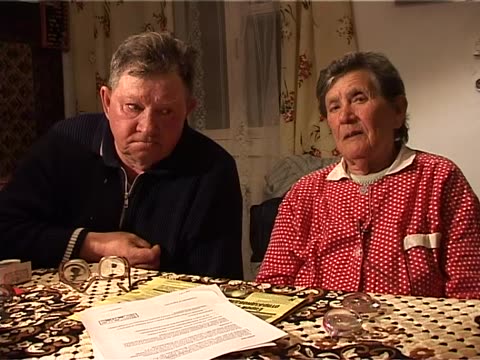
Zak describes how she founded and worked in a library after the war, collecting books from around the town, and getting a small room in a school. She says she spoke Yiddish before the war and afterwards spoke only Russian and Ukrainian at work.
The catalogue entry gives only the library; the transcript also covers the shift from Yiddish to Russian and Ukrainian.
Zak says that many Jews returned to Polonne from evacuation but most of their grandchildren later left, so that only a few remain. She recalls that Peretz Markish visited her school in the ninth class at a New Year's tree celebration. He shook everyone's hand and stayed until the early morning. She later heard that he was killed in 1952. Kerler remarks on the Yiddish spoken in the town.
The transcript is mostly about Markish's visit to her school, not the museum.
Zak tells about her husband, who is Jewish but grew up in a village and does not speak Yiddish. His family lived in Shepetivka before the war and was evacuated to Kazakhstan, where his father was killed at the front and his mother died of hunger. After marriage he worked at a ceramics factory for 36 years. He now has health problems, and his commemorative plaque (?) is mentioned.
Zak describes the mass grave of Jews killed near Polonne, which lies about four kilometres away. After the return from evacuation, Rozmarin (?) organised volunteers to dig a trench around the site, find remains and put up a stone monument. She says he later died in Israel.
Answering Kerler's questions about her early years, Zak says her father worked for a landowner (?) and then in a factory after the revolution. The family lived in an old, dilapidated house, which he rebuilt shortly before the war. He died young. Her mother returned with her to Polonne after the evacuation and lived until 1969.
Zak recalls her poor, hungry childhood, going to school barefoot and ragged, without bread for years, and the famine in the early 1930s. Her sisters and brother went to work, and her brother served in the army. She says that two sisters now live abroad, in Israel and America. She names a childhood friend, Rachel, and says that she spoke Yiddish with the Jewish neighbour. She tells how the town centre was Jewish and the non-Jews lived on the other streets.
Beyond early childhood, the passage covers the famine, her siblings abroad and the Jewish quarter of the town.
Zak says that today's Polonne has hardly any old houses; the town was rebuilt after the war. She says that non-Jewish children understood Yiddish but did not speak it, and that she played with Russian children. She goes on to tell how, at thirteen, she worked at a factory because of the family's poverty, and how her mother made her return to school so that she completed ten classes.
The passage also covers her factory work at thirteen and finishing ten classes.
Zak says her father was observant, put on tefillin and a tallit, and went to a small synagogue for workers. She names seven synagogues in the town before the war and recalls the street named for them. She says the Yiddish school closed in 1938, that the synagogues were closed earlier, and that she attended an anti-religious campaign in school (?). She answers questions put by Kerler and other speakers.
The transcript adds the seven synagogues, the synagogue street and the Yiddish school closing in 1938.
Zak tells how the family left in evacuation: her brother and brother-in-law were sent to the front, and her father did not return. Two sisters died in Polonne, and others are in America and Israel. She mentions her postwar work as an official in an organisation and as a librarian, and that she and her husband now live alone with no family nearby, apart from a relative in Moscow.
Besides the war, it shows her later work, her family abroad and living alone today.
Answering Kerler's questions, Zak recalls her mother blessing the Sabbath candles and crying, and says Jewish holidays were kept in Yiddish in the home. She describes the Sabbath cholent cooked in the oven and the Passover seder, where her brother and father said the four questions. She says she knows many Yiddish songs but is shy about singing.
Kerler asks Zak to sing, and she sings or recites a Yiddish song, though shy. He then asks about Sukkot, Simchat Torah and her father taking her to the synagogue, where wine was given out. She mentions travelling to Khmelnytskyi on Simchat Torah.
Kerler asks about holiday celebrations in earlier years and Hasidic practice, and Zak mentions Khmelnytskyi. The exchange is brief and only partly clear in the transcript.
A photograph is shown, and the other people present discuss it. Kerler asks Zak about the Jewish holidays and their present observance, and about travelling to Khmelnytskyi for Simchat Torah. She recalls her father building a sukkah, what was done and eaten at Hanukkah (latkes and pancakes), and Purim hamantashen with poppy seed, as well as Shavuot blintzes. Some of the details are said not to be remembered.
Zak says her brother worked in the town fire brigade. She describes the 1937 teacher Yosl Freylis, who taught Yiddish literature from the fifth to the tenth class and was taken away in the ninth. She recalls that Markish, Sholem Aleichem and Peretz were taught, and mentions meetings against religion at school.
The transcript names the teacher Freylis and his arrest in 1937.
Zak recites a few lines of a Yiddish song and says she knows many and could sing until midnight. Kerler asks about Pioneer songs and she says she was a Pioneer and Komsomol member. She says there were Yiddish songs in the Yiddish school.
Zak says there were anti-religious posters and propaganda at school. In the 1930s, around 1935, there was less matzo at Passover. Kerler asks her about the library she set up after the war.
Zak says she founded the library in 1945 (?) and that before the war the public library held many Yiddish books as well as Russian ones, which she used. Asked about Hasidim, she mentions one Pasik (?), who slaughtered fowl (?), and that Jews gathered for prayer in private houses with ten or twenty men. She says her husband does not understand Yiddish.
The transcript adds Yiddish books in the library and private prayer houses.
Zak says her husband grew up in a village with Jews, and that Shepetivka is about thirty kilometres from Polonne. Kerler suggests they travel to Shepetivka, and there is a closing exchange of thanks.
Kerler asks about the Yiddish expressions for a good Jew and for a Jew from Lithuania, and about the word misnagid. Zak says there were no Litvaks or other Jews of different speech in Polonne.
Kerler puts questionnaire items about food: gefilte fish versus chopped fish, with Zak describing how she prepares gefilte fish, kugel and babka, and the meaning of a term for fat or broth (?). He asks the Yiddish words for sausage, tomato, plum, cherry, apple and grapes, raisins, and a song is mentioned.
Zak says her brother went to cheder in his first years and later to a state school. Kerler describes a filled pastry made with raisins and nuts, then asks if Zak remembers other Yiddish writers visiting, besides Markish.
Zak says that writers visited the library after the return from evacuation. Before the war there was Yiddish theatre, including Sholem Aleichem plays such as Tevye the Milkman (?). There was a craftsmen's club where actors performed and where she and other young people organised a choir. She says she was too poor to dress for the stage. She agrees to sing.