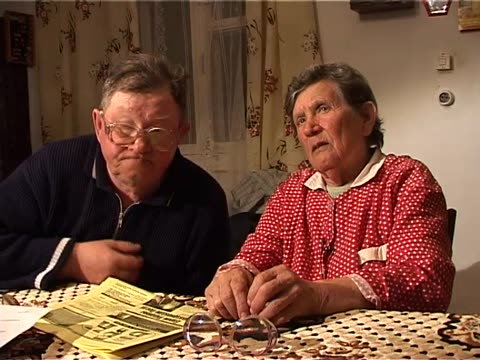
Zak sings a humorous Yiddish song, whose text is only partly clear in the transcript, about a woman. Kerler praises it as a theatre song and then begins to ask her about the club where they used to sing.
Zak names the director of the Yiddish club, Yankl Kuritse (?), and recalls dancing, singing and meeting people there. She recalls Jewish weddings before the war, when the bride was led to the synagogue and a canopy was set up, though she was still a child. She says her sister had a Jewish wedding with a canopy in the house after the war, and answers Kerler's questions about music at weddings. Kerler also asks whether she knows a badkhn, folk remedies, a saying about three women on a stone, and the word dibbuk.
The catalogue sentence does not mention the questions about the badkhn, folk remedies and the dibbuk.
Dialectological questionnaire. Kerler asks Zak about words for a holy place, a non-Jewish cemetery, a Jewish cemetery and a golem, then for greetings and polite phrases (good evening, good morning, please, congratulations, thank you), using Russian prompts. He goes on to adverbs and adjectives (late, earlier, cold, high, fast, near), the verbs build, run away, cross oneself, and sour-sweet, 'the head aches', and the difference between rov and rebbe. The passage closes with her mention of earlier interviews she gave.
Zak says she has been interviewed twice, once in Polonne and once with photographs, by a woman from Moscow, in Russian rather than Yiddish. Kerler remarks that Russian is a fine language but that they are interested in Yiddish.
A long continuation of the dialectological questionnaire. Kerler asks Zak for words for household things (bed, window pane, porch, the animals mouse and pigeon), kinship terms (mother, father, grandmother), numbers, dates, 'wine' and 'vodka', and words for taste. He also asks for sentences to translate (about a crying child, living on a street where only Jews live, hearing, being right, whose child this is), words for suddenly, back and again, and the verb to pray. He asks about Passover food after the seder and about the rich, a row and a wagon. In between, Zak remarks on how her Yiddish was laughed at when she worked elsewhere. At the end Kerler asks her to sing one more song.
In the car, in Russian with some Yiddish, the man the catalogue names as Bentsianov and Kerler discuss how many Jews are left in Ukraine according to the census and whether Yiddish speakers are likely to be found. They also discuss visiting the cemetery of Yankev Yosef and filming a short film on Markish, with the old houses and former synagogue of Polonne passing by.
At the Peretz Markish museum in Polonne, S2 (the catalogue's Bentsianov) guides the team and talks mostly in Russian about Markish's life, with Kerler putting in a few comments. He covers Markish's birth in Polonne, cheder, singing in the synagogue, early jobs, his move to Yekaterinoslav, the Polish and Paris period, Palestine in 1923 and his return to Kharkiv and Moscow. He also mentions Markish's family, with pictures of the parents and siblings, his children Olga and Shimon, and his wife Esther. He describes the museum's collection of photographs and books. Zak is hardly heard in this passage.
The catalogue sentence does not mention Markish's later career, family or the museum's collection.