0:00
This tape begins with a continuation of a formal interview with Moisei Zelmanovich Fish.
The division was proposed from the catalogue's descriptions and the machine transcript, not stated by the catalogue (how).
This tape begins with a continuation of a formal interview with Moisei Zelmanovich Fish.
The sound turns on. Fish describes old photographs of his family.
A speaker, probably Fish, identifies old family photographs for Kerler. The photographs show his father, mother, sisters, a brother and nieces. They were taken in Rivne in the late 1920s (?). Kerler then says he will see all the medals, and Fish is asked to change his jacket.
Names several relatives and says the photograph was taken in Rivne.
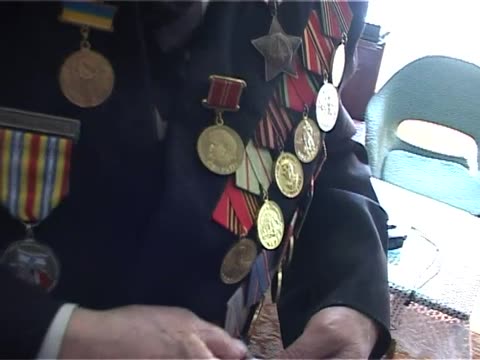
Fish changes his jacket to display and explain his many medals.
Fish, in Russian and Yiddish, names and explains his medals and orders. They include the Order of Glory, a Ukrainian order, the Zhukov medal, a medal for the defence of Stalingrad and a victory medal. Kerler comments on a long-service award.
Medals are named one by one in Russian.
The camera then cuts to a formal interview with Zorekh Motelevich Kurliandchik, who was born in 1924 in Novohrad-Volyns’kyy (Yiddish: Zvil; Polish: Zviagel’).
Kurliandchik is introduced as a man from Novohrad-Volyns'kyy. Kerler asks about the old name of the town, which Kurliandchik gives as Zviagel and the Yiddish Zvil, and about its location and former province (Volhynia). Kerler states the date and place of the recording. Kurliandchik gives his name, patronymic and official name, says his family came from Courland, and gives his address in Rivne, postal index and telephone number. Kerler ends by asking his birth year.
Covers the town's old names, the interviewee's surname origin and his address.
Kurliandchik’s father, Motl ben Zorekh, was born in 1886 in Novohrad-Volyns’kyy and died in 1933 during the Great Famine. He worked as a Yiddish language teacher and a bookkeeper.
Kurliandchik was born in 1924 in Novohrad-Volyns'kyy. He gives his father's name as Motl, born in 1886 (?) in the same town. His father died young in 1933 on a journey, while trying to save the family from hunger. He had been a Yiddish language teacher in a Yiddish school and later a bookkeeper in an artel.
Says the father died en route while seeking food.
Kurliandchik completed ten grades of Yiddish school in Novohrad-Volyns’kyy. There were two such schools in the town.
Kurliandchik says there were two Yiddish schools in Novohrad-Volyns'kyy and that he finished ten grades of Yiddish school before the war. He does not know which school his father taught in.
His mother, Ruse Shlayen, was born in the village of Rogachëv in 1886. She was a housewife and took care of Kurliandchik and his three siblings: Boris, Basya and Yoylik.
Kurliandchik gives his mother's name as Ruse and her maiden family name as Shlayen (?). She was born in Rogachov, a small town or village near Novohrad-Volyns'kyy, and was a housewife. Kerler remarks on the Belarusian Rogachov. Kurliandchik names his siblings: an elder brother Berl (Boris), a sister Basya, and a brother Yoylik, with himself the youngest.
Gives the siblings' Yiddish and Russian names.
Zorekh graduated from Yiddish School No. 1 in 1941. Yiddish School No. 2 was converted into a Russian-language school, he reports, because Jews wanted to send their children to Ukrainian/Russian-language schools. All his siblings studied to some extent in the Yiddish school. His sister worked as a telephone operator and his middle brother worked as a bookkeeper until they were both drafted into the army.
Kurliandchik recalls attending Yiddish School No. 1 in Novohrad-Volyns'kyy until 1941. The other Yiddish school became a Russian school, which he blames on Jews who sent their children to Russian or Ukrainian schools. After his father's death his eldest brother returned to run the household. His sister was a telephone operator and his other brother a bookkeeper until called up in 1940. All the siblings studied in Yiddish schools.
Includes the siblings' occupations and the eldest brother's technical job.
When his father died, he was the only one able to say kadish, because his other siblings were members of the Komsomol (Communist Youth League). His mother would not allow him to join the Komsomol, specifically so he could go to synagogue on his father’s yortsayt [anniversary of death] every year to say kadish and he followed her orders.
Kurliandchik says he alone said kaddish for his father, because his older siblings were in the Komsomol. His mother told him not to join, so that he could go to synagogue for the yortsayt every year, and he obeyed. Kerler asks whether his brother's wedding just before the war had a huppah; it did not, and the family then evacuated.
Includes the brother's pre-war civil wedding without a huppah.
Kurliandchik then tells the interviewers about his wartime experiences. Along with his mother, and his older brother’s family, he was evacuated to Central Asia, where he worked on a kolkhoz [collective farm] and then in a sugar factory. He was drafted in 1942, attained the rank of sub-lieutenant while still in Uzbekistan and sent to the front in 1943.
Kurliandchik tells of the war years. He was evacuated with his mother and his brother's family, first to the Voroshilovgrad region and then to Central Asia, where he worked on a kolkhoz and in a sugar factory. His mother died in evacuation. He was drafted in 1942, trained at an officer school near Tashkent and sent to the front in 1943. Wounded twice, he spent months in hospitals including Baku, and ended the war as a senior lieutenant in Austria.
Adds the mother's death in evacuation, the two wounds and the route through the Balkans to Graz.
After the war, he returned to Novohrad-Volyns’kyy, where he found his eldest brother and his family; his other brother was killed during the war in Crimea in 1942.
After the war Kurliandchik returned to Novohrad-Volyns'kyy and found his eldest brother's family back from evacuation. His second brother was killed in Crimea in 1942, after being in Azerbaijan and Iran. Kerler then says he will return to Kurliandchik's childhood and ask whether his parents arranged Jewish teaching for him.
Kurliandchik returns to the pre-war period and briefly discusses his limited religious education, which consisted of learning how to put on phylacteries at age thirteen.
Kurliandchik says he had no melamed and went to a Soviet school. His mother wanted him to begin putting on tefillin, and a teacher taught him a little before his bar mitzvah at thirteen. He did not learn the Shema or much else. The school then taught Yiddish writers such as Sholem Aleichem, Peretz, Mendele and Bialik.
Names the Yiddish classics read in school.
In the Soviet Yiddish school, Kurliandchik read authors such as: Sholem Aleichem, Y. L. Perets, Mendele Mokher Sforim, Bialik, Dinezon, Goldfaden, Bergelson, Fefer, Markish, Hofshteyn. He also learned Russian and Ukrainian language and literature and took science and math classes in Yiddish. His subsequent professional and personal life, however, was lived in Russian and Ukrainian.
Kurliandchik discusses what the Yiddish school taught: Yiddish classics (Dinezon, Goldfaden) and Soviet Yiddish writers such as Fefer, Dovid Hofshteyn and Markish. Russian and Ukrainian language and literature were also taught, with science and mathematics in Yiddish. He says he now remembers little Yiddish poetry and recites some Pushkin in Russian. After the war his working life was in Russian, with little Ukrainian. Kerler pushes him to recall what he can.
Includes the Russian recitation and the language of his postwar working life.
Kurliandchik remembers the 1937 visit of Perets Markish to his town and visits from the Kyiv Yiddish theater, which performed plays such as: Shulamis, Koldunye, Hershele, Der Karger.
Asked about visits of Yiddish writers, Kurliandchik recalls Perets Markish visiting in about 1937. He also remembers Yiddish theatre from Kyiv coming to the town and names several plays, including Shulamis, Koldunye, Hershele and Der Karger.
He then sings a fragment from a song in Koldunye.
Kurliandchik sings a short fragment from a song in the play Koldunye, in Yiddish. Kerler then says he is from Poland and speaks of the few Jews who live there.
Kurliandchik lived in Chernivtsi for forty years, a city where one heard Yiddish in the streets, but spoke Russian at work. In this city there was a Yiddish theater until 1952, where Sidi Tal’ performed as well as others such as Nehama Lifshitsaite and Zinovi Shul’man.
Kurliandchik says he lived for about forty years in Chernivtsi. There Jews met and spoke Yiddish in the street, though Russian was used at work. A Yiddish theater operated there until the early 1950s, and he mentions performers from the philharmonic including Sidi Tal and Goldman. Kerler also asks about Nehama Lifshitsaite, Zinovi Shul'man and Misha Aleksandrovich, and Kurliandchik says he has heard of them.
Describes Yiddish speech in Chernivtsi's streets versus Russian at work.
After the war, Kurliandchik lived for 1.5 years in Novohrad-Volyns’kyy. He met his wife Hasia in Chernivtsi. He then talks about his children, who live in Ukraine and Israel.
After the war Kurliandchik lived for about a year and a half in Novohrad-Volyns'kyy. He met his wife, Khase, in Chernivtsi after returning from Austria; she came from elsewhere. He has two children; his daughter, a graduate, lives in Rivne and married a Russian. His son emigrated to Israel in 1990 (?). He has four grandchildren, two in Ukraine and two in Israel, one of whom was in the army.
Gives the wife's name and background and the grandchildren in Israel.
On shabes, his mother would light candles and his father would go to synagogue. Kurliandchik’s grandfather was a rich merchant as he sold Judaica and other ritual objects. Kurliandchik’s older brother learned in a kheyder and knew Hebrew well.
Kurliandchik answers Kerler's questions about the holidays and the Sabbath. His mother lit candles, his father went to synagogue, and as a boy he carried his father's tallis. His grandfather, a rich merchant with eight children, ran a shop selling tallitot, tefillin and prayer books. His older brother Berl studied in a kheyder and knew Hebrew well. Berl emigrated to Israel, lived in Ashkelon, and died in 1983 (?). Berl's family includes daughters in America, and Kurliandchik visited Israel and Berl's grave.
Adds the brother Berl's emigration, death and family in America.
Kurliandchik briefly describes the Jewish holidays and how they were celebrated in his youth. His family baked their own matzah for Passover, and he recalls Passover celebrations in Novohrad-Volyns’kyy even after the war.
Kurliandchik briefly describes the holidays at home in his youth, including Sukkot and the sukkah, Rosh Hashanah, Yom Kippur and Simchat Torah. Kerler asks how Sukkot was pronounced. Passover was kept, and the family baked its own matzah, with people gathering for it. After the war older people still came together, and a shul in Novohrad-Volyns'kyy was closed.
Adds Kerler's question on the pronunciation of Sukkot.
According to Kurliandchik, the synagogues in Novohrad-Volyns’kyy were all closed in 1934. After that, a minyen (minyan) would come together in a private home on shabes (the Sabbath). A synagogue was briefly re-established in the town after the war.
Kurliandchik says Novohrad-Volyns'kyy had a large synagogue and about ten small ones, all closed in 1934. After that older men gathered for a minyan on Sabbath in a large private house, whose owner he remembers. Kerler adds that in the 1960s communities needed twenty married men to get permission to hold services. After the war a synagogue was set up again in the town.
Adds the closure year, the private minyan, and the postwar reopening.