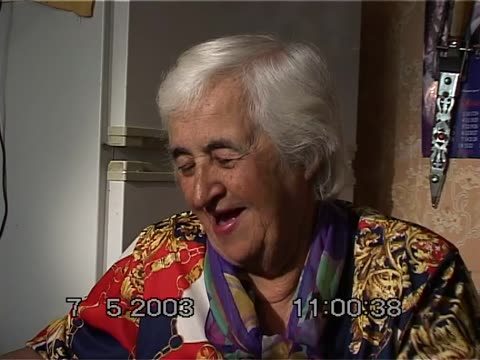
This tape consists of a formal interview with Sonia (Sure) Shevelevna Litvak. She begins the interview telling of a recent visit by a Chabad Rabbi and his wife.
From the machine transcript
Opening of the interview. Kerler sets up the microphone and explains the consent papers and his own work as a Yiddish researcher. Litvak says she mostly spoke Russian with her husband. She tells of a Chabad rabbi and his wife (named something like Shmilek and Sterna, unclear) who stayed with her one Rosh Hashanah and with whom she was photographed. She offers their address in America or Israel, and Kerler asks which name the town had, Zvil or Novohrad-Volynskyy.
Most of the passage is consent paperwork and microphone setup, and the rabbi couple's names and origin are unclear.
Before the war, Novohrad-Volyns’kyy, the town were Litvak was born in 1925, was mostly Jewish; she remembers only one non-Jew who lived on her street growing up. The town had two Yiddish schools that were both closed around 1937, one having been converted to a Russian-language school.
From the machine transcript
Litvak explains that the town was called Zvil and later Novohrad-Volynskyy, once a small town and now a city. Before the war the Jews lived in the town and non-Jews around it; her street was Jewish, with a single non-Jew on it. Two Yiddish schools, the first and the fifth, were closed, apparently in 1937, and one turned to Russian. Kerler then asks her to give her personal data.
Adds the town's earlier name Zvil and the mixed non-Jewish surroundings; the closure year is only roughly heard.
Litvak speaks about life before the war, focusing on the hardships of the 1933 famine, during which her brother Leybl was born. She also recalls swimming in the river in the summertime.
From the machine transcript
Litvak gives her name, patronymic and Rivne address and phone number, and says she was born in Zvil, which people called Novohrad-Volynskyy in speech. She recalls the river near her house, the very hard years of the 1933 famine when people died of hunger and her brother Leybl was born, and swimming in the river as children.
Adds her address and phone details, the street renaming, and the river memories.
Litvak gives a detailed description of her education in Soviet Yiddish schools, recalling the names of teachers and the interesting subjects she learned, including world history, geography, algebra, math, and Russian. In her Yiddish language and literature class, she read many stories by Sholem Aleichem, whose characters were referenced in everyday language.
From the machine transcript
Litvak describes her Yiddish school, the first school. She names Friedman as her history teacher and Novak as her Yiddish language and literature teacher, and lists the subjects: geography, history, algebra and mathematics, mostly taught in Russian, with no German. She recalls reading Sholem Aleichem, including Mendele-like characters and the story of Motl Peyse the cantor's son. She says she has Sholem Aleichem's works in Russian and some in Yiddish. Some of her words suggest she also reads Hebrew.
Adds Sholem Aleichem's works that she read and owns, and the remark on Hebrew.
Litvak still has many books in Yiddish, even though her husband did not speak Yiddish. She spoke Yiddish with her first son (b. 1950), who, she claims, has “not a drop of goyish in him”. He observes shabes (the Sabbath) and cares about Israel; “he has a Jewish heart".
From the machine transcript
Litvak says she has many Yiddish books though her husband, an officer, knew no Yiddish. She speaks of her two sons, born in the early 1950s, one living with her and one in Dnipropetrovsk. The elder son wanted to learn Yiddish and she tells of using it with him as a child. She says he keeps the Sabbath, is attached to Israel and has a Jewish heart. Kerler then returns to the family data.
The catalogue's birth year for the first son is not confirmed by the transcript; the dates heard there are unclear and inconsistent.
Her father, Sheylik, was born in Novohrad-Volyns’kyy. He used to say that their family originally came from Spain and then to Lithuania. Litvak’s paternal grandfather, Yerikhem, was also born in Novohrad-Volyns’kyy.
From the machine transcript
Litvak gives her father's name, Shilek, and her grandfather's, Yerikhem, both born in Zvil. She recounts a family tradition of coming from Lithuania, with ancestors expelled from Spain, and says the local rabbi and his wife tell her she speaks like a Litvak. Her father also told stories of the Civil War years.
Adds the remark that the local rabbi and wife hear a Lithuanian Yiddish in her speech.
Her father used to tell a story about the Russian Civil War in 1918: A soldier in Deniken’s army grabbed him by the river and tried to kill him, but another non-Jew intervened and saved his life.
From the machine transcript
This very short stretch holds one remark in the transcript: Litvak's father was a hatter (kirshner). The catalogue's civil-war story about him is not visible in the transcript.
The transcript shows only his trade, with nothing of the Deniken story.
Litvak’s father worked as a hat-maker and was sometimes paid in salt during the years of poverty.
From the machine transcript
Litvak says her father made hats and recalls that in the poor years he was paid in salt. Her mother, afraid, went alone to collect it and was told to take only what she could carry. People gave whatever they could. The family survived the famine when others died.
Litvak’s family survived the famine intact because they were able to hold onto her grandmother’s savings from her work as folk-healer despite harassment by White Army soldiers during the Civil War.
From the machine transcript
Litvak says her grandmother was a midwife and healer whose earnings helped the whole family through the hunger. She recounts the story of a White Army soldier who tried to take a felt cloak and beat the grandmother, who died two days later. This was the time of the pogroms, in 1918 (?). Kerler asks about the dates.
The grandmother's death after a beating is told, and the soldier is not necessarily from the White Army.
Before the war, Litvak’s aunt moved to America, from where she would send the family five dollars a month. Litvak’s mother cut off communication, however, as new Soviet laws made this a dangerous activity. Litvak recalls how her mother had to sell her silver Passover dishes for oil and grains.
From the machine transcript
Litvak says her mother's sister went to America and sent money each month, but the mother stopped corresponding out of fear. She recalls her mother selling the family's silver Passover dishes and jewelry for flour and groats, and the mother's prayers every evening. They baked matzah secretly at night with two other families. A brief exchange on a grain term follows.
Adds the exchange about the food term and the mother's evening prayers.
Litvak remembers how, when she was 14 years old, her family together with two other families would bake matzah for Passover in secret at night.
From the machine transcript
Litvak says she was about fourteen, in seventh grade, when the family secretly baked matzah. Kerler then asks about her grandfather Yerikhem's occupation.
Litvak then describes the professions of her grandfather, father and brother who worked in a tannery, as a hat-maker and as a tailor respectively. Her mother was named Leyke and her maternal grandparents were Leybl and Etl the folkhealer. Her paternal grandmother, Malke, was killed during the war in the town of Romaniv along with many other family members. Her siblings were: Etl, Nume, Dvoyre (who died at four years old during the Famine), and Leybe (Leybl). She notes that this was not a big family for that time. Her mother worked occasionally, as a freelance seamstress, which was illegal under Soviet law.
From the machine transcript
Litvak describes the trades of her grandfather, who worked in leather with several workers and had many children, her father the hatter and her brother the tailor, now in Netanya. She names her mother Leyke, her maternal grandparents Leybl and Etl, her paternal grandmother Malke, killed in Romaniv, and her siblings, among them Dvoyre who died in the famine. She says her family was not large for those days. Her mother sewed privately, which the authorities forbade, and was caught once.
Adds the brother's later life in Netanya and some of the dates of the parents.
In the post-war period, Litvak worked in various kindergartens as curricular administrator, and was also employed in a textile factory for some time. She also details her contemporary economic troubles.
From the machine transcript
Litvak says she worked as a kindergarten teacher and later in a textile knitwear factory, after living in Germany. She explains her husband's pension as an officer and her own small pension. She describes today's economic hardship, high rents and costly medicines, and says only the Hesed keeps her from hunger. She mentions her brother in Israel and her son, an ecological engineer. Kerler suggests returning to school.
Adds her Germany years and her son's work as an ecological engineer.
Litvak then returns to the topics of the Soviet Yiddish schools. She states that the students read more Russian than Yiddish literature, but they did study writers such as Y. L. Perets and Mendele Mokher Sforim.
From the machine transcript
Answering Kerler's questions, Litvak says she remembers little Yiddish literature from school. She names Peretz and the story of the pious cat, and Mendele, whose Hebrew words she found hard. She adds that school favored Russian writers and poets and that Yiddish literature and language came only twice a week. She says she reads Yiddish books and the Lekhayim paper. She mentions a visit to Chisinau and an acquaintance with Berman, and cannot recall the Yiddish term for exercises.
Adds the pious cat story, her Yiddish reading today, and the failed attempts to recall the term for exercises.
Litvak then tells a story about how she was sick after she had given birth to her first son, and she could only speak in Yiddish, even though her husband did not understand her.
From the machine transcript
Litvak says she can count and remember only in Yiddish. She recalls that after her son's birth she was ill with a high fever and could speak only Yiddish, though her husband, who knew no Yiddish, did not understand her.