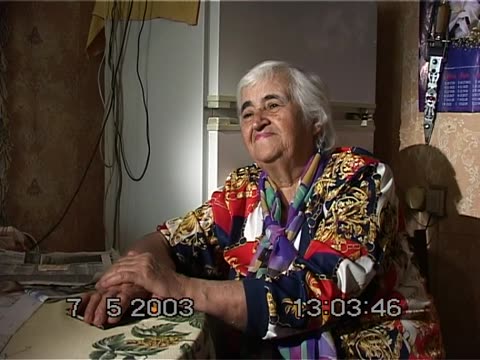
This tape begins with a continuation of a formal interview with Sonia Shevelevna Litvak. The conversation begins with a discussion about how to make fludn and its differences with shtrudl (different pastries).
Kerler asks Litvak about a baked item, fludn, and she describes a dough with butter, eggs and sugar, with filling, that is cooked in the oven. She and Kerler sort out whether she means strudel, which has layers, or a filled pastry. Kerler then moves to folk remedies and charms.
Kerler also mentions a gift of a bag and Bershad (?) in passing.
Litvak shares the phrases one says when one mentions a loved one who has passed away. Litvak never learned folk remedies from her mother, but she does remember fragments of some of these spells, cures and charms.
Litvak recalls her mother, who died young in Stalinabad, and gives the sayings used for a dead person. She also gives a plea to God learned at home. She did not learn cures from her mother. Asked about folk remedies, she mentions cupping and recalls hearing an incantation against illness, and begins to recite a rhyme about three women.
Gives her mother's death at about 42 in Stalinabad and a saying learned at home.
Litvak recites a version of the rhymed charm about three women sitting on a stone. She then tries to explain how a skin rash (a rose) was treated, with a red cloth, a candle or cotton wool and walking it around, but says she has forgotten the words. Kerler comments that such things are disappearing and then asks about singing.
Litvak loved to sing and dance in her youth, and fondly remembers participating in a Ukrainian-language theater production in her young years. Litvak now sings in the Jewish Choir set up by Hesed (Jewish communal organization), but complains that the other participants are all non-Jewish women.
Litvak recalls that she loved singing and dancing, and took part as a child in a Ukrainian-language play. She now sings in the Jewish choir of the Hesed, and complains that the other singers are non-Jewish women who do not know Yiddish. Kerler asks why they come and she says they have to.
Asked about the Yiddish choir in her school, Litvak recalls a Soviet Yiddish song addressed to a coat or kaftan. She says she has forgotten the beginning. Kerler asks where it comes from, and they talk about Bessarabia and about remembering versus reading songs from writing. She goes on to start a text about a teacher, a melamed, in a cheder.
Kerler comments that her songs sound like literary or theatrical material, and asks about Soviet Yiddish songs such as Dzhankoye. Litvak answers in Russian with a song about a man called Pinya (the Russian lyric is partly rendered by the recogniser).
Litvak continues the Russian-language song about Pinya. She says it is about a Jew and was shown on film, though she doesn't recall the film. Kerler asks about a Jewish song that mentions Sevastopol.
Identifies the song as from a film but not Yiddish.
Kerler tries to get Litvak to recall Dzhankoye and other Soviet-era songs. She says she doesn't remember them, and he then moves on to Yiddish theater before the war.
Litvak recalls going to see a production of Goldfaden’s Koldunye as a child, staged by a visiting troupe from Kyiv. She sings songs from this play as well as a rendition of Tum Balalaika.
Litvak recalls seeing Goldfaden's Koldunye two or three times as a child of about ten or twelve, when a theater came to Novohrad-Volynskyi from Kyiv. She recites lines of the witch's dialogue with the girl and sings songs from the play, including Tumbalalaika.
Litvak sings a children's or folk song, Lomir zikh iberbetn, with its verses about the window, the door and the samovar. Kerler adds another variant of the lines. He then asks what a dybbuk is and whether she saw the Yiddish film.
Also covers the word dybbuk and the film Der dibek.
Kerler begins his sociolinguistic questionnaire. Litvak says the Yiddish film Der dibek was not shown there, and recalls a song about a Jewish fiddler. The two then discuss words for tree and small tree and for cooking oil, the cross, and the idiom about a tzadik in felt. She also explains what going to slaughter means for people and for animals. She talks about the shoykhet and kosher meat, and about her mother, who would not eat meat unless a non-Jew made it kosher.
Covers the word for a tree, the cross, and the idiom about going to slaughter.
Litvak describes the kosher butchers' shop by the market in her town before the war. Several men slaughtered all day, and everyone came before the Sabbath. Kerler then turns to his next group of questions, in which he gives Russian sentences to translate.
Kerler puts Russian words and sentences for her to translate into the Yiddish of her parents' generation: polite requests, thanks, greetings, late, earlier, river, rich, cold and others. They discuss which forms are homely and which come from school or from writing. Litvak says she speaks like Sholem Aleichem and also mentions Belarusian speech. They also discuss the hun and the hin (hen) and the Litvak forms, and how Yiddish may be lost.
Covers Litvak speech, school-taught Yiddish and Sholem Aleichem's language.
Litvak shares her experiences about contemporary Jewish politics in the community, describing in the detail conflicts that arose around her teaching Yiddish. She also expresses her love for the language.
Litvak describes how she teaches Yiddish in the community with a conversational book and a grammar. Her classes met with objections: she was told to take only classes of at least twelve people, who would pay, or stop, and she said she took no money. She says she loves Yiddish as her mother's language. She also complains of Jews, one whose mother spoke Yiddish, who do not love it. Kerler comments on this, and asks whether Hebrew is taught.
Gives the Yiddish class dispute and Hebrew classes.
Kerler continues the questionnaire. He asks for near and nearer, how and where, listen to me, very ill, and very beautiful, plus expressions such as a kapore (atonement) for someone, and the words for convert, Christian, a non-Jew and a peasant. Words he asks about include terms for collective farm, the Russian words for Jew, the verb for building, and sour. Litvak gives forms, and also recalls the curse about falling into Jewish mouths and gentile hands, and comments on how Jews got along before the war. The passage ends with Russian-to-Yiddish prompts for numbers, the road, bed, young and honest, and forms of all people and pious.