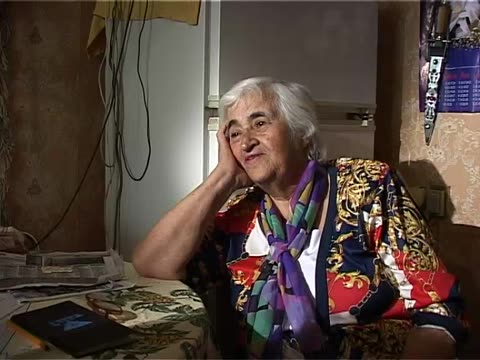
This tape begins in the middle of a formal interview with Sonia Shevelevna Litvak. It starts in the midst of the researchers asking questions from Professor Kerler’s linguistic survey.
From the machine transcript
Litvak answers dialect-questionnaire items from Kerler: words for belly, mouse, pigeon, broth, groats, deaf, blue and well, with discussion of which forms she heard from her parents. Kerler closes by asking to see her Yiddish books.
Names the specific dialect items asked, including the pronunciation variants discussed.
The camera then cuts to Litvak’s kitchen, where she explains how to use some of her mother’s old Passover cooking implements and shares some of her recipes.
From the machine transcript
Litvak describes how her mother made Passover dumplings from matzo and eggs and potato-starch dumplings, with Kerler commenting. She explains the quantities and method of the recipes.
Gives the recipes (matzo dumplings, potato-starch dumplings) rather than the implements.
The researchers then examine Litvak’s collection of old Yiddish books, consisting mostly of Soviet imprints.
From the machine transcript
Kerler looks through Litvak's Yiddish books and comments on editions, including Soviet printings from the 1940s, classics such as Sholem Aleichem, Peretz and Mendele, and a Polish-Yiddish author he knew. The recording is garbled and part of the talk is hard to follow.
The camera cuts to a formal interview with Itskhak (Itsik) Pinhasovich Shteingart (b. 1922 in Kovel’, then in Poland).
From the machine transcript
The tape moves to Shteingart. Kerler gives the date (7 May 2003 is stated, though the informant says otherwise) and asks him for his name, Russian patronymic and Rivne address and telephone number in Yiddish. Kerler also asks how Kovel' was said in Yiddish.
Shteingart shares basic biographic information about himself and his immediate family. His father, Pinkhes, worked as a teacher of Yiddish and Hebrew in a private Yiddish-language school. His mother, Khane, was a balebuste (home-maker) who raised Itsik and his three sisters: Liza, Sonia, and Brukhe.
From the machine transcript
Shteingart gives personal information: he was born in Kovel' in 1922 and lived there until the war. His father Pinkhes, born in Brest, taught in a private Yiddish school; his mother Khane, also from Brest, was a homemaker. He had three sisters, Liza, Sonia and Brukhe, and was the youngest.
Shteingart shares his memories of life in pre-war Kovel’. From the age of three to eight years old, Shteingart learned in kheyder (religious school for boys), where he remembers studying prayer and khimesh mit rashi (Torah with commentary from Rashi). Shteingart still has a siddur and phylacteries in his apartment, which he uses to pray every day. He would go to the synagogue in Rivne.
From the machine transcript
Shteingart recalls his prewar Kovel' childhood: he lived on a street near the railway station, with many Jews and about ten prayer houses and a great synagogue. He attended cheder from age three for six years, studying Humash with Rashi and prayers, and still has a siddur and tefillin and prays daily. He then did not study for a long time and began working in a pharmacy.
Shteingart learned in a Talmud Torah for 6-7 years after kheyder and then worked in a pharmacy.
From the machine transcript
Shteingart says he worked in a pharmacy warehouse from about age ten to twelve and attended a Talmud Torah for about six or seven years after cheder; he also recalls a state school next to the gymnasium. He talks about his sisters: one married, one left to study, and one stayed, and the family home was large.
Adds work at the pharmacy and the state school next to the gymnasium.
Shteingart describes his father's work, and how he learned how to read Yiddish at home from his father. He then continues with his description of pre-war Kovel’, a town with many non-Jews, Poles and Ukrainians, who spoke Yiddish. Shteingart also remembers the town’s various churches.
From the machine transcript
Shteingart says his father taught Yiddish and Hebrew in a private Yiddish school and taught him to read Yiddish at home. He describes Kovel' with its market, mixed streets of Jews and non-Jews, friendly relations and Ukrainian and Polish neighbours who spoke Yiddish, and mentions the large church destroyed by the Germans and an Orthodox church.
Shteingart shares his memories of Kovel’’s Great Synagogue, relating how women prayed on the balcony and how famous cantors came to the synagogue.
From the machine transcript
Shteingart describes the great synagogue of Kovel': women prayed in the gallery, the cantor stood at the lectern and cantors such as Kusevitzky visited. Kerler asks about his bar mitzvah, and the talk then turns to children's games and to cholent as a Sabbath dish.
There were many youth groups in Kovel’ according to Shteingart. Although he did not participate in them, his sisters did and he remembers how Liza was a “farbrente” (“ardent”) Zionist.
From the machine transcript
Shteingart says he did not take part in the youth clubs in Kovel', but his sister Liza was an ardent Zionist, in Hashomer Hatzair (?). Kerler asks about Betar, hakhshara and kibbutzim near Kovel', and about other youth groups.
There were also Bundists and Communists in the town and Shteingart jokes that these two groups were sometimes hard to distinguish.
From the machine transcript
Shteingart says there were Bundists and Jewish communists in Kovel', and jokes that the Bundists wanted much the same as the communists.
Shteingart details Jewish participation in sport that took place in Kovel’, including teams in swimming, chess, volleyball, and soccer. Jewish teams in the latter sport included Hashmoneyo, Makabi, Hapoyel, all of whom played with other Ukrainian and Jewish teams.
From the machine transcript
Shteingart answers questions about Jewish sports in Kovel': swimming, chess, football and volleyball, with Jewish teams such as Maccabi and others, and play against Ukrainian and other Jewish teams. Kerler asks about the swimmer Zishe Breitbart.
According to Shteingart the only professional theater in prewar Kovel’ performed in Polish, but there were also groups of Yiddish enthusiasts who put on plays, such as The Dybbuk.
From the machine transcript
Shteingart answers questions about theater and cinema in Kovel': a Polish theater and Yiddish amateur groups who staged plays such as The Dybbuk. He recalls a cinema, probably Jewish-owned, and then begins to talk about a lullaby he knew from home.
Shteingart sings fragments from several songs he heard at home from his sister Liza: “Shluf mayn kind in zay gezint, ki leoylem khasdoy” (Sleep my child and be healthy, for His kindness is everlasting) and Yidl mitn Fidl.
From the machine transcript
Shteingart sings fragments of a lullaby and of Yidl mitn fidl, learned at home from his sister Liza. He lists the languages he and she knew: Polish, Yiddish, Hebrew and some Russian. Kerler also asks about debate evenings.
Shteingart speaks briefly about learning Polish in school and then sings a Polish song from his youth.
From the machine transcript
Shteingart says he began Polish state school at about age four, attending cheder in the afternoons. He sings a Polish marching song; he did not sing Yiddish songs in his youth.
Shteingart then speaks about the last years in Kovel’ before the war. He describes the changes that came to the town when Kovel’ became Soviet in 1939, saying that the transformation was not for the better, even with the numerous Yiddish schools, newspapers and publishing houses that the new regime established. He also notes how the Soviets closed down Kovler shtime, the local pre-war newspaper.
From the machine transcript
Shteingart says that before the war he worked on the railway, delivering goods by wagon. He talks about Kovel' becoming Soviet in 1939, a few Yiddish schools and the Yiddish newspaper Kovler Shtime, which was closed after a short time.
During the war, Shteingart worked on the trains, while living in evacuation.
From the machine transcript
Shteingart says he did not serve in the army. During the war he was evacuated to Penza, where he worked on the railway as responsible for a wagon with provisions and sold goods to workers.
Shteingart remembers shabes in his family’s house: His mother would bless the candles and serve foods such as khale (challah), fish and tshulnt (cholent). He also remembers going to synagogue with his father on Friday night and singing zmires (paraliturgical Sabbath songs) after dinner.
From the machine transcript
Shteingart recalls Sabbath in his parents' home: his mother baked challah and blessed the candles, and the Friday meal included carp, gefilte fish and cholent, kept in a stove. Kerler asks about zmires and kiddush and a siddur is fetched.