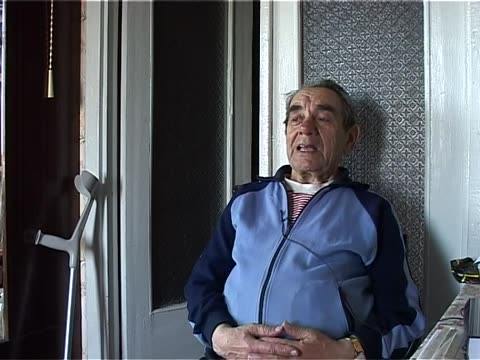
Kerler discusses how Kovel' was pronounced in Yiddish and asks Shteingart to recite kiddush as it was said in the past. Shteingart recites a short fragment. Kerler asks whether he sang at the table before kiddush and whether he remembers the tune. Kerler then asks about the old holidays at his parents' home.
Kerler also asks about the pronunciation of Kovel' and the Sabbath table song, and then the old holidays.
He remarks that his family celebrated all the Jewish holidays, including Chanukah, Shavuot, Sukkot and Passover. On Chanukah, his family would eat a special kind of blintz for the holiday.
Shteingart says his family kept all the holidays: Hanukkah, Shavuot, Sukkot and Passover. He mentions the Shavuot flatbreads, an annexed sukkah in which his father slept, and matzo always being available in Poland but not in Russia. For Hanukkah he describes eating small pancakes or latkes of grated potatoes. Kerler then asks him to show photographs from an album.
Also covers Shavuot, Sukkot and Passover customs, and the request to look at photographs.
Shteingart shows the researchers a photograph of a contemporary holiday celebration of Simchat Torah and speaks briefly about the founding of a post-Soviet Jewish community in Rivne.
Looking at a photograph, Shteingart and Kerler identify a Simchat Torah celebration in the Rivne synagogue, taken some years earlier. Shteingart says he organised the community and took over the synagogue, beginning in the late 1980s, and describes his letters asking for a Torah scroll. He mentions that a Torah was stolen, that tefillin came from someone from Israel, and that prayer books came from Chabad. Kerler then introduces Russian words to be translated.
Adds the founding of the community in the late 1980s, the stolen Torah and the gifts of tefillin and prayer books.
Kerler puts his dialectological questionnaire, partly through Russian prompts and partly by asking for Yiddish terms. Items include religious and community terms (a good Jew, Galitsianer, misnaged, tsadik, Litvak, dibbuk, golem, rov and rebbe), the place of Shteingart's father in Brest, and everyday vocabulary such as greetings, adverbs, household words, numbers, verbs and sentences to translate. Shteingart answers, says which words he has heard and which not, and comments on Polish borrowings. He also gives the Yiddish forms for a series of Russian words.
Shteingart sings a fragment of the song Papirosn. Kerler asks about other songs from his childhood and invites a greeting to Jews abroad. Shteingart gives a brief greeting from Rivne, says Jewish life there is hard to maintain, and notes that tefillin and a mezuzah can be found at the synagogue.