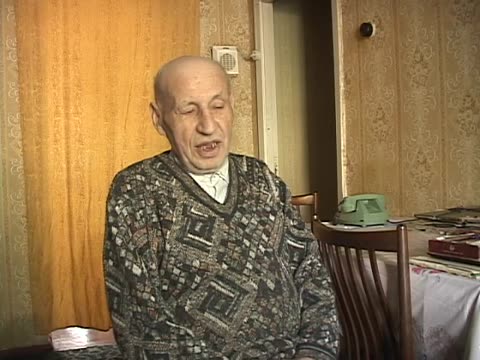
The tape consists of a formal interview with Moisei Zelmanovich Fish (b. 1922). He speaks briefly about the contemporary Jewish community in Rivne and its few remaining Yiddish speakers.
From the machine transcript
Opening of the interview: setting up seats and camera, then talk about Rivne's former pharmacy and streets. Fish says almost no Jews remain and that perhaps three people still speak Yiddish, one an old woman whose husband was Christian. He says he has no one to speak Yiddish with except the rabbi from Israel, and mentions his wife's death. Kerler asks about names of local Jewish women.
Adds Fish's remark that his wife died, and the discussion of the remaining few Yiddish speakers by name.
Showing the research team an old photograph, Fish describes his family life before the war. His mother, Khaye bas Yoyne, worked as a housewife, raising Fish and his four siblings: Etl-Rayzl, Mordkhe-Yoyne, Leye and Mirl.
From the machine transcript
Fish shows a 1928 family photograph and identifies his parents, aunts and siblings. His mother was Khaye, daughter of Yoyne(?); the siblings were Etl-Rayzl, Mordkhe-Yoyne, Leye and Mirl. He says the whole family was shot, including relatives in Lublin. His parents came from villages near Rivne; he was born in Rivne in 1922.
Adds the fate of the siblings, shot during the war, and the parents' villages and Fish's birth in 1922.
Fish details his prewar education in “kheyder,” and in Polish-language Jewish schools. He also describes the religious “Beys HaSeyfer” in the town, and how each ethnic group in the city had its own school system in their own language.
From the machine transcript
Fish describes his schooling: private kheyder at the teacher's home until about age seven, then Polish state school with Jewish pupils, and a Hebrew-language Beys HaSeyfer in the afternoons. He explains that each nationality in town had its own schools in its own language.
Adds the street name of the kheyder and the state school's Polish teaching.
Fish reports that there were no Yiddish schools in Rivne, only Hebrew-language institutions. Despite this, Fish can read in Yiddish. He then recalls the names of several Jewish and Yiddish newspapers that circulated in Rivne before the war.
From the machine transcript
Fish says there were no Yiddish-language schools in Rivne, only Hebrew ones. He nevertheless reads Yiddish and spoke it at home, and he mentions a Yiddish newspaper that appeared in the town.
The names of the newspapers are unclear in the transcript.
Fish began studying at a Polish-language Jewish gymnasium at the age of thirteen. He graduated in 1939, 2-3 months before the war began.
From the machine transcript
Fish describes entering a Polish-language gymnasium at age thirteen, where all subjects, including Jewish religion and history, were taught in Polish. He finished in 1939, a few months before the German invasion of Poland.
Fish reminisces about his participation in the youth club Shomer Akiba, where he sang, danced and discussed literature. Fish sings a fragment of the movement’s hymn.
From the machine transcript
Fish speaks of the Shomer youth club (Akiba), where members sang, danced and talked in Yiddish, and sings part of the movement's hymn. He briefly mentions Bialik and other writers, but cannot recall names.
Fish describes some of Rivne’s 44 synagogues from before the war.
From the machine transcript
Fish says Rivne had forty-four synagogues before the war, three of them on Shkolna street, including the main one. He describes the tailors' synagogue and begins to describe his father's occupation.
Fish remembers his father and his occupation as a “miler” (bricklayer, housebuilder).
From the machine transcript
Fish explains that his father Shloyme was a builder of houses, with Kerler helping on the Yiddish word. His father built the family house, and Fish went with him to the synagogue on Sabbaths and holidays.
Fish also describes the the town’s Jewish bathhouses, where he went every week with his father.
From the machine transcript
Fish describes the mikve and bathhouse next to the great synagogue, where he went weekly with his father. He adds that the Jewish theater stood near Shkolna street.
In Rivne, according to Fish, there were two Jewish theaters, as well as a movie theater that played Yiddish movies. Fish saw “Yidl mitn Fidl” in the latter institution.
From the machine transcript
Fish says Rivne had two Jewish theaters and a cinema, and that he attended performances in Yiddish. He recalls seeing the film Yidl mitn fidl, owned by a German proprietor. He also says he knew Polish after gymnasium but had no Russian when the Soviets arrived.
Despite his initial difficulties with the Russian language, Fish continued his education in a Soviet accounting institute after the war and has worked in that profession since then.
From the machine transcript
Fish tells of learning Russian and passing external exams for the tenth class. He then graduated from a Soviet institute in accounting and worked as a senior bookkeeper, finally chief accountant of a trust of canteens.
The catalogue's initial difficulties with Russian are less clear; the name of the institute is not given.
Fish recalls Jewish weddings in Rivne before the war, which took place in restaurants or cafés, accompanied by klezmer or a gramophone.
From the machine transcript
Fish recalls the engagement and wedding of his brother in the 1930s, with Jewish klezmer in a large house, singing and a master of ceremonies. Lemster asks about a badkhn. At his older sister's wedding a gramophone was used, and he does not remember his other sisters' weddings.
Fish shares his memories of Jewish holidays, including Passover, Rosh Hashone (Rosh Hashanah), and Purim. On this latter holiday, youth from the Shomer Akiba club would light a bonfire in the forest. Fish emphasizes that certain rituals, such as the pirim-shpil (Purim play) or peysekh seyder (Passover seder) were done in private homes, in contrast to today’s celebrations when the whole community comes together in one place.
From the machine transcript
Fish remembers prewar holidays: Passover matzo preparation and the kheyder lessons about Egypt, Rosh Hashanah, Shavuot, Sukkot and Purim. At Purim children from Shomer dressed up and made a bonfire in the forest; Purim plays and seders were done at home. He names Mekl(?) as leader of the Purim group, and says that at times he led prayers when there was no rabbi.
Adds Fish's role as prayer leader and the Purim leader's name.
Fish briefly discusses contemporary community politics and the different Jewish organizations present in Rivne.
From the machine transcript
Fish talks about the synagogue's upper floor and how the congregation shifted to the Hesed. He tells of the rabbi, called Shneur Zalman (?), who took on communal matters, left for Israel and was expected back, leaving Fish to pray alone. Lemster then asks how many Jews were there before the war.
The transcript shows the rabbi and the Hesed, not organizations in general.
According to Fish, before the war, 28,000-30,000 of Rivne’s 40,000 residents were Jews. In the last Ukrainian census, Fish reports, there were 442 self-registered Jews in the city, 7% of whom said they could speak Yiddish. Fish maintains that at least 80% of the these Jews are from mixed families. [00:35:26] Fish relates his experiences during the war years, travelling by foot to the Polish-USSR border, where he was then evacuated into the Russian interior and, eventually, into Kazakhstan. After working in a Korean kolkhoz (collective farm), he was eventually mobilized into the Red Army, fighting in Belarus, Poland, Germany and the Far East.
From the machine transcript
Fish gives Rivne's prewar numbers (about 28–30 thousand Jews of 40 thousand) and the latest census (442 self-declared Jews, a few percent Yiddish speakers, most from mixed families). He then narrates the war years: flight on foot to the old Polish border, Korets, Kyiv, Voronezh, Kazakhstan and a Korean kolkhoz. Mobilized in 1942, he fought at Stalingrad, Kursk, Belarus, across the Vistula in Poland and in Berlin, was wounded, and was posted to the Far East; he returned to Rivne in February 1946.
Adds the details of census figures and the route; Kerler's questions about numbers and a food aside.
Fish discusses the immediate postwar period in Rivne and how he found work through his few friends remaining in the town.
From the machine transcript
Fish describes his return to Rivne in February 1946 via Moscow, where he was demobilized. A school friend, Aharon Giber, recommended him to a chief accountant; he worked in canteens and as bookkeeper at the trust until 1982.
Fish describes Jewish religious life in postwar Rivne, stating that the Great Synagogue functioned until 1955, when a local Ukrainian paper published an anti-Semitic story after which the synagogue was closed. After this, the Jews of Rivne were afraid to speak Yiddish or publically identify as Jews, signaling the end of Jewish activities in the city under the Gorbachev years.
From the machine transcript
Fish says the great synagogue on Shkolna street was open until 1955, when a Ukrainian local paper published an attack on the Jews, after which it was closed. He recalls a shoykhet until the Soviets, no Jewish schools, and that Yiddish and Ukrainian schools were not allowed under Soviet rule.
Fish returns to the subject of prewar Jewish life in Rivne, speaking about Yiddish films and Jewish sports organizations. He remembers the special 1938 “Makabiade” games between Jewish soccer teams across Poland in honor of the republic’s 20th anniversary. Professor Kerler also asks Fish about words and phrases relating to sports and gameplay.
From the machine transcript
Fish speaks of prewar Jewish film and sport: he saw the Yiddish film Der dibek, and describes the Jewish sports club Hasmoneans, stadiums, spectators and football matches. He recalls the 1938 Maccabiah, and answers Kerler's questions on football words such as goalkeeper and ball (Yiddish or Polish).
Fish learned English in gymnasium, but does not remember it well since he has no one to talk to in that language in Rivne.
From the machine transcript
Fish says he learned English in gymnasium but has forgotten most of it with no one to speak to. Kerler asks about sports terms, goal and ball, in Yiddish.
Adds the Yiddish word questions on ball and goal.
Fish’s mother worked as a housewife, raising him and his siblings. He comments on the differences between gender roles before and after the war, and sings two songs he heard from his mother: a Yiddish/loshn koydesh rhyming song and “Papirosn.”
From the machine transcript
Fish says his mother had five children and was a housewife; he compares the roles of girls before and after the war. At Lemster's request he sings a rhyming Yiddish-Hebrew word song and the song Papirosn, which his mother taught him.
Adds the gender-role remarks.