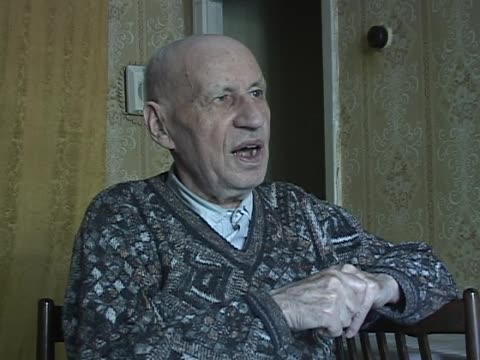
Moisei Zelmanovich Fish describes how on Friday nights, he would go to synagogue with his father and how his mother would always “bentsh lekht” [bless the Sabbath candles].
Fish recalls going to synagogue with his father and his mother lighting Sabbath candles on Friday evenings, and that challah was baked at home for Sabbath and holidays. He describes the street where the family lived, with its streets and its mostly Jewish residents, and answers Lemster's question about Yiddish stories. He ends on the point that under Soviet rule Yiddish could hardly be used.
Also covers the family's street, its Jewish residents and Yiddish storytelling.
Fish answers Kerler's question about non-Jews who spoke Yiddish. He recalls a woman co-worker at a restaurant where he worked in the 1950s who spoke Yiddish with a proper Jewish accent, and that she was later removed from the job. In answer to Lemster, he says Jews in prewar Poland spoke Yiddish in the street, not Polish.
Also covers Yiddish usage on prewar streets under Polish rule.
Fish talks about his friends before the war, including a boyhood friend who was poor and did not continue his schooling, unlike Fish at the gymnasium. Lemster asks about a family of a melamed, which Fish only vaguely recalls. He briefly mentions non-religious Jews who attended the synagogue.
Fish shares the details of how he met his wife, Ida Lakir, a girl who had grown up on a Jewish kolkhoz (collective farm) in Ukraine. Fish also talks about her family and their prewar and wartime experiences.
Fish says he married in 1946. His wife Ida (Yide) Lakir grew up with her parents and brother on a Jewish kolkhoz in Kherson oblast, where she attended a Yiddish school until it was closed. Her father evacuated the kolkhoz livestock when the war began, and after the war the family moved to Rivne, where Fish met her through an acquaintance. He describes the housing difficulties of the first months and answers Kerler's questions about her and her father's names and the kolkhoz.
Adds the wife's father's evacuation of the kolkhoz livestock, the return to Rivne and the housing difficulties.
Fish has three sons: the eldest emigrated to Germany, the middle one works in Karelia in Russia after finishing the institute in Rivne, and the youngest lives in Rivne as a businessman. He describes how often they call or visit and says he has seven grandchildren. He adds that the youngest son's first marriage ended.
Adds where each son lives and the grandchildren count; the circumcision mentioned in the catalogue is not clearly in the transcript.
Fish briefly comments on his role as the head of the contemporary Jewish religious community in Rivne. No one in the town, according to Fish, knows how to pray properly, and everyone reads the siddur in Russian.
Fish comments briefly on the present Jewish religious community in Rivne, of which he is the leader. He says people there cannot pray properly, read the siddur in Russian, and afterwards share something to eat.
Fish enumerates the surrounding shtetlekh where a few Jews can be found, but comments on the inclination toward mixed marriages even among his own sons.
Fish says only a few Jews remain in the surrounding small towns, such as Zdolbuniv (?) and Kostopil (?), and that they do not speak Yiddish. Kerler and Fish discuss the head of the local Hesed and a former colonel. Fish says that the veterans have non-Jewish wives, and that of his sons only the eldest married a Jewish woman, while the youngest's first wife was Ukrainian, and he reflects on Jews marrying non-Jews.
Fish spoke half in Yiddish with his wife, and in Russian with the kids. Fish read and subscribed to the Yiddish journal Sovetish Heymland, but remembers it as being in the Russian language.
Fish says he spoke Yiddish with his wife while the children spoke Russian, and that there were no Yiddish books at home. He subscribed to Sovetish Heymland, which he recalls as being titled in Russian, and says he still has a few Yiddish journals. He says his eyesight makes reading difficult.
Fish shows the research team several Yiddish and Hebrew newspaper back issues he has held onto including issues of Forverts and the Israeli newspaper Yediot Aharonot.
Fish shows the interviewers old issues of the Forverts and Hebrew papers, passed to him by relatives of a Rivne man who has since died. He says he can read Yiddish with difficulty but little Hebrew. Lemster and Kerler ask whether Jews born in Rivne remain, then about the evil-eye custom and a word for ritual blessing (?); Fish answers vaguely. Kerler then asks what should be remembered about Jewish Rivne, and Fish begins to answer that Jewish schools matter most.
Adds the questions on Jews born in Rivne and on evil-eye and blessing terms.
Fish states that education should be the priority for Jews in Rivne and around the world in the future. When pressed by the researchers, Fish also states that future generations should remember the Holocaust before all else.
Pressed by Kerler to say what should be remembered rather than done, Fish says Jewish schools and the teaching of children to be Jews matter most. He adds that the millions of murdered Jews, including children, must be remembered. He recalls that under Polish rule Jews lived as Jews and spoke Yiddish from childhood, and worries about children of mixed families. The interview closes with thanks.
Adds a brief interruption by a person entering and the interview's closing thanks.