0:00
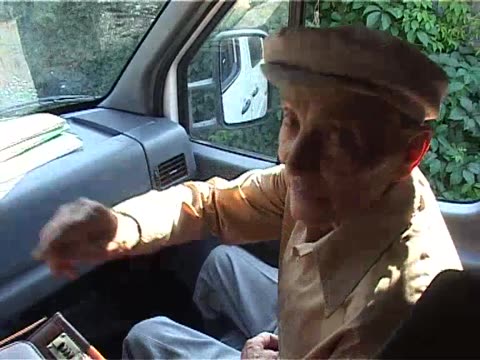
The camera focuses on the interior of his house with its newly placed mezuzahs. Exterior shots of courtyard. Street scenes of Bratslav. Researchers speaking and taking photos with the informant outside his home. Street scenes of Bratslav. Kupershimdt leads the team to the Bratslav cemetery where Reb Nosn haTsadik is buried and tells them about the shtetl along the way. Scenes of the Bratslav cemetery. Scenes of Sharhorod. The researchers begin a formal interview with Mikhail (Motya) Isaakovich Yerikhman, who was born in Sharhorod in 1939. (Part 1 of 3. See MDV 658 and MDV 659) He starts his interview talking about his family, including his son, now in Israel, and his nephew, who still lives in Sharhorod, who has became religious. Yerikhman remembers Sharhorod as being a Jewish shtetl into the 1990s, where all the non-Jews spoke Yiddish. During the war, Yerikhman tells the interviewers, only two Jews died in the town, both of whom, a deaf man and a woman, were killed by accident. He also describes the town’s wartime ghetto population as being almost exclusively women and children, as most of the local men were drafted into the Red Army and were thus on the front. Yerikhman also talks about the Pechera camp where Jews from the whole region were killed.
Kupershmidt takes leave of the team in Bratslav and gives directions to the field and the tsadik's grave. He points out former Jewish houses, a Jewish blacksmith named Rozenberg (?), the wartime ghetto and its camp, a visiting Hasid from Israel, and the old mill. Kerler and Katz then discuss the route to Uman and Rebbe Nakhman of Breslov, who was born in Medzhybizh. On arrival in Sharhorod they begin an interview with Yerikhman, who says he was born in 1939 and names his parents and his brothers, one of whom died in Moscow. He describes a relative with a non-Jewish wife who observes the Sabbath, the sale of the family house, and the Jewish town of about 7,000 where Yiddish was spoken, still with 3–4 thousand Jews until the 1990s. He recalls that only two or three Jews died in the war, accidentally, among them a deaf man shot by a German. He also says the ghetto held mostly women and children while the men were in the Red Army, and discusses the Pechora camp and who was killed there.
The transcript shows the end of Kupershmidt's Bratslav part and the talk with Yerikhman in Sharhorod, but not the footage the catalogue describes.