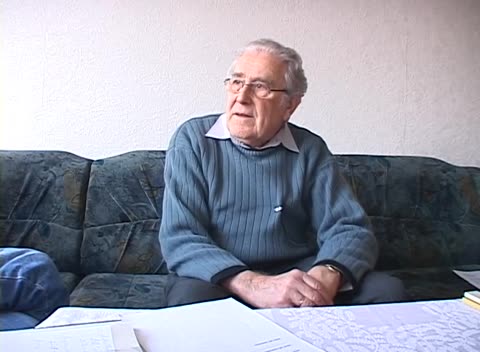
Rezmovits and Kerler discuss other Yiddish speakers he can recommend to the interviewers, including a Russian-born man, a blacksmith from the Carpathians who got extra rations in forced labor, and a man of Polish descent who speaks Yiddish. Rezmovits then mentions meeting Polish Jews and speaking Yiddish with them during his time in Israel.
Most of the passage is about recommending other Yiddish speakers and their backgrounds, not the community as such.
Rezmovits provides personal information and talks about his family. His parents were born in Sighetu Marmației. His father moved to Buda before World War I.
Rezmovits gives his birthplace as Debrecen and his official name as Andor, while at home he was called Avrom. His parents came from the Máramaros region; his father, whose Yiddish name is given, was born in 1896(?) and came before the First World War. He never knew his grandfather, who died in 1929, a year before Rezmovits was born in 1930.
The transcript also gives his birth year, his names, his father's name and his grandfather's death.
Rezmovits addresses his religious school (talmud torah) education. Rezmovits published a book about this period of his life. He also gives a glimpse of local Jewish life in prewar Debrecen.
Rezmovits speaks about the talmud torah and mentions a story he wrote in his book about a boy in his class and a teacher who beat pupils with a stick. He then turns to the Hungarian occupation of March 1944 and the family's being put into wagons.
The passage also covers the start of the 1944 deportation.
Rezmovits speaks about his life during World War II, when he was deported on a train from Debrecen to Auschwitz on March 19, 1944. Rezmovits grew up with three sisters and two brothers. He describes the journey, particularly when the train stopped in Košice, Slovakia, and was then rerouted to Austria. Rezmovits explains why he was not deported to Auschwitz, which he learned from historical studies. According to the historian Marion Amber, documents were switched. Rezmovits's immediate family survived and his father was liberated by the Red Army from forced labor.
Rezmovits tells how the train taking his family from Debrecen stood for hours at Košice and was then sent to Austria instead of Auschwitz. He explains this from a historian's book based on German archives, which describes a mix-up of transport papers and an SS man's error, and gives the book's Hungarian title. He mentions that most Debrecen Jews survived, that his father was in forced labor, and that a camp commander picked men for a march toward Munkács, all of whom were killed when the Russians arrived. He ends by saying that surviving made him feel he had to do something for Jewry, and so he went to Israel.
The passage also covers a historian's book, the SS officer's mistake and Eichmann's role, and the father's forced labor.
Rezmovits speaks about his life after the war. He made aliyah and returned to help out his family in 1953. Rezmovits served in the Israeli army and then worked as brick layer in Israel. Rezmovits speaks about his work as laborer and antisemitism he encountered. He then worked as technician until his retirement. Rezmovits raised two sons.
Rezmovits explains that he returned from Israel in 1953 to support his parents and younger sisters. He describes hard times under Rákosi, being refused a job at a factory because of his Israeli background, and the manual work he did, including carrying bricks. He worked as a technician and studied at night; his wife died after 21 years, leaving him with two sons, both now in Budapest, one a calculator operator and one a lawyer. He has no grandchildren. He names his mother, Tojbe, whose parents came from Máramaros and had a large onion business.
The passage also covers his wife's death, his sons and the start of his account of his mother's family.
Rezmovits speaks about his father's side, where his grandfather Avrom was a poor teacher (melamed), and about visiting his maternal grandparents at about age four. He recalls a cousin, Sara, who turned up in 1945 as the only survivor of her family, then married a ritual slaughterer and went to Manchester. He names his three sisters and brothers and says four of the six siblings are alive; his brother in Debrecen is ill. Kerler then asks about his childhood memories of Debrecen.
The passage also covers his siblings' names, the surviving cousin who went to Manchester, and his paternal grandfather the melamed.
Rezmovits addresses his childhood memories, growing up in Debrecen. In particular, he speaks about his education at a primary school and talmud torah school. According to Rezmovits, both schools were located in the same building.
Rezmovits describes his Orthodox community in Debrecen. In the morning he studied secular subjects at a school in the Real School Street, and in the afternoon he went to the talmud torah in the same building. He and Kerler discuss the synagogue on Post Street, a cantor whose son became an opera singer in Switzerland, and the Paul Robeson records he collected. They also talk about the surviving remnant of the old school with its Star of David on a window grating, the mikveh, and the Orthodox and status quo communities in the same street.
The passage also covers the cantor's family, Paul Robeson records and the layout of the Jewish streets of Debrecen.
Rezmovits talks about his family and speaking Yiddish before the war. He recalls antisemitic sentiments among Christian boys. Rezmovits returns to his education at a talmud torah school.
Rezmovits talks about his ill brother in Debrecen, with whom he now speaks Hungarian. In the family only Yiddish was spoken, but outside Jewish children were beaten by non-Jewish boys, so he learned to speak Hungarian and to box. Debrecen is described as an antisemitic town. In the talmud torah he studied Humash, Rashi and some Gemara and learned to write Yiddish. He says he was pious as a boy and gives the reason he lost his faith.
The passage also covers language use at home and the schoolboys' Yiddish writing.
Rezmovits speaks about his aliyah. According to him, he became less observant during that period. He then talks about prewar religious life, including the Hasidic community, in Debrecen.
Rezmovits speaks about his arrival in Israel and says he and his comrades there left Jewish observance behind. He mentions that he was the leader of a Hebrew club where people came who did not speak Yiddish but kept holidays and put on tefillin.
The transcript does not clearly show talk about the Hasidic community of Debrecen.
Rezmovits speaks about his life before the war. He states that he attended meetings at Zionist youth organizations, such as Hashomer Hatzair and Po'el Mizrakhim. He then sings a Zionist songs.
Rezmovits talks about Zionist youth movements and the songs he learned. A song about the attic and the pioneers is recalled by Kerler and sung in part by Rezmovits, and he also recites a humorous rebbe song. He mentions the Communist Yiddish newspaper Frei Israel, which he read in Israel, and says he felt reborn on arrival, though he found conditions difficult.
The passage also covers Yiddish songs, the Communist newspaper and his early years in Israel.
Rezmovits describes the Jewish population of Debrecen, some 10,000 Jews, most of them not Yiddish-speaking. He remembers his mother's saying a line in an old Yiddish full of Hungarian and Polish words about a curfew. He also describes her courage.
The transcript shows no clear talk of his return in 1953 here; it deals with the Jewish population, local language and his mother's Yiddish.
Rezmovits speaks about his and his family's life in Klausen-Leopoldsdorf, Austria, toward the end of World War II. In particular, he shares episodes from daily life and fighting on the front line.
Rezmovits recalls the family's time in Klausen-Leopoldsdorf in Austria near the end of the war, where they posed as Hungarian refugees. They hid a young Jewish man whose looks might betray him, and heard that twenty Jews had been killed nearby. As the Red Army approached, he describes an Italian soldier and a cellar scene, in which German soldiers threw grenades into houses before entering.
Rezmovits addresses his liberation by the Red Army. He specifically recalls a Russian Jewish soldier who spoke Yiddish to him. He then speaks about his life in Israel and search for survivors of the Warsaw Ghetto Uprising. Rezmovits wrote an article in Hebrew about it.
Rezmovits recounts the arrival of Russian soldiers and a Jewish officer who spoke Yiddish to the family, and says this made a deep impression on him. He then speaks about his search in Israel for survivors of the Warsaw Ghetto Uprising, his meeting with two of them near Nahariya and his article in Hebrew on Masada. He then gives Kerler addresses of Yiddish speakers in Budapest to contact, including Tamás Miller and Shmuyevitsh (?).
The passage also covers arranging a further interview with Yiddish speakers in Budapest.
Kerler asks about the regional term for Jews from the Carpathians and about the term used in Debrecen. Rezmovits answers with a Hungarian-language stretch, then describes the Máramaros origin of such Jews. He then talks about meeting a woman at an Israeli university who invited him in, how he read Yiddish books there, and how he studied Aramaic for a year to understand prayer.
The transcript also shows talk of the regional term for Jews of Máramaros origin.