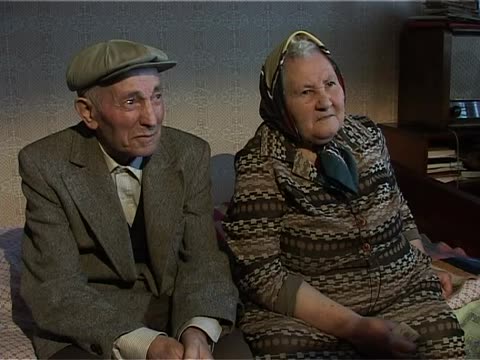
Kleiner describes Passover preparations in Shepetivka: making the dishes kosher, burning the chametz, and cooking Passover dishes such as potato and matzo-meal pancakes and kugels. She explains the term 'kuzlekh'(?) for berry-based kugels and says dairy was avoided on Passover. She says a special Passover cloth was put on the table and tells how the seder was held and who asked the questions. She and Kerler then move to Shavuot food (blintzes, green borscht) and a discussion of the sorrel/sour-dock plant.
Passover seder customs, Shavuot dishes and a discussion of the terms for sorrel/dock.
Kleiner answers questions about a Jewish library in town and the difference between a rav and a rebbe. She discusses plurals and the terms for Litvaks, Polish Jews and Galicians, and how Jews from other regions spoke. She says that anti-religious mock trials and Komsomol checks on synagogue-going and baking were held; she says there were no Hasidim in Shepetivka. She also describes the rabbi acting as judge in a Jewish court.
Terms for Litvaks, Galicians and Polish Jews, Hasidim and the rabbi as judge.
Kleiner explains how gefilte fish was prepared and which fish was used, with questions about sweetness and pepper. She discusses latkes made from buckwheat flour for Hanukkah or from potatoes for Passover, her father's work as a sausage maker making kosher goose sausage, the removal of veins (trebern) and plum terms. She describes a baked dough dish with nuts, whether Jews drank brandy or beer, and homemade kvas.
Gefilte fish recipe, her father's sausage trade, plum, brandy and kvas terms.
Kleiner says she married in 1945, after the war, with a cantor writing the betrothal contract and a wedding canopy. She mentions that her son is a painter and her husband a military man, and recalls that she has no wedding photographs. She remembers prewar Jewish weddings, with betrothal contracts (tnoim), klezmer music and the breaking of a plate. She then answers questions about folk remedies such as milk with butter or honey, potato compresses, rubbing with turpentine, kerosene for worms, and cupping.
Folk remedies and prewar weddings alongside her own 1945 wedding.
Dialectological questionnaire. Kerler asks Kleiner about dybbuk and golem, then gives Russian prompts for Yiddish equivalents: greetings and replies, 'please', congratulations, 'late', 'earlier', 'cold' and comparatives. He also asks about 'where do you live', 'how', 'sick', 'beautiful', 'he likes me', 'ten', 'you are young', 'to pray' and 'grandmother'. Further items include 'book', 'mouse', 'pane', 'deaf', 'well', 'to make a mistake', 'many', 'various' and a standing prayer, and Kleiner often comments on the difference between spoken and written Yiddish and on Ukrainian or Russian influence.