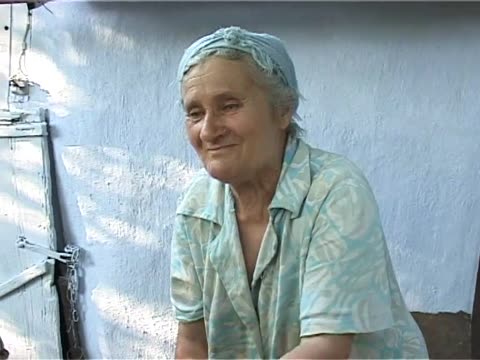
Krasner tells of a swindle by a woman who took money from her; this turns into a conversation with Katz about Katz having been born in Brooklyn. The passage includes Yiddish lines about a young man who sits thinking all night whom to marry, which looks like a folk song.
The transcript shows a complaint about a swindle and a Brooklyn connection, not clearly the Tum balalaika song.
A noisy exchange in Yiddish, Russian and Ukrainian as a neighbor joins and greets the team, remarking on the filming. Krasner and the others talk about the neighbor and the garden, and she is asked for another song.
A Ukrainian-speaking neighbor greets the team; Krasner speaks of a neighbor in Yiddish.
Katz asks Krasner for more songs, and she recalls Hanukkah songs and sings a song about a merchant, which she says she learned in a camp. She mentions a Romanian Jewish girl called Tutsa from whom she learned a Romanian song, and the Romanian word for dog. Katz and the others then discuss Brooklyn and Canada.
The transcript shows a camp song with a Romanian girl, not obviously the song Papirosn.
Katz and S2 explain to Krasner that they are recording how people speak Yiddish for a university in America, and a drink is offered. Krasner writes down her name for the team.
Includes a drink and Krasner's name being written down.
Informal talk with Krasner about health and her knowledge of Yiddish; she says she has little opportunity to speak it. The team says it is from Lithuania, and a team member comes from Vilnius.
Adds a conversation about Lithuania and Vilnius; no clear proverb.
Krasner talks about her brother's wedding, held in Kyiv. She mentions that her brother now lives in Bila Tserkva, and talks of gravestones photographed.
Krasner and the team discuss Canada and America, and a team member asks in which year she was born, to which she answers 1936. She says she knows Yiddish from home and speaks Ukrainian since school, which was the Shpykiv secondary school. The group mentions a meal at a restaurant in Sharhorod.
Adds Krasner's birth year, her Yiddish at home, and the Sharhorod restaurant.
Chat about a cat and kittens, with Katz asking how to say cat in Yiddish. A neighbor is called Rafael, and conversation turns to the names Ben Khaim and Ben Yosef, and a team member's Lithuanian Yiddish, whose father came from a town near Donetsk.
Krasner says she reads small religious books in Russian, because she cannot read Yiddish. She is not religious, but says one reads a little at a holiday. Her favorite holiday is Passover. She says she bought a few books from a Christian woman, and the talk touches on Sholem Aleichem.
The team asks Krasner whether there was a ghetto in Shpykiv; she says she lives among Christians now and asks where the Jews are. Talk of Jewish houses and a plan to walk down the street. Someone asks about the poems of Perets Markish.
Katz asks Krasner about Perets Markish, and she says he wrote stories and novels. She says she studied and worked as a librarian, and the talk continues in Russian and Yiddish.
Informal chat in Russian and Yiddish about visiting the cemetery by minibus, cats, and gifts; Katz asks Krasner repeatedly to speak Yiddish because the team is studying how it is spoken. They discuss the meaning of a mitzvah and the microphone and batteries.
Camera material from the garden and house, with a few remarks in English, Yiddish and Russian; the team asks to sign the guest book, and S2 asks when electricity came.
Krasner explains the history of the house. After the war, Christians lived there during the war and left when the family came back, and before the war her uncle and aunt lived there, whose daughter lives in Brooklyn. Someone then wants to show an album.
Adds that the daughter of the aunt and uncle lives in Brooklyn, and the album.
Krasner shows family photographs: her brother Mendl (a surgeon), his wife (a gynecologist) and their children, her mother Khaike, and her mother's sister who lived with the family. She says she is Shaindl, daughter of Khaike. She mentions a former mayor, and photographs from before the war.