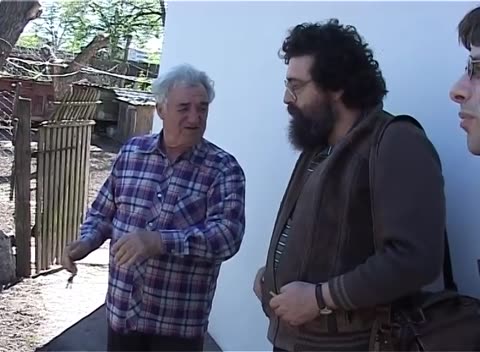
Geller sings or recites a Yiddish song about a revolutionary being led to execution, who addresses his wife Malka (?) and asks her to name a child after him. He says he remembers it from his mother. Kerler asks about the confession scene, discussing the Ukrainian and Yiddish words for confession, and Geller explains the main character.
Kerler asks the Ukrainian and Yiddish words for confession
Outside, Geller shows his yard and garden to the camera, including flowers, hens, a rooster, ducks, former rabbits, potatoes, onions, apple and walnut trees, raspberries and the stones removed from the ground. Kerler asks the Yiddish names of plants and animals. At the end he asks Geller for a Kotovsky story.
Back inside, Geller shows something that was bought and made to be sturdy. Kerler points to the pictures on the wall, and Geller names his mother (Leah, Leike) and his first wife, Faige. Kerler again asks for a Kotovsky story.
Geller tells of Kotovsky as an extremely strong man who could eat half a calf at one sitting and handle horses. Kerler remarks that he was good to Jews. They then turn to holidays: Kerler asks about Hanukkah and Purim, and Geller says they ate homentashn.
Purim pastries rather than present-day celebration
The team enters Liberzon's house. Russian talk about the recording equipment and where to sit follows. Kerler explains that the interview is in Yiddish so that future generations can learn about Yiddish and Jewish life, and asks whether she was born in Slavuta.
Liberzon says her father was a rabbi, and he or the family is said to descend from the Ba'al Shem Tov (the transcript is unclear). Kerler says he and the other interviewer come from America, he from Moscow originally. She mentions Shepetovka and Reb Pinkhas of Koretz, and Kerler confirms they are in Slavuta.
Formal introduction: after the date (5 May 2003) is given, she gives her name as Malka, in Russian Maria, Liberzon. She says her mother was a Tverski, her father a Liberzon, and his mother a Shapira, linked to Reb Moshe Shapira, the Slavuta rabbi. She tells of the Slavuta press, its fine paper and print, and the Russian bookbinder Yuri. The owners were accused when he died, flogged and exiled to Siberia, in 1835, and pardoned after Nicholas I died in 1855.
Liberzon describes how after the war her father had a small wood or square planted over the old cemetery, whose stones were used for pavements. Kerler asks whether the shtibl of Reb Pinkhas Koretz was a shtibl or an oyel. She lists the many synagogues of prewar Slavuta, such as the Pritsker and Rabinovitsh kloyzn, and the family's wealth, naming her grandfather Reb Khayim Shapira.
Cemetery stones used for pavements; list of Slavuta synagogues
Liberzon tells the family story of her ancestor Reb Liber, who was thrown from his horse and beaten in the woods while praying by a river. He healed a squire's son in return for a promise not to harm Jews, and this is connected to the founding of Berdychiv. She links her mother's side to the Tverski family of Chernobyl. Kerler asks the year she was born.
Liberzon talks about the 1930s, when the campaign against religion began and her rabbi grandfather was sent away. She mentions the Polish border near Slavuta and the passports needed to reach it. He was sent to Zhytomyr, returned after the 1936 constitution, and stayed until the war.
Liberzon remembers attending the Yiddish school for five classes and being told in 1941 to buy Russian textbooks as Jewish schools were closed. She recalls anti-religious agitation: an anti-religious meeting poster on the eve of Passover, and a teacher giving her sister money to buy a roll. After evacuation to Krasnoyarsk she attended a Russian school, where a teacher made an issue of pork. Russian remarks by others interrupt.
Liberzon says that during the war the family was in Siberia while Jewish theaters and schools were closed across the country. Her father was highly respected, and the Slavuta synagogue was the only one in the country not closed, opened at the end of 1947, after the war. Kerler asks about the permit required, then turns the conversation back to her mother's side of the family.
Liberzon names her mother (Tsipoyre?, a Tverski) and her mother's father, and says her father's father was Moshe Mordkhe. She speaks of relatives in America, including one in Philadelphia, of the Rokeach family, and of a book sent from there. She says her father believed in educating his children, and that she finished Odesa University as a historian.
Liberzon explains she studied history at Odesa but could not work in the field since she was not in the Communist Party and did not know Ukrainian. She taught in one school for many years, 45 by one account. She is interested in Yiddish and is asked to translate letters from relatives in America who do not know Russian. A second voice speaks briefly, apparently about teaching, with mention of the Rokeach.
Her teaching career and translating letters from America
Liberzon shows Kerler documents from Israel and America about her rabbinic lineage, including a journal on rabbis. Kerler reads aloud the Hebrew text, naming Liberzon, Reb Liber of Berdychiv, Rabbi Khayim Shapira the Slavuta rabbi, Reb Pinkhas of Koretz, and the Chernobyl and Belz rebbes. He also notes the yeshivas, including Zvill (Novohrad-Volynskyi). Names and relations are uncertain in the transcript.
Liberzon returns to the Shapiro brothers: Reb Pinkhas Koretz, his son Moshe, and brothers Shmuel and Pinkhas, who quarreled over who should go first. Their descendants moved the printing house to Zhytomyr. She tells how relatives from London visited Slavuta to find their roots, and how her father made wooden fences for graves after the war. The wooden fences were burned in wartime for heating.
Liberzon recalls her mother in Krasnoyarsk during the war, and visitors from Slavuta who came to her father about relatives in America. Kerler asks about gravestones and fences, and she explains the Jewish custom of fencing a grave and of wooden fences, with stone monuments added a year later. Kerler then asks her to tell about the Yiddish school.