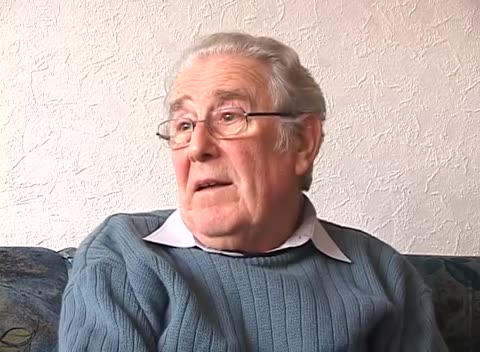
Rezmovits speaks about his life in Israel after the war. He continues to share episodes from his military service and mentions wartime comrades. Rezmovits then addresses his work as brick layer and other construction tasks.
Rezmovits recalls his Israeli army service, including a commander who had asked him to travel with him and who was later killed with five comrades. He mentions a friend from Hungary, named Reiner (?), whose father was shot into the Danube. Kerler asks about his family background and how long he served. Rezmovits then describes learning bricklaying and building water pipelines in the Safed (Tsfat) area, and says he took on any kind of work.
includes a Hungarian-born friend named Reiner and the fate of his father
Rezmovits answers Kerler's questions about how to say 'sick' and 'holy place' in his Yiddish. He then talks about his mother, who could read Hebrew and ate pork when it was necessary to stay alive, and about his father, a poor ritual slaughterer. He mentions Romanian Yiddish theater from Bucharest.
includes the mother's pork story and the father's poverty
Rezmovits talks about postwar Yiddish culture, specifically theater performances and how his mother reflected on them. He then continues to answer questions about cultural terminology.
Rezmovits recalls a Yiddish theater visit after the war and the humorous way his mother retold the performance. Kerler asks about a Yiddish newspaper and about the terms 'dybbuk' and 'golem', which Rezmovits explains from his mother's stories, and he also mentions films. He adds how the word 'golem' is used for a fool.
Rezmovits recalls the Passover seder at home before the war, where the youngest boy asked the four questions and the afikoman was stolen, which upset his father. He then reads a text of his own about the four questions and antisemitism, and mentions writing in school.
Rezmovits answers dialectological questions from the AHEYM Yiddish linguistic questionnaire and recalls folk customs. He then addresses traditional weddings and Yiddish sayings.
Rezmovits answers questionnaire items about dialect words, the evil eye and customs such as putting salt in pockets, and recalls a story about Polish Jews in Israel with a comic speech. Kerler asks about Jewish weddings in Debrecen, and Rezmovits speaks of the village wedding jester and his mother's stories. He mentions learning Aramaic from Sonia and translating a Hungarian poem.
includes the Debrecen weddings and his Aramaic studies
Rezmovits speaks about his religious schooling, the study of Mishnah, and why neither he nor his brother attended yeshiva. He mentions Folkovitch (?), his last melamed, who was strict, and the melamed's Hungarian origin. Kerler asks about his languages, and Rezmovits tells a story from the Israeli army about a Canadian-English-speaking officer who watched who did not laugh at him.
Rezmovits sings a songs about poverty and the village idiot, he remembers from his mother. He then talks about prewar Sabbath food customs, before answering questions about cultural terminology related to food terms.
Rezmovits sings or recites a song about poverty and a village fool that his mother knew. He says the family was poor and seldom travelled, and describes Sabbath meals of soup, meat and fish without sugar. In answer to Kerler's questions he gives words for a non-Jewish cemetery, talks about Christmas customs and a rhyme about Yossl, and describes 'zakhor' bundles and a charm against the evil eye.
includes Sabbath fish without sugar, Christmas customs and the evil-eye charm
Rezmovits repeats a rhymed saying against the evil eye that he heard from his mother, who performed it humorously. Kerler asks him to say it again, and Rezmovits adds a related spitting formula and discusses the phrase 'three persons'. A Russian-sounding opening formula is also noted.
Rezmovits answers questions about Hungarian Yiddish speech, the vowel in 'Eloheinu' as pronounced by Polish and Hungarian Jews, and greetings such as good day and good year. He speaks of reading Sholem Aleichem in Yiddish only after the war, at a seminar, and of reading aloud in the Yiddish club in Budapest. He mentions Jews from Satmar and from the Budapest district where he lives.