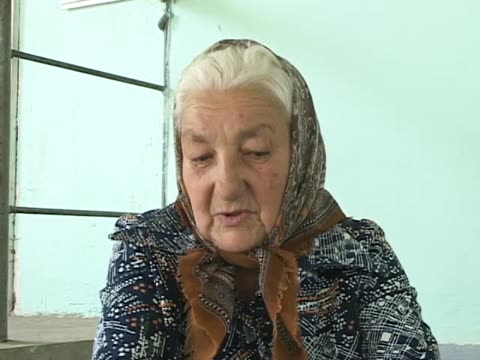
Tartinets talks in Russian about her life today. She then turns to life during the war. Tartinets lists the towns she lived in before moving to Svalyava.
Tartinets speaks mostly in Russian/Ukrainian, with Yiddish fragments, about her life and about the war. She remembers neighbouring Jewish children, their prayers and the fact that she forgot songs and prayers. She recalls Jews being taken away on carts, and her being taken as a young girl to work on beets in Hungary, where food was rationed for those who would not work. She mentions that there were six children in her family.
The transcript shows the main topics are neighbours' deportation and her own forced beet labor in Hungary (?), not a list of towns.
Tartinets, answering questions in Russian/Ukrainian, tells how Jews in her village were taken away on carts and how she ran barefoot after the cart with her friends. She names the family of a Jewish ironmonger (Haskl, ?) and friends such as Rivka and Hana. She recalls playing with Jewish children, lighting the stove for them on Sabbath, and praying with them; she speaks of her injuries and how she was a worker at a poultry plant after the war. Kerler asks whether the Jewish children spoke Yiddish with her.
The passage is mainly about the deportation of Jewish neighbours and her childhood friends and Sabbath help, rather than life after the war.
Kerler puts questionnaire items to Tartinets, such as the Yiddish for body parts, Passover matzo and hametz, and beets cooked in the war; she answers partly in Yiddish and partly in Russian. She is asked about Sabbath food such as cholent, kugel and challah. She then returns to the wartime work on beets and maize, being sent from her village, and says she raised two children alone. Kerler asks whether she knows a Yiddish song.
The transcript shows questionnaire items about body terms and Passover/Sabbath food, and her account of forced work in Hungary.
Katz and Kerler ask Tartinets for a Yiddish song and prayer; she says she understands little and recalls only fragments. She remarks that Yiddish was spoken by Jewish neighbours and that the Jewish word for money (kesurim, ?) was used so non-Jews would not understand. Kerler asks how Yiddish speakers would say a certain thing, and questions about the Yiddish word for vodka follow.
Besides life today and sayings, the transcript shows requests for a song and discussion of a Jewish word for money.
Tartinets answers questions about cultural terminology and talks about prewar celebrations of Sabbath. She then talks about Passover celebrations and food customs.
Kerler asks the Yiddish term for vodka and Tartinets answers questions on Sabbath food: fish, kugel, cholent. She says she herself ate matzo from Jewish neighbours at Passover while the Jewish children were not allowed to share Christian bread. Kerler asks again whether she recalls a Yiddish song, without result.
The passage also covers the exchange of matzo and bread between Jewish and non-Jewish children.
Kerler asks about folk customs, including pouring wax, an egg for fright and prayers for the dead, which Tartinets mostly does not recall. She says the Jews in the village were poor and worked with horses and carts, and that after the war she returned at about fifteen and worked. She mentions a Jewish wedding that was beautiful, burial customs, the word for the Jewish prayer house versus the church, and an American visitor. The conversation also touches on Kerler's speaking a different kind of Yiddish.
The transcript adds Jewish poverty and occupations, burial and mourning practice, and terms for synagogue and church.
The team arrives the Lviv Community Center to invite Boris Mikhailovich Dorfman to join them for a tour of the Golden Rose Synagogue of Lviv. The team then greets Rabbi Meylakh Sheykhet inside the center.
The group drives toward the synagogue in Lviv. A guide mentions a synagogue wall, a street named after a historical figure and a poet, and a terrorist-turned-good man; the transcript is partly garbled.
The team enters the synagogue; a guide, speaking Yiddish and Ukrainian/Russian, arranges a phone call and refers to two professors from a Jewish university in America who are filming. He says that this is a new synagogue, built over several years from 1924 and opened in 1931, one of forty that worked in Lviv.
The passage in the transcript shows the guide beginning the synagogue's history, including the years 1924 and 1931.
Dorfman gives some historical background on the synagogue. The synagogue was built between 1924 and 1931. Dorfman himself worked at the synagogue. He then describes the conditions of the building in the immediate post-Soviet period and how Dorfman helped to fix it up. He then talks about contemporary religious life, including rabbis. The camera then records footage of the synagogue area.
The guide gives the history of the synagogue in Lviv: built under Poland and not destroyed because of the nearby railway station; the Germans used it in 1941, and after the Soviets a sports club used it and the community got the building in about 1990. A new rabbi from New York came, whose wife heads the Jewish school. Kerler asks whether he is a Hasid; the guide says he is a Karliner Hasid, and speaks of Chabad in Ukraine, a kosher restaurant, a mikveh, and rabbis from Belz, and people leaving for Israel and Canada.
The transcript adds the German use in 1941, the sports-club period, Karliner Hasidim and Chabad, and the kosher restaurant.