0:00
Yakuta provides personal information.
From the machine transcript
Kerler states the date and Yakuta's address, then asks for her name for the record.
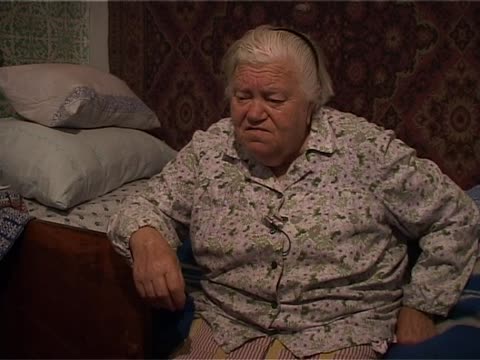
One conversation with Mariia Andreevna Yakuta, continuing over MDV 682, MDV 683, MDV 684.
Yakuta provides personal information.
Kerler states the date and Yakuta's address, then asks for her name for the record.
Yakuta provides personal information and speaks about her family. Yakuta has relatives in Israel. She grew up with three brothers and two sisters. Three of her siblings perished during the war. Yakuta's parents were also born in Teplyk. Her father was a hatter. Yakuta then describes her father's work. Yakuta mentions that her mother made pilgrimages to Uman.
Yakuta gives her name and birth in Teplyk in 1921 and says she lived there until the war. She names her father and says he was born in Teplyk, and that he and her mother and three children were killed by the Germans. Her father was a hatmaker, and she describes the lined caps and collars he made. She gives her grandfather's name and her parents' names and birth years, lists her siblings, and says two brothers were evacuated to Tashkent. One brother served as a military doctor, and the family is now partly in Tel Aviv.
adds the hat-making terminology, the siblings' names and birth years, and the brothers' evacuation to Tashkent
Yakuta discusses her childhood memories of Teplyk, particularly her school education. She attended a Yiddish school for seven years. Yakuta remembers how her father read the journal "Der Shtern " to the community.
Yakuta talks about her Yiddish school in Teplyk, its director, and her seven years there. Kerler asks whether she remembers Yiddish writers studied in literature, and she does not. She recalls her father, who was self-taught, reading the Yiddish newspaper Der Shtern aloud to the people of the town who came to listen.
adds the school director and the other townspeople gathering to hear the newspaper
Yakuta describes the moment when electricity came to Teplyk in the 1930s. She also speaks the use of electronic devices after the war.
Yakuta recalls how electric light first came to Teplyk in the 1930s, from an old tractor set by the river that gave one lamp per house. After the war a captured tank supplied more light, and radio arrived. S3 and Kerler briefly discuss the Ukrainian word for radio.
adds the postwar radio and the exchange on the Ukrainian word for radio
Yakuta talks about her education at a Yiddish school, including subjects. She then describes her father's observance as Bratlaver hasid, frequently driving to Uman and Bratslav.
Yakuta lists the subjects taught in Yiddish at her school, including dictation and letter writing, and mentions Russian as a subject. She describes her father's secret Sabbath and religious practice during Soviet times and his trips to Uman and Bratslav with a pooled cart, as a Bratslaver hasid. Kerler asks her about the terms "good Jew" and "honest Jew", and the tsadik. She then begins to tell how the Germans selected craftsmen from among the Jews, including her father.
adds the terms for 'good Jew' and tsadik, and the start of the wartime account of the selection of craftsmen
Yakuta talks about her family's fate during World War II. She explains how her father was selected as artisan to stay in the ghetto, whereas his family was selected for deportation to another ghetto. She maintains that he decided to join his family instead.
Yakuta says her father refused to stay as a selected artisan when his wife and children were taken, and that he was killed with them. The other specialists were killed later. Kerler asks for the Yiddish for "later".
Yakuta addresses prewar Sabbath celebrations at home. According to Yakuta, her father would tell stories about life of the past, as well as his experiences in Uman. She also describes her mother's observance.
Yakuta describes prewar Sabbath at home, with her mother blessing the candles and her father requiring the children to sit and listen to his Sabbath order. He told stories about Teplyk people who went to America, and about Uman. Her mother prayed from a Yiddish prayer book, which Kerler discusses with her, and retold biblical tales such as the binding of Isaac. A side discussion with Kerler concerns Yiddish words and a blessing phrase.
adds the stories about emigrants to America, the prayer book, the binding of Isaac, and the Yiddish word discussion
Yakuta addresses her father's observances and pilgrimages. She then talks about prewar Jewish life in Teplyk, including synagogue (tailor's, cobbler's, klezmer's, wealthy's, pauper's) and occupational structure, local klezmers, as well as traditional weddings.
Yakuta describes the many prayer houses of prewar Teplyk, including those of shoemakers, tailors, butchers and klezmers, and the one for the rich. She says Teplyk klezmers were hired for weddings elsewhere, in Bershad and Uman. She also lists other trades such as shoemakers, tailors, wigmakers and tinsmiths, and mentions a dentist and his wife.
adds the trades list including tinsmiths and the klezmer travel to other towns
Yakuta addresses folk and healing customs in prewar Teplyk. She specifically describes how her mother prepared oatmeal and then threw the pot with oatmeal into the river in attempt to heal her husband from malaria.
Yakuta talks about the local wise woman and folk healing, including the cure for the evil eye by spoken charm. She tells how her mother, when her husband had malaria, cooked porridge with bread and salt and threw the pot into the river with an incantation to the seven spirits. Kerler and S2 discuss the Ukrainian and Yiddish words for the "grain of salt". Kerler then asks about the time when religious practice had to be hidden.
adds the discussion of the Yiddish and Ukrainian word for the pinch of salt
Yakuta talks about prewar religious life and persecution, before recalling the Great Hunger in 1932/33. Yakuta remembers that famished Ukrainians ate the mash of the local alcohol plant from a pit outside and often died of it.
Yakuta says religious practice was done secretly before the war, and that the change came with collectivization. She recalls the great hunger of 1933, when starving non-Jews ate the mash from the alcohol plant's pit and died, and the road was full of corpses. She mentions the common pit at the non-Jewish cemetery and says she does not remember Jews dying of hunger there, though they suffered. The Jewish cemetery is also named.
adds secret religious practice and collectivization before the famine
Yakuta addresses the synagogue structure of prewar Teplyk.
Yakuta describes the main synagogue of prewar Teplyk, with its high steps, the women's section at the back, and the ark with the Torah, and a bimah she remembers from childhood.