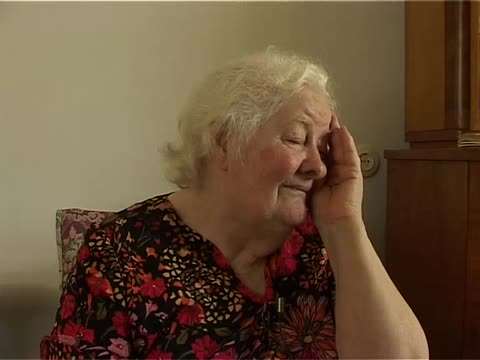
The recording begins with the continuation of an interview with Sofia Moiseevna Palatnikova (part 3 of 3. See MDV 687 and MDV 688). She discusses celebrations of Jewish holidays, particularly Tisha b'Av. She discusses contemporary life in Ukraine.
Kerler asks the interviewee about Tisha b'Av and the children's custom of throwing burs at the beards of adults, which she does not recall. He then asks a few vocabulary items, such as words for face and for "a lot". She describes her life today: illness, a heart operation in Vinnytsia that she could hardly pay for, her pension compared with German payments, and her great-grandson and grandson. She also mentions having been in a camp as a child and sharing a camp background with another woman. Short exchanges with other visitors follow, with Russian speech and some Hebrew.
The transcript adds her illness and operation, pensions and relatives, and vocabulary questions; the catalogue does not mention these.
The team drives around Teplyk with Leonid Trachtenburg, the director of the Jewish Community of Teplyk, who points out important historical Jewish sites in Teplyk, including sites related to the Holocaust, the sites of former synagogues, and the cemetery. The tape concludes with the beginning of an interview with Maria Andreevna Yakuta.
The team drives around Teplyk with a Russian-speaking guide, probably the community director, who points out a cellar where more than a thousand people were shot on 27 May 1942 and where captives were held afterwards. He shows the sites of former synagogues, now a bathhouse and a dry cleaner, and the Jewish school of 1928. He discusses the old Jewish cemetery with its eighteenth- and nineteenth-century graves, the history of Jews in Teplyk, the Potocki castle, and a former Jewish mill. From about 35:30 a woman begins an interview in Yiddish and Ukrainian, with a dialect question about "hayssn" versus "gayssn" and the Tisha b'Av bur-throwing custom.
The transcript shows the synagogue sites, the cemetery history and the mill, and that the Yakuta interview starts with dialect questions and a Tisha b'Av custom.