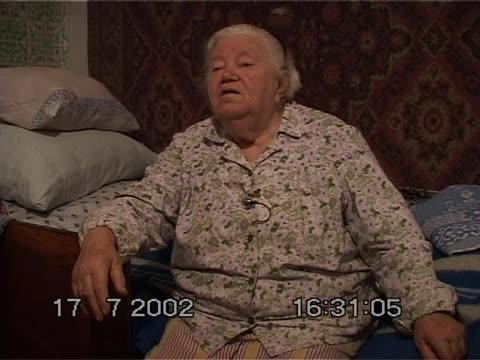
Yakuta describes the synagogues of Teplyk before the war, among them a small wooden one near her house and the Great Synagogue, which had two floors. She explains where the men and women sat, how the women could hear the cantor, and that small girls were not allowed near the bimah. She recalls women being allowed in on Simchat Torah, when there was dancing, singing and great joy. Kerler asks the questions that clarify the layout.
Simchat Torah dancing and women's access to the synagogue that day.
Yakuta talks about prewar holiday celebration, including Passover. She also recalls praying customs. Yakuta then talks about her family's life in the 1930s. She recalls how the Yiddish school was turned into a Ukrainian school. Yakuta maintains that the community agreed with the closure of the Yiddish school to be able to advance in careers.
Yakuta recalls the Passover seder at home, with her father reclining on a cushion on a bed and the children asking the questions. Kerler asks about the four questions, the Haggadah and the name of the bed. She then says the Yiddish school was closed before the war and made into a Ukrainian school. According to her, Jews accepted this because their children needed to advance. The second woman adds that a Yiddish soviet existed in Teplyk in the 1920s.
Yakuta's account of why Jews accepted the closure, and the Yiddish soviet.
Yakuta speaks about prewar Jewish and religious life in Teplyk. She describes how the community gathered in private homes in the 1930s. Yakuta then addresses her family's life in the 1930s. Yakuta explains how Ukrainian officials arrested her uncle in search for money.
Yakuta says that after the synagogues were closed Jews gathered in private homes to pray, and that there was a Jewish militia for some years. Kerler tests a few words by having her translate from Russian. She then describes her father's brother, who kept a small kerosene shop. A chairman of the Yiddish soviet had him arrested and held for a winter when he could not produce gold, and he came out in a terrible state. The family was poor.
The militia, the translation questions, and the uncle's arrest by a Jewish official.
Yakuta explains how buckwheat dumplings were made and eaten with boiled milk. Kerler asks about the details. She recalls childhood poverty: oranges and bananas were unknown, her mother split an apple among the children, and a glass of milk was a holiday. Kerler and the second woman ask about the Yiddish word for orange.
Yakuta speaks about the shops of prewar Teplyk, including an iron goods store, and about where vodka and lemons came from. Kerler asks about the Sukkot sukkah. She says neighbors used to come to sit in the sukkah at her father's house, that fish and soup were served, and that songs were sung. Kerler also asks about the words for meals (supper, breakfast, lunch).
Yakuta says her parents' house was taken apart after the war. Kerler asks her mother's gefilte fish recipe, and Yakuta describes boning, chopping, onion, pepper and matzo meal. They discuss sweet versus peppery fish, and the horseradish served with it. She then talks about borscht cooked in clay pots, meat cutlets, and kinds of kasha. The second woman asks about beans in soup.
Borscht, cutlets and kasha varieties, and the fate of the parental house.
Kerler puts the AHEYM questionnaire to Yakuta, giving Russian prompts for her to translate into Yiddish. They cover body and illness words, forgiveness phrases, going out on the road or street, numbers of people, 'cold', 'high', 'mouse' and 'luck'. They also discuss how Litvaks speak Yiddish and a non-Jewish servant woman who spoke it.