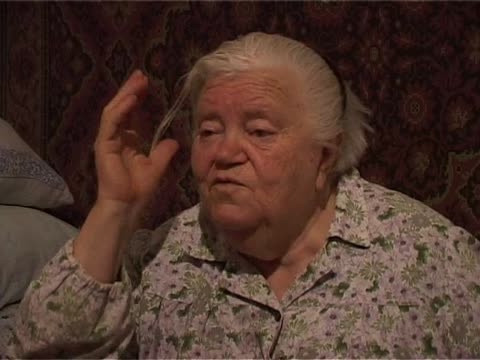
Questionnaire work with Yakuta, driven by Kerler's questions. It covers words for converting from Judaism and for putting up a gravestone, the terms for non-Jews and for 'tasty', and words for sausage and for stuffed or baked fish. Further items are 'there isn't', house types, 'thousand', 'run away', 'sour', rain, 'came from another town', book, mouse, group, pigeon, broth and 'deaf'. Some talk about the economy today is mixed in.
Besides the questionnaire, it contains food terms, with sausage, treyf and stuffed fish discussed, and some remarks on the economy.
Yakuta speaks about prewar Hanukka celebrations at home, before she continues to answer dialectological questions from the AHEYM Yiddish linguistic questionnaire. She also recalls Tishah b’Av, as well as Sabbath food customs before the war.
Yakuta describes how Hanukkah was celebrated at home before the war, including gifts of money and sweets for the children. She also names the fruits and treats eaten on Purim and other holidays. Kerler continues the questionnaire with items such as 'then', 'I had', 'tooth', 'dessert' and a word for floor or boards. Yakuta says what her mother baked for the Sabbath and discusses the word for challah and the terms for mushrooms. She adds that nobody knew of any non-kosher food before the war.
Beyond Hanukkah, it has Purim treats, a Tishah b'Av item (not clear in the transcript), and Sabbath baking and mushroom terms.
The interview with Yakuta winds down with brief remarks among the team, and then the scene shifts outdoors, where an unnamed woman is heard talking about whether one can live in Israel.
The team chats with Veliye, born in Sharhorod, about her life today. Veliye moved to Israel six years ago, and now visits her son in Teplyk. She also talks about her family and life in Israel, as well as contemporary Hasidism.
The team talks with Veliye, born in Sharhorod, who lives in Israel and is visiting her son in Teplyk. She talks about her pension, her husband, her children and grandchildren, and the Jewish relatives and acquaintances she knows in Israel. She tells of visiting the grave of a revered figure at Uman and of the climate and the sea in Israel. She also describes Hasidic families who travel there, and recent news of killings. Kerler says that he is recording how Yiddish speakers talk.
Besides her life today, it includes details about her family, relatives in Israel and the Hasidim there.
Veliye answers questions about cultural terminology. She then speaks about her and her family's life during World War II. Veliye was imprisoned in the Sharhorod ghetto.
Veliye answers a few terminology questions, including the word for a priest and for one who converted. She says her sister, father and grandmother were baptized to avoid being caught. She then speaks about the war years in Sharhorod, where the occupiers were Germans, and about relatives who were shot there. She also tells of the fate of her mother in the ghetto. The details are hard to follow in the transcript.
The team greets another woman, perhaps Marinina, who joins the conversation with Veliye. Veliye's group says goodbye with promises to meet in Israel. The people present talk about who speaks Yiddish in their families and in Israel and Canada. Kerler explains that he speaks only Yiddish and tells where he is from, and the scene ends with further farewells in Yiddish and Russian.