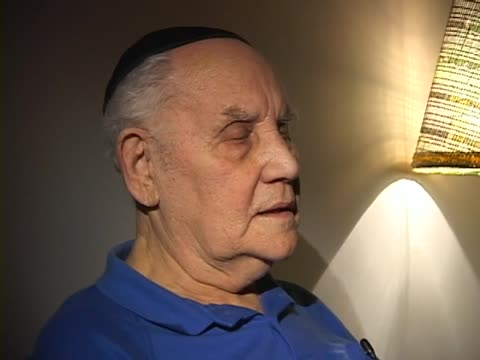
Galambos provides personal information.
From the machine transcript
Kerler introduces the interview and asks Gross for his name. He gives his Hebrew name and says the family name was formerly Gross, then Galambos; Kerler asks about the official form of the name.
Galambos discusses his childhood memories in Vaja (Yiddish: Voyo), including his education. He left his hometown at the age of thirteen and attended yeshivot in Putnok Nizhbartozh 2:35, Mizhkorz and Kisvárda for four years. Galambos attended a religious school (heder) at the age of four. He began primary schooling at six. Galambos grew up with five sisters and two brothers.
From the machine transcript
Gross says he was born in Vaja and went to yeshiva for four years. He names several yeshiva towns in the region (the spellings are unclear) and says they were 20–30 km from home. He attended cheder from age four and school from six, and he was one of eight children, five girls and three boys.
The transcript gives eight children (five girls, three boys), whereas the catalogue says five sisters and two brothers.
Galambos speaks about his family and provides personal information. His father was a carpenter. He then recalls how his family would spend Sabbath. An older yeshiva student (shire-geyer) would examine him.
From the machine transcript
Gross says his father was a carpenter and gives his name; the family also had a little land. He recalls how Sabbath afternoons were spent and the Sabbath examination, and he names the godfather at his circumcision, a prominent man in Vaja related to the rebbe by marriage. He states his birth year, 1920.
Also covers the godfather and his link to the rebbe, and Gross's birth year.
Galambos addresses prewar religious life in Vaja and remembers the local rabbi. He then talks about prewar Sabbath celebrations and food customs.
From the machine transcript
Gross remembers the rabbi of Vaja, who gave sermons, and the yeshiva there. He then describes the Friday-night Sabbath meal at home, with soup, meat and fish, including gefilte fish without sugar.
Galambos speaks about his daily routine in cheder and lists his teachers (melamdim). According to him, he studied in cheder in the mornings and evenings.
From the machine transcript
Gross names his cheder teachers and says teachers used a stick. He describes the school day: early morning cheder, then Hungarian state school, and cheder again until evening. He lists what was studied (Humash, Rashi, Gemara, Tosafot), and says he later learned to read the Torah, and he still remembers some of it.
Galambos shares his prayer customs and addresses local religious life.
From the machine transcript
Gross says he prays regularly and describes the nusakh used at home. He mentions a rebbe who visited the village once a year and the Friday-night gatherings around him, and Kerler asks about the Baal Shem Tov, hasidism and visiting preachers (maggidim). He says he remembers little about what was said at the rebbe's study house.
Galambos chants a prayer, before mentioning Purim shpiels. He then speaks about life in Vaja before the war. According to Galambos, fifty Jewish families lived there.
From the machine transcript
Gross is asked about singing and chants a prayer; he is then asked for Purim songs and recalls the Purim play, performed by yeshiva students in the home of his godfather. He gives the number of Jewish families in Vaja, but the transcript is inconsistent (forty or fifty families among about 160).
Gross's Purim song is a Yiddish rhyme sung on request.
Galambos talks about prewar holiday celebration, specifically Simchat Torah and Passover at his uncle's home. He then speaks abou his family.
From the machine transcript
Gross describes Simchat Torah and, as celebrated in Vaja, compares the other holidays to ordinary weeks. He describes Passover at the home of his childless uncle and aunt. He recalls the uncle, a shoemaker who died in 1938, as a pious man who wore a tallit and fetched water daily.
Details the uncle (a shoemaker) and aunt.
Galambos speaks about prewar Jewish life Vaja, including institutions. He then talks about his yeshiva education. Galambos explains that he spent the first three semesters in Kisvárda, where he studied with a khazer-bokher (repeater). Galambos explains that one semester included four months. In 1938, Galambos returned home and worked as carpenter until 1941. His father took him on as apprentice. Galambos continues that he was drafted into the army and was stationed in Košice, Slovakia, for two months.
From the machine transcript
Gross says the mikveh, the synagogue and the rabbi's and shoykhet's houses in Vaja were all destroyed. He recounts his yeshiva years, with a study partner in the first terms, then the troubles of 1938, his return home to work as a carpenter until 1941, and military labor service in Kassa (Košice). Kerler also asks about a yeshiva-student song.
Also covers the destruction of the Jewish buildings in Vaja and the song question.
Galambos speaks about his yeshiva education and school breaks, when he was able to return home. He then speaks about his relatives in America.
From the machine transcript
Gross answers questions about yeshiva life: he did not find studying hard, read little in Hebrew, and does not know the word shaymes. He says he went home for holidays and spent four months at home, and gives the number of terms in each yeshiva town. He talks about the cost of yeshiva education today in America and mentions that a brother's family in New Jersey is paying for it.
Also covers the cost of yeshiva education in America and his brother's family in New Jersey.
Galambos describes his father's work as carpenter and explains occupations of family members.
From the machine transcript
Gross lists what his father made as a carpenter (tables, windows, doors) and explains that his father was one of five brothers, with three shoemakers and a tinsmith. He says he learned the trade from his father between 1938 and 1941 and then went into labor service, as did his brother in 1943.
Galambos talks about his life during World War II. He worked as carpenter in the labor division of the army. Galambos then addresses his life after the war. He returned to Vaja in 1945 and lived there until 1950. Before moving to Budapest in 1974, Galambos lived in Üröm from 1958 to 1959 and then Debrecen. He then speaks about his family and their fate durin World War II, as well as addresses the languages (Hungarian and Yiddish) spoken at home. Galambos has relatives in America and Canada. Galambos attended his grandnephew's bar mitzvah.
From the machine transcript
Gross talks about his wartime service as a carpenter and says he returned to Vaja in April 1945 (the year is partly unclear) and opened a shop, then moved to Debrecen and arrived in Budapest in 1974 (?). He says his mother spoke Yiddish, as did only the older sisters, and that he, his wife and a sister survived Auschwitz. He mentions relatives in America and Canada and a grandnephew's bar mitzvah.
Also covers the languages spoken in the family and the bar mitzvah of a grandnephew.
Galambos answers questions about cultural terminology and speaks about regional geography. He then addresses prewar religious life and recalls the well-known Hasidic tune of the Kaliver rebbe "Szól a kakas már."
From the machine transcript
Kerler asks about the expressions "a good Jew" and "a good place" in a cemetery. Gross talks about relatives buried there and about hasidic rebbes, mentioning the Satmar rebbe and Kaliver rebbe. He sings the Kaliver rebbe's Hungarian tune and says a relative was the Kaliver rebbe's attendant.
Galambos speaks about prewar traditional weddings. He then continues answering questions about cultural terminology and recalls a Yiddish song about money.
From the machine transcript
Gross recalls the weddings of his three sisters, with Gypsy musicians and no badkhn. Kerler asks about Hebrew words used in Yiddish, including words for money, and Gross recalls a song and Hungarian coin names. He is then asked about the Messiah song and tells a joke about a man who goes to the Messiah.
Galambos speaks about the contemporary community, before addressing his life after World War II, particularly in Debrecen. 48 30 places lived and work. Galambos then talks about contemporary religious life.
From the machine transcript
Gross names a man from Maramureș who lives in Budapest, then describes postwar life: in Vaja until 1950, later in several places including Nyíregyháza and Eger, and sixteen years in Debrecen. He says the Jews of Debrecen have no rabbi or shoykhet, and he describes the Budapest rabbis and the Orthodox and Neolog communities.
Also lists residences after 1950 and Jewish communal life in Debrecen and Budapest.
Galambos answers questions about cultural terminology, before the team chats with his wife. She shares an episode about running away from the private Yiddish tutor during her childhood and therefore did not learn how to speak Yiddish.
From the machine transcript
Kerler asks about the postwar yeshiva in Budapest and puts questions about the words dybbuk and golem, including the Golem of Prague. Gross's wife then comes in; she speaks Hungarian and some Yiddish and says she did not learn Yiddish because she ran away from the private Hebrew teacher as a child.
Also covers the postwar yeshiva in Budapest and the dybbuk and golem questions.
Galambos addresses his observance after the war. He states that twenty family members were deported to Auschwitz and only his sister survived.
From the machine transcript
Asked whether he wanted to pray after Auschwitz, Gross says he did. He says twenty members of his family were deported to Auschwitz and only one sister came home.
Galambos answers questions about cultural terminology and speaks about his family.
From the machine transcript
Kerler asks about the term for mother tongue and Gross talks about his mother's prayers, including the tkhine (Yiddish prayer) and the Tsene-rene read on Sabbath. He also describes an aunt who wore tefillin and a cousin who was a rebbe's student; the passage ends with a telephone remark.