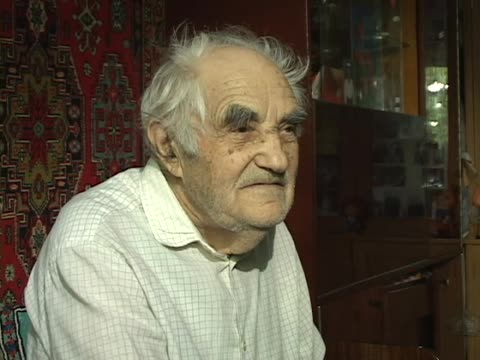
This tape is a continuation of a formal interview with Izrail (Yisruel) Yosifovich Gliazer (b. 1919 in Podgaytse, Ukraine) (part 2 of 3. See MDV 690 and MDV 693). He speaks about his experiences during the war as well as about local Nazi collaborators.
Gliazer talks about the war and the Holocaust years, saying the atrocities were committed not only by Germans but also by local non-Jewish collaborators. He names one local man who helped the Germans search out Jews. Kerler also asks briefly about children's play in Yiddish.
Opens with a question on children playing in Yiddish before turning to collaborators.
Gliazer answers Kerler's questions about the Polish-language school he attended: the subjects taught, such as mathematics, chemistry, physics and Polish language, were all in Polish. He recalls some Polish literature but cannot recite verses, and begins to describe a play.
He then speaks about the Jewish theater groups that would perform in Yiddish and Polish in his town, a topic which leads him to discuss Purim observances and the “shpiln,” or plays, that were sometimes performed then.
Gliazer describes Jewish amateur theater in the town, where a club staged plays in Yiddish and Polish in a hall or in the synagogue. Kerler asks about Purim, and Gliazer recalls it as a joyous holiday on which children got new clothes. Kerler recites a Purim begging rhyme, and Gliazer calls it typical of small Jewish towns.
According to Gliazer, Podgaytse had popular Jewish public baths that included a “mikve” (ritual bath) that was used by the men before shabes (the Sabbath). Gliazer also recalls the town’s different synagogues and other religious institutions.
Gliazer talks about the town's bathhouse and mikve, which men used on Friday before the Sabbath; his father or older brother took him. He lists the large synagogue and several small prayer houses (kloyzn), including a Hasidic one and a Chortkiv kloyz. He also answers whether there was a beis-medresh and whether yeshiva students ate days at members' homes.
Gliazer describes how Passover was celebrated by his family and recites one of the Four Questions. The team then discusses a potential plan to visit Podgaytse with Gliazer the next day.
Gliazer recites the first of the Four Questions and recalls the Passover seder at home with his father. Kerler and Katz ask him to repeat it. The interviewers then discuss with Gliazer a visit to Podgaytse the next morning at about ten, to see the Jewish sites, and agree to see how he feels. Gliazer notes his age and his health.
Includes planning of a visit to Podgaytse and his age.
Gliazer tells of the Jewish uprising in the Kremenets camp or ghetto, in which he says his mother's family came from; Jews attacked the guards en masse, many died and few survived. He heard of it from a participant but declines to name him, and says the uprising is recorded in the Ternopil' historical museum.
Gliazer mentions that his parents were hidden in Skalat, and that Jews from America, Israel and Poland set up a memorial there. Kerler asks about the language of the inscription, which is in Hebrew. They also note that Podgaytse has a synagogue and talk about driving there.
Adds the hiding of his parents and the inscription's language.
Gliazer answers Kerler's questions about his military service, which he began a year before the war as a radio operator (signalman). He spent the war far from the western front, in Siberia, and finished it against the Japanese, near Korea, opposite the Americans. The talk touches on kamikaze pilots, a Japanese general, and Japanese who speak Yiddish.
The camera cuts to a photograph in Gliazer’s home, while he and the research team drink tea. He underlines the importance for youth to understand the peaceful multiethnic character of prewar Europe. Reflecting on his father’s service in the Austrian army during the First World War, Gliazer states that "human beings are essentially good (lit. “humane”)"; the change during the Second World War is the fault of Hitler and others.
Over tea, Gliazer says young people must understand how many peoples once lived together in harmony before the war, and recalls how Jews and non-Jewish neighbors helped each other. He speaks of his father's service in the Austrian army and the Emperor Franz Joseph's keeping order, blaming Hitler and the Germans for the change. Much of this stretch is in Russian and garbled.
Adds a tea break and reflections on interethnic relations.
Gliazer gives his views on Bandera and the Ukrainian nationalist organization, which he calls terrorist, and on the assassination of the Polish minister Pieracki. He says Bandera's brothers were communists who were imprisoned with his own brother and killed, probably by the Russians.
Gliazer describes the changes that occurred when the Soviets came to power in his town in 1939, and how these events affected Jewish merchants, artisans and traders. Gliazer only details the development of political anti-Semitism, imported from Western Europe in the years before WWII.
Asked by Katz about 1939, Gliazer describes how Soviet rule hurt Jewish small merchants, artisans and traders, who could no longer earn a living. He traces antisemitism to German influence, saying it grew among Poles from the mid-1930s after Pilsudski's death, with press propaganda against Jews.
Returning to the subject of the early years of Soviet rule, Gliazer describes the general enthusiasm for the regime among poor working Jews. He further details the immediate closures of Jewish political, religious and cultural institutions, although one synagogue was kept open. Gliazer also briefly talks about the Soviet Yiddish newspaper Eynikayt.
Answering Katz, Gliazer describes the Soviet entry in September 1939. Poor Jewish workers welcomed it, wealthy Jews and non-Jews were later deported to Siberia, and Jewish theater, schools and cultural groups were closed, with only one rabbi left open. He also discusses the Yiddish newspaper Eynikayt, which was read, and the earlier German propaganda. Much of the stretch is garbled.
Adds the Jewish theater, the Soviet press and the arrival of the Soviets.
Gliazer answers Katz's questions about the rebbes of Husyatyn and Chortkiv. The Husyatyn rebbe came in summer from Vienna once a year, which was a great holiday for his Hasidim. The Chortkiv rebbe had more Hasidim, and in Ternopil' his followers took the horses off his carriage and pulled it themselves.
He then continues to speak about the war years and how the Germans used ideological propaganda to turn the Ukrainians against the Jews and the Soviet government. Gliazer also reflects on the wider philosophical meaning of the war in world history.
Gliazer continues on 1939–41, describing German officers visiting before the invasion, German spies on the border, and the Soviet failure to expect an attack. He reflects on the war as a whole, citing the six million Jewish victims and comparing Hitler and Stalin. Katz asks whether he believes in God.
Gliazer briefly comments on life in contemporary Ukraine and in the local Jewish community. Cities and towns mentioned on this tape: Podgaytse, Kremenets’, Ternopil’, Skalat, Vienna, Husyatyn, Chortkiv
Gliazer answers questions about life today in Ternopil' and the region, noting few Jews remain and that a community exists in Chortkiv. He thanks the visitors, while other voices speak in Russian about few Yiddish speakers left among the young.