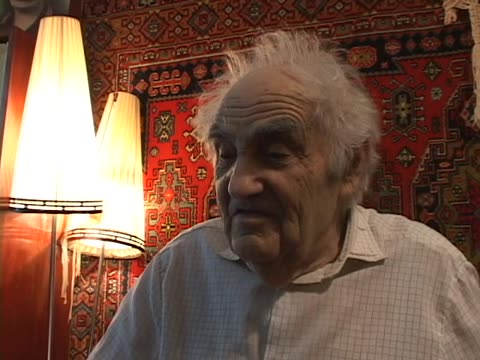
This tape consists of a formal interview with Izrail (Yisruel) Yosifovich Gliazer (b. 1919 in Podgaytse, Ukraine) (part 3 of 3. See MDV 690 and MDV 691). He begins by discussing the various trades and jobs in the shtetl (town), including doctors and water-carriers. He also mentions the terminology associated with these professions.
Gliazer lists the trades and professions in the prewar shtetl: porter, shoemaker, tailor, doctor, lawyer, engineer, and four or five Jewish doctors. Kerler asks about the water-carrier and his yoke, buckets and barrels, and about Polish-influenced words for the vessels. Gliazer does not remember the term for the water-carrier.
Mostly a terminology exchange about the water-carrier's yoke and buckets.
Gliazer recalls kheyder learning: Khumesh, siddur and Gemara, and being taught about tefillin by his father before his bar mitzvah at thirteen. Kerler and Katz ask whether he remembers Bible stories, the binding of Isaac, or passages of Gemara and Mishnah, and he remembers very little. A Russian-speaking visitor interrupts.
Gliazer details how Purim was observed in his shtetl, noting that non-Jews and Subbotniki (Judaizing Orthodox Christians) would observe the celebrations. He also tells the story of Purim.
Gliazer describes Purim in the shtetl: masks, collecting Purim money, and plays, with Christians coming to watch. He says the Subbotniki took a strong interest in the Jews and even rescued some during the war. Asked about the Purim play, he recounts the Esther and Mordecai story with Haman hanged.
Gives the Purim story and the Subbotniki's help to Jews during the war.
Gliazer describes the Subbotniki as a group who kept to themselves with their own traditions and lived in about three nearby villages. They were tolerant of Jews, believed in God and held that one should be good and help others.
Gliazer says the Husyatyn rebbe came once a year to the town to visit his ancestors' graves and pray in the fine synagogue, and that neighbouring Christians, and even the Germans and Communists, did not touch it. He does not know where the tsadikim are buried. Katz then suggests a future visit to his town when Gliazer is well enough.
Includes talk of a possible later visit to the town.
Gliazer says his mother's brothers emigrated to America after the First World War. They wrote to his father but not to his sister, and he heard nothing of them after the Second World War.
Gliazer briefly talks about the postwar period, noting that he moved to Ternopil’ from Chortkiv in the 1960s. He also talks about the synagogues in surrounding shtetlekh.
Gliazer says he lived in Chortkiv and moved to Ternopil' in the 1960s. He estimates 150 to 200 Jews in Ternopil' and fewer in Chortkiv, and says the synagogue in his hometown stands empty and unharmed. He recalls the wooden synagogue in Chortkiv, torn down by non-Jews for building wood after the war.
Includes the fate of the synagogues and Jewish population numbers.
Asked about the town's synagogues and prayer houses, Gliazer distinguishes Hasidim from the less observant. He says that after 1939 the Soviets did not close the synagogues but restricted prayer to Sabbath. He then describes how the economy changed: no factories, small trade, and taxes on artisans.
Also covers the Soviet economic changes and taxation of artisans.
Gliazer details how the Nazis convinced local Ukrainians into collaboration through their propaganda. He also comments on Jewish views of Nazi Germany in the late 1930s.
Katz asks how Jews and non-Jews who had lived peacefully came to turn against each other. Gliazer describes antisemitic literature and caricature spreading from Germany from the 1930s, boycott calls and attacks on Jews. He recalls Hitler Youth slogans and his own puzzlement before leaving for the army in 1941.
Covers the 1930s propaganda and the Jewish reaction to Nazi Germany.
Serving several years, Gliazer encountered some anti-Semitism in the Red Army, but emphasizes the important role the Jews played in the war-effort overall.
Gliazer describes relations between Jews and non-Jews in the Red Army. He recounts a Muscovite comrade who praised Hitler for attacking Jews, and says that officially there was no discrimination in a multi-ethnic army. Part of the passage is in Russian and badly garbled.
Asked about Ilya Ehrenburg and Shloyme Mikhoels, Gliazer identifies Ehrenburg as a Soviet writer and Mikhoels as the Yiddish theatre director who led Jewish wartime contacts and was later killed by Stalinists. Kerler asks about Yiddish newspapers and Soviet Yiddish writers; Gliazer remembers the newspaper Der emes and the name Fefer.
Gliazer says he served another year after the war, in the Far East. He says officially Jews were treated well but that some individuals showed antisemitism, and tells of a Jew who was decorated while others complained.
Gliazer sings a few words of a Yiddish song, "Lomir zikh iberbeytn", and says there were many Jewish amateur performers in the town. Asked about plays, he mentions Land of Israel themes and Sholem Aleichem.
Gliazer describes Passover: the seder, matzo and the four questions, with his father's response, and the door opened for Elijah (or the Messiah). He describes Simchat Torah as a joyful day of dancing with Torah scrolls and calling up all to the Torah. Kerler asks about a custom of calling up the children, which Gliazer does not remember.
Gliazer describes the town's fire brigade, which had a paid core and Jewish volunteers, and its orchestra. He mentions sport, mainly football, with a Jewish team whose name he forgets, and says he lacks a clear memory of the details.
Includes the Jewish football team and the brigade's orchestra.
Gliazer details what newspapers were read before the war in his town, and talks about the traveling peddlers who sold Jewish religious books and ritual items in his shtetl.
Gliazer names the Polish and Yiddish papers read before the war, including Heynt, and says prayer books came from Lviv. A traveling Jewish book dealer sold religious books, probably bringing them from Warsaw, and sold ritual items. Kerler also asks about tallit and the dealer's name.
Adds the Yiddish and Polish newspapers read, and the book dealer.
Gliazer shares his thoughts on contemporary world Jewry, emphasizing the importance of the State of Israel as well as the need for mutual assistance between people. Gliazer notes that he reads the American Yiddish newspaper “Forverts,” and shows the researchers his back issues.
Asked about the future of world Jewry, Gliazer says Israel is the one good thing and that without it Jewish life elsewhere would disappear through assimilation. He says Jews should help one another. He gets the American Yiddish Forverts and shows his back issues, and the interviewers thank him and discuss sending him materials.
Includes the closing thanks and talk of sending materials.