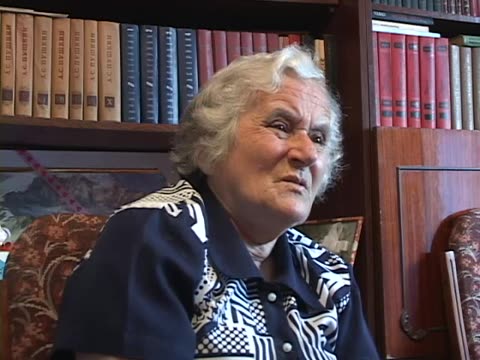
Questionnaire session with Tkach. She is asked for Yiddish equivalents of Russian and Ukrainian words and sentences: verbs, adjectives, synonyms for 'sick', words for honest and religious people, a convert, a midwife, family terms, house and household words, the dreidel, and sentences to translate. She says she has not spoken Yiddish for some fifty years. Katz and Kerler then ask about earlier songs, pious Jews and a poor 'tsadik' in Kleyn Chernevits (Mala Chernivtsi?), tsadikim's graves, the abandoned houses there and Yiddish writers she has read.
Moves from the questionnaire to pious and poor Jews, tsadikim, and the decline of Yiddish in the region.
Interview with Preger outside her home. Preger says she was born in Tomashpol' and that her parents were from there too. She calls Yiddish a jargon and says she prefers to speak Ukrainian. She describes the seven-class Yiddish school and the pedagogical technical college in Vinnytsia, where she studied for three years. She describes wartime in Tomashpol' and her work as a teacher of large classes of 45 pupils until retirement. She also covers present-day hardship, prices, health and the Joint help. She says her father was a worker, her mother a housewife who baked on Friday, and mentions the prewar synagogue.