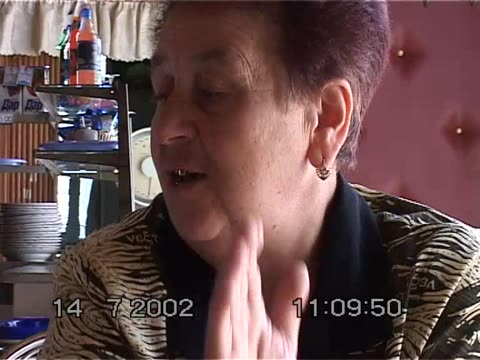
Shveibish talks about the contemporary Jewish community of Tulchyn. She talks about the support of the Joint Distribution Committee has given to the community. She then provides personal information.
Shveibish gives the size of the local Jewish community and says it is small. She says that only one man in Tul'chyn can write Yiddish, a man of seventy-four from Bershad who was in the ghetto there. Many people can speak Yiddish because they were in the camps, where only Yiddish was spoken. Kerler states the date and place of the interview, and Shveibish gives her married name and her maiden name, Vaynblat. Café talk about food and drink and a phone number is mixed in.
Also includes talk about who still speaks and writes Yiddish and a café scene with food and drink.
Shveibish provides personal information and talks about her life after the war. She studied at the medical institute in Vinnytsya to become a nurse. She worked in the medical profession for fifty years. Shveibish then talks about her family.
Shveibish gives her birth year and says she spent her life in Tul'chyn, apart from the Pechera camp. After the war she studied in Vinnytsya, became a nurse and worked for over fifty years, and is now on a pension. She gives her parents' names and says her father worked in a sheet-metal (?) shop and her mother was a housewife with three children. Her grandfather David was a carpenter and the other grandfather a trader, and she describes Tul'chyn as a town of tailors, shoemakers and other artisans with many thousands of Jews before the war.
Also covers her parents' names and occupations, the artisan trades of prewar Tul'chyn, and Kerler's note on the local word for a housewife.
Shveibish says that visitors come to Tul'chyn from America, Germany, Israel and Australia, drawn to the graves of relatives. She mentions a visiting Swiss delegation (and a man from Switzerland who comes twice a year), whom she took to Pechera, and says few people remain who can lead the prayers at the cemetery. She speaks about a visit to Germany, saying she could not bear to hear the language and would travel only to Israel. Kerler asks about Zionism, and she answers that prewar Tul'chyn was a Jewish town of many specialists, a cheerful and good place, and begins on earlier persecution.
Adds the Swiss delegation visiting Pechera, visitors' graveside pilgrimages, and prewar Tul'chyn as a Jewish town.
Shveibish discusses the history of Jewish persecution in the region before detailing the persecution of Jews during World War II and the evacuation of the Jews of Tulchyn to Pechera through the village of Torkiv in 1941. She remembers the names of individual police officers who oversaw the transport.
Shveibish speaks of earlier persecution and pogroms, then of the Romanian-run Transnistria period. Local non-Jews looted Jewish property while police and soldiers with dogs and horses drove the Jews, shooting those who could not walk. At night the column was driven through a village called Torkiv, then on to Pechera.
The transcript does not clearly show the police officers' names the catalogue mentions.
Shveibish details the conditions in the Pechera concentration camp, recalling individual acts of cruelty imposed upon them by the Romanian gendarmes and the Germans who guarded the other side of the river Southern Bug.
Shveibish describes conditions in the Pechera camp until spring 1944: killings, rape, no food or water, lice and typhus, and the dead dragged away. Her father was the first of the family killed, in 1941, and her mother died a month later, leaving her with her older brother. She recalls begging, and old non-Jewish women who gave food or took rings for bread, and the Romanian guards. Germans on the far bank of the Bug fired at those who went to the water. Prisoners came from other towns, from Bukovina and from Bessarabia, and the Judenrat is criticised.
Adds her parents' deaths and her begging for bread with her brother, and the origin of the other prisoners.
Shveibish mentions the Judenrat, which she accuses of being only for themselves. She then discusses how the prisoners in the camp were occasionally taken for forced labor in Baranovich.
Shveibish says the Judenrat was bad and cared only for itself. She describes overcrowding in the camp, children buried alive, and able-bodied prisoners taken to build a road and buried alive once it was done. A place name for the labor site is garbled, and the catalogue gives Baranovich. She also describes how the dead were buried in the woods in a large pit when it grew warmer.
Shveibish discusses the mass grave near Pechera, where the community has erected a memorial. She explains that at least once a year she and ohters in the community visit the site to maintain the memorial.
Shveibish speaks of the mass grave at Pechera and the memorial there. The community visits the site a few times a year and she herself clears the grass to keep it tidy.
Gives the frequency of visits and her own upkeep work, which the transcript only partly supports.
Shveibish again talks about the charity work that the Joint Distribution Committee provides for the community, and about her own involvement with charity work and communal activities.
Shveibish describes how the Joint and the Vinnytsya Hesed support the poor and camp survivors with parcels, medicine, firewood and coal, and pay people to clean and cook for the elderly. They repair the homes of the lonely, and children from a large family are sent to a summer camp near Pechera. She tells of Sabbath and holiday gatherings in the community's office, with children singing and tea and a simple table. She says the office is in the Potocki house and offers to show it. Kerler asks where the office is.
Adds the Sabbath and holiday gatherings for children and the elderly, and the office in the Potocki house.
In answer to Kerler's request for childhood memories, Shveibish says she grew up in Tul'chyn on a street whose name is unclear and was the third of three children. She names her brothers, Velvl and Borukh. The elder studied in Odessa, was invalided in the war and died; the younger was with her in the camp and was killed in the army in April of the war's final year. She was left alone and was helped by townspeople with tea, soup and bread.
Adds both brothers' fates and the local help she received afterward.
Shveibish speaks about her life after the war, in hospitals in several cities, and about repression. She recalls the outbreak of the war, when the Jews were put into a former Jewish school and then sent to Pechera. She tells how her father was killed and her mother died a month later, leaving her with her brother, and recalls herself as a five-year-old girl and her doll. She describes how hard the years after the war were.
Gives her parents' deaths and her postwar hospital stays, while the catalogue sentence is limited to the camp.
Shveibish speaks of her marriage and her two sons, then of nearby towns, the Tomashpil district and Shpykiv. There are no Jews left in the first, and in the second many Jews stayed in Pechera or left, with some remaining. Kerler asks how many Jews live in Tul'chyn now.
Asked about Jewish holidays she remembers, Shveibish recalls that her grandfather Yekhiel was a trader and that there were ten synagogues in Tul'chyn, none of which remains. Candles were blessed, Sabbath and Passover were kept, and food was kosher; today there is no shoykhet. She speaks of the community's modest help for the sick and poor, and of paying for burials of lonely people. Kerler asks what is meant by erecting a memorial, and he also asks about her father, whom people called Nyune.
Adds the ten prewar synagogues, the grandfather, and the absence of a shoykhet, though the transcript is unclear on how the memorials are handled.
Shveibish talks about her family, in particular her father. She describes the moment when he was arrested in 1937 during Stalinist purges. Shveibish's father delivered sheet metal.
Shveibish says her father was called Nyune by the townspeople but Yeynekh in his documents. He was arrested in 1937 and released later; no one knew why, and her grandmother wept and lit candles. He worked in a sheet-metal (?) shop and sent goods to towns such as Bershad, Haysyn and Lodz. He was not a property owner, and the family had two sons and wanted a girl.
Adds that her father was released after his arrest and the towns his goods were sent to, and the confusion between his two names.
Shveibish talks about gefilte fish: her grandmothers loved it, and she now makes it for holidays for the community, together with Passover noodles and matzo meal. She insists on matzo and no bread during the eight days. She tells in outline how she makes it, with minced fish and ingredients such as onions and egg, matzo meal or a substitute, and sweetening and salt. Kerler then begins the dialectological questions.
Adds Passover customs and the details of the recipe, with the community meals she prepares today.
Shveibish answers Kerler's dialectological questions. He asks for words and phrases such as the sign of the cross, to cross oneself, to kiss, greetings (good day, good evening, goodbye, good holiday), a mouse, luck, a mountain, cold, a head hurting, to do, to ask and bed. She offers her own forms and says which expressions she does not know or does not use.